Guides / Quality
Are Raw Cashews Really Raw? The Heat Steps Behind a Raw Cashew Kernel
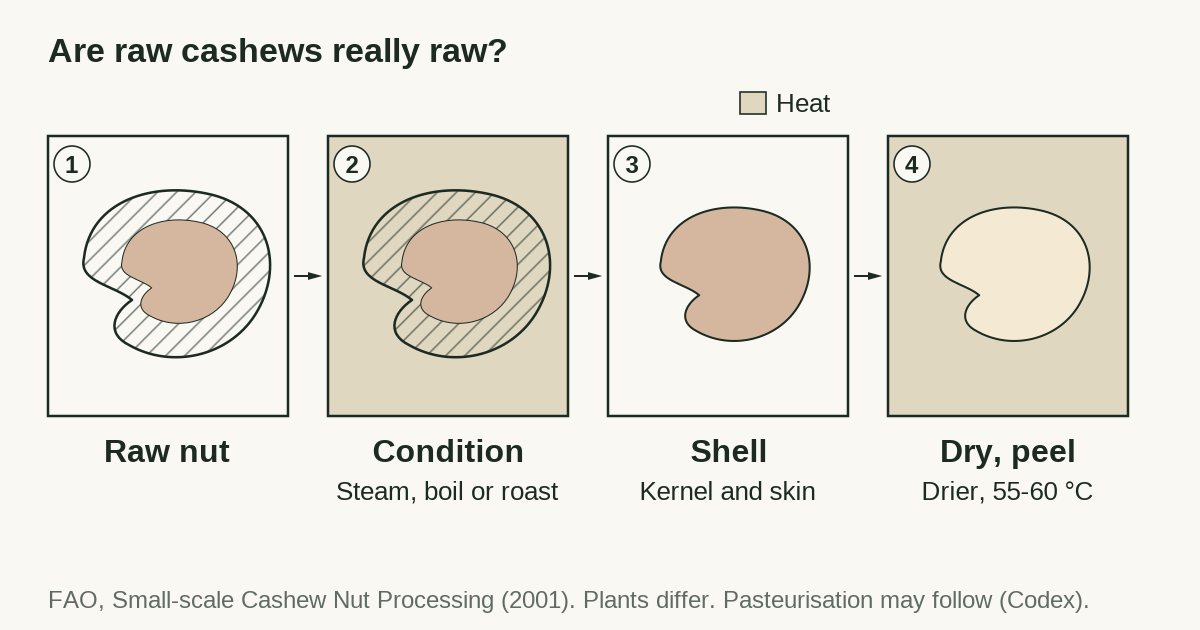
Are raw cashews really raw? On a kernel pack, “raw” means the kernel has not been roasted as a snack. It does not mean the nut or the kernel never saw heat. The whole nut is normally steamed, boiled or roasted so the shell can be opened, and the kernel is dried with warm air before the skin is peeled. This post is part of our guide to how cashews are processed, and it lists the heat steps so you can word a pack accurately.
The summary follows public documents we opened. Plants differ, so ask your processor for its own list.
Why the nut needs heat before the kernel comes out
The cashew nut sits in a hard shell with a honeycomb of cells. The New York Botanical Garden notes that the shell contains a dermatitis-causing resin, and nuts are eaten only after careful separation from it. The FAO small-scale processing guide, by Azam-Ali and Judge, says the shell is virtually impossible to penetrate after harvest. To extract the kernel, it describes soaking the whole shell in water, softening it by steaming and air-drying it carefully to about 9 percent moisture.
Roasting is the other route to opening the shell. The same FAO document says roasting makes the shell brittle and loosens the kernel inside it, and that the shell oil is released when the nuts are roasted. It also describes a plant that boils raw nuts in a cauldron for 25 minutes and sun-dries them for 48 hours, which makes it easier to separate the nut from the shell. Steaming in batches is the other common route, and our processing guide covers it.
None of these steps makes the kernel a roasted snack. They prepare the shell. That is the point behind the trade’s use of the word: the kernel is “raw” in the sense of not yet roasted for eating.
Heat steps between nut and pack
| Step | What the source says | Temperature or time as written |
|---|---|---|
| Shell conditioning | Whole shell soaked in water, steamed, air-dried (FAO, section 2.11) | Air-dried to 9 percent moisture |
| Boiling at origin | Nuts boiled in a cauldron, then sun-dried (FAO, section 5.1.1) | 25 minutes, then 48 hours |
| Drum or pan roasting | Shell made brittle, shell oil released (FAO, section 6) | No figure in the passages we read |
| Kernel pre-heating before peeling | Mechanical drier loosens the skin (FAO, pre-heating and peeling) | 55 to 60 degrees C, three to four hours |
| Kernel drying at one plant | Kernels dried on cooling screens (FAO, section 5.1.1) | 77 degrees C, seven hours |
| Final drying | Dry to a set moisture without roasting (FAO) | To 5 percent moisture |
| Microbial reduction, where used | Roasting or steam followed by drying are named examples (Codex RCP 75-2015) | No figure given |
Source: FAO, Small-scale Cashew Nut Processing (2001), whose text we read in a 2006 web copy, and Codex Alimentarius CAC/RCP 75-2015, section 5.2.2. The FAO document describes small-scale and traditional methods, so a modern plant may use other settings.
The FAO text adds a caution about the last drying step. It says the drying temperature must not be too high, because that would cause roasting and discoloration rather than just drying. So a kernel dried correctly has been dried, not roasted.
Where “raw” and “roast” meet in a specification
The AFI Specifications for Cashew Kernels treat raw and roasted kernels as separate test conditions. Its defect table is headed “Tolerances for Defects and Damage in Raw Cashew Kernels”, and it defines spotting after roasting as brown spots that appear on the surface after roasting but are not visible in the raw kernel. So the trade uses “raw” for the kernel as it ships, with roasting as a later stage the buyer or a roaster performs.
The Codex hygiene code adds a further heat step for safety. It says low-moisture foods or their raw materials should be treated, whenever feasible, with a validated microbial reduction treatment, and it gives roasting and steam treatment followed by a drying step as examples. If a plant applies such a step to kernels, “raw” on the pack still describes flavour roasting only. Our guide to pasteurisation and kill step validation covers what a buyer should see in the validation file.
Need a price for this grade? Request a quote
What a private label pack can say
We found no public definition of “raw” for cashew kernels in the documents we opened, and we did not read the labelling rules of any market for this term. Treat the wording as a question for your label reviewer. As a working approach, describe the product by what was done. “Not roasted” is a plain statement of the finished kernel. A phrase such as “never heated” is a different claim, and the sources above describe heat at the nut stage, the drying stage and sometimes a pasteurisation step.
Ask the processor for a written list of every heat step from nut to pack, with the method, not the settings, and ask which of them your pack wording touches. Our note on roasted cashews from Vietnam covers the roasted route when you want the flavoured or salted product instead.
Questions to put to a processor
- Which method conditions the nut: steam, boil, drum roast or another?
- At what point is the kernel dried, and to what moisture?
- Do you apply a pasteurisation or other microbial reduction step, and is the study on file?
- Can you confirm in writing that the kernel is not roasted?
Once those answers are on paper, the pack wording follows. Send your grade and volume as a requirement and we price it with a processor that runs it. The full route from nut to kernel is in our guide to how cashews are processed.
Sources
- FAO, Small-scale Cashew Nut Processing, Azam-Ali and Judge, ITDG, 2001.
- Codex Alimentarius, Code of Hygienic Practice for Low-Moisture Foods, CAC/RCP 75-2015.
- Association of Food Industries, Specifications for Cashew Kernels, updated September 2023.
- New York Botanical Garden, Plant Talk, on the cashew tree.
Sources
- FAO, Small-scale Cashew Nut Processing, Azam-Ali and Judge, ITDG (2001), sections 2.11, 5.1.1 and 6
- Codex Alimentarius, Code of Hygienic Practice for Low-Moisture Foods, CAC/RCP 75-2015, section 5.2.2
- Association of Food Industries, Specifications for Cashew Kernels (updated September 2023), tolerance tables and Appendix I
- New York Botanical Garden, Plant Talk: The Cashew Tree, a Resource of Nuts, Apples and Even Brake Linings
Frequently asked questions
Are raw cashews really raw?
Not in the sense of never heated. In the trade, raw kernels are kernels that have not been roasted as a snack. Before that, the whole nut is usually conditioned by steaming, boiling or roasting so the shell can be opened, and the kernel is dried by gentle heat before the skin is removed. The pack word describes the finished kernel only.
Does steaming the nut make the kernel a roasted cashew?
No. FAO describes steaming or boiling the whole nut to soften the shell for cutting, while drum roasting makes the shell brittle and releases the shell oil. The AFI specification treats roasting as a separate later step, testing kernels raw and after roasting. A kernel from a steamed nut is still sold as a raw kernel.
What can a private label pack say about heat treatment?
We found no public definition of raw for cashew kernels in the texts we opened, so describe the product by what was done. Ask the processor to list every heat step, including any pasteurisation, then have your label reviewer approve wording such as not roasted. Avoid claims like never heated unless the processor can document them.
VietCashew supplies Vietnamese cashew kernels on one quote. We publish no prices, because a cashew quote is only valid for days. How an order runs and what we publish.
Need a price for this grade?
Send the requirement. We reply within 24 business hours with one detailed quote for the packed kernels.
Request a quote