Guides / Quality
From Raw Nut to Packed Kernel: The Steps Inside a Cashew Plant
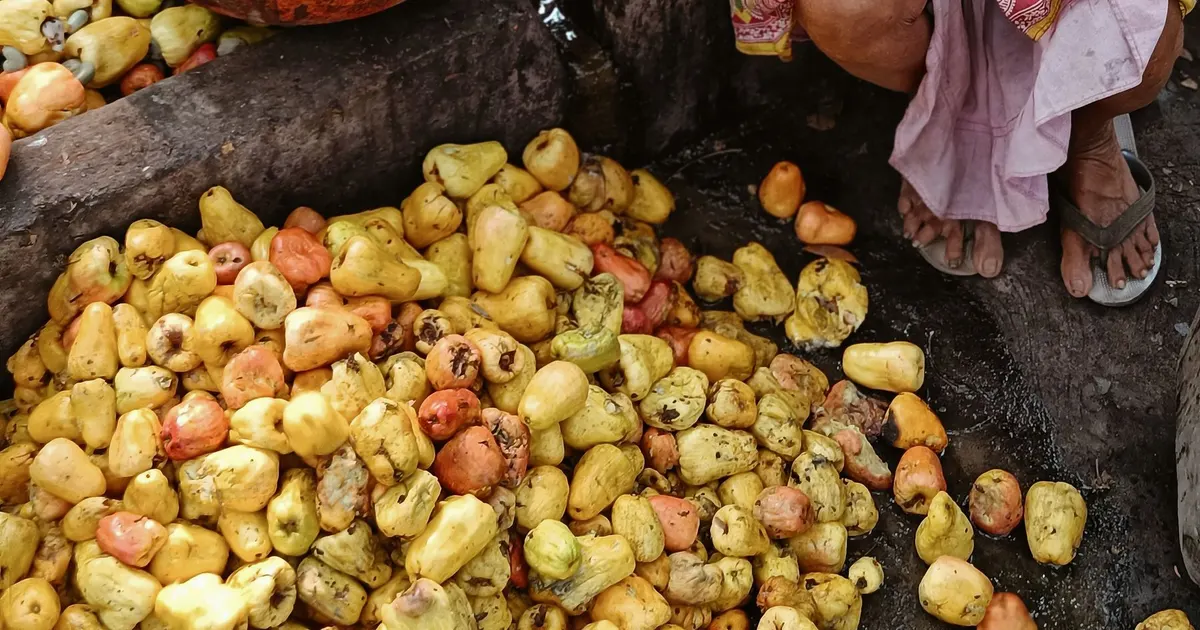
A cashew kernel looks like a finished food, but nothing about the nut it comes from is edible. The raw nut sits inside a hard shell that holds a caustic oil, and the kernel is wrapped in a thin brown skin. Getting a pale, whole, dry kernel out of that takes a sequence of steps, and each one leaves a mark on the grade, the cost and the risk in the lot you eventually buy.
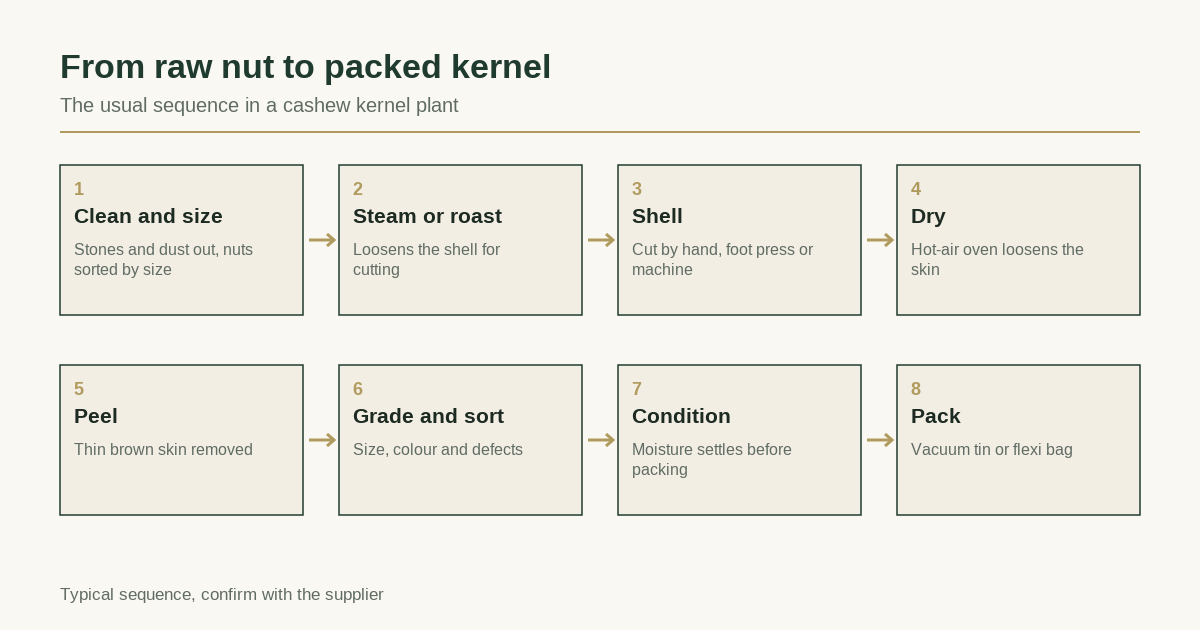
This guide walks through the steps in the order a Vietnamese plant runs them. It will not teach you to run a line. It will show you what each stage does, what goes wrong there and what to ask a processor so you are not relying on a brochure.
Step 1: Receiving, cleaning and size grading
Raw cashew nuts arrive in jute sacks or bulk, usually imported, and are checked for moisture, nut count and the share of defective nuts. A sample is cut open to estimate outturn, which is how many pounds of kernel the nuts should yield from an 80 kg bag. Our guide to raw cashew nut price and outturn covers why that figure matters commercially.
Cleaning removes stones, soil, sticks and loose shell. The cleaned nuts then go over size screens, because every later step works better on nuts of one size. A cutting blade set for a large nut crushes a small one, and a small setting leaves a large nut half cut. A plant that skips size grading pays for it in broken kernels.
Step 2: Steaming or roasting the shell
The shell has to be conditioned before it is cut. Most Vietnamese plants steam the nuts in batches or run them through a cooker, which softens the shell and brings the shell oil out of its honeycomb. Some plants roast the nuts in a drum instead. A few older lines used hot oil baths, which are now rare because the oil is a hazard and a cost.
The setting matters for colour. Too much heat at this stage can tint the kernel and push a lot toward the scorched classes, which our guide to scorched cashew grades explains. Too little heat leaves the shell tight, and the kernel breaks when it is cut. Plants tune time and temperature against the moisture of each batch of nuts.
Step 3: Shelling
Shelling opens the shell without cutting the kernel. In many plants this is still done by hand or with a foot-operated cutter, where an operator places each nut and brings down a blade. Other plants use semi-automatic or fully automatic cutting machines. We compare the two in our guide to manual and automatic cashew shelling.
The shelled kernel still carries a film of shell oil, so operators wear gloves and the kernels are dusted or wiped to keep the oil off the surface. Oil on a kernel stains it and carries a bitter taste, which is one reason a spotted kernel is a quality flag.
Step 4: Drying
The shelled kernel goes into a hot-air oven for several hours. This drying step does two jobs. It lowers the moisture of the kernel and it shrinks the thin skin so it lifts away from the flesh. Kernels spread on trays pass through the oven in racks or on a belt.
Drying is where moisture is first set. Dry too hard and the kernel scorches, goes brittle and breaks in peeling. Dry too lightly and the skin clings, peeling is slow and the moisture stays high for the rest of the line. Our guide to kernel drying and peeling goes deeper on this stage.
Step 5: Peeling
The dried kernels rest briefly and then lose their brown skin. Peeling is mostly done by hand with a small knife or a soft brush, and some plants add compressed air peelers to speed up the first pass. Peeling is where many kernels break, and where a plant with trained staff separates itself from one with a rotating team.
Any skin left behind shows up later as a defect, so peeled kernels go back for a second pass when needed. Some kernels leave the line with the skin on, which is its own product. Our guide to skin-on cashews covers who buys it.
Step 6: Grading and sorting
Peeled kernels are graded by size, which gives the count per pound behind labels such as W240 and W320. They are then sorted by colour into white, scorched, second scorched and dessert classes, and graded for defects. Mechanical colour sorters handle much of the volume and trained graders check what the machine passes. A related guide on colour sorters and hand grading shows how the two work together.
Step 7: Conditioning and packing
Kernels rest for a short time so moisture evens out through each batch, then they are weighed and packed. The usual export format is a 25 lb vacuum tin, two to a carton, though flexi vacuum bags are common too. Packing is the last chance to catch metal, shell and insects, so most plants run a metal detector just before the pack goes out.
Need a price for this grade? Request a quote
Where each step sits in the lot you buy
| Step | What it sets | What a buyer can ask |
|---|---|---|
| Receiving and sizing | Outturn, breakage rate | Raw nut origin and typical outturn |
| Steaming or roasting | Shell release, colour | Method and batch records |
| Shelling | Whole kernel share | Method and recent whole kernel share |
| Drying | Moisture, skin release | Oven time and moisture checks |
| Peeling | Defects, breakage | Second-pass peeling policy |
| Grading and sorting | Count, colour class | Colour class and defect split by lot |
| Packing | Shelf life, safety | Pack format and metal detection |
What to ask a processor
You do not need to visit every plant to learn how it runs. Ask a few questions and notice how specific the answers are.
- Which raw nut origins do you run this season, and are lots kept separate?
- Do you shell by hand, with semi-automatic cutters or with automatic machines?
- What moisture do you target after drying and again at packing?
- How are peeled kernels checked for skin and shell pieces?
- Do you run a metal detector or an X-ray unit, and how often is it tested?
A processor that answers in numbers and routines is usually one that measures them. A processor that answers with adjectives is worth a counter sample before a container. Our sample approval guide sets out what to check when it arrives.
Why the order of the steps matters
The sequence looks fixed, but each step hands a condition to the next, and a fault passes down the line. Raw nuts that were not size-graded make the shelling cut uneven. Uneven shelling leaves kernels with shell oil on the surface, and the drying oven bakes that oil into a visible spot. Kernels dried unevenly peel badly, and the extra handling in peeling breaks more of them. By the time a lot reaches the sorter, the mistakes from three steps back have become defects, colour classes and pieces.
This is why a processor that controls every step usually quotes a more consistent product than one that buys in half-processed material. Some traders buy shelled but unpeeled kernels from small workshops and finish them in their own plant. That arrangement is common and it can work, but it adds a handover where moisture and handling are harder to track. Ask whether the kernels in your lot were shelled and peeled in the same facility that will pack them.
What changes between a small workshop and a large plant
A small workshop may run entirely by hand with steaming in a single cooker and drying in a small oven. Output is modest, and quality depends on the foreman. A large plant adds size-grading machinery, automatic or semi-automatic cutting, mechanical colour sorters, metal detection and a quality laboratory, along with the paperwork a retail buyer expects. Neither is automatically better for your order. A small workshop can pack an excellent counter sample. A large plant is more likely to repeat that quality across a container and across seasons. Match the plant to the order: a one-off specialty pack suits a small workshop, while a retail programme with audits suits a larger facility.
Next step
If you already know the grade and volume you need, send the requirement and we price it with a Vietnamese processor that runs it. You can describe the process questions above in the notes field and the quote answers them. Send a requirement and we reply within 24 business hours.
Frequently asked questions
How long does it take to process a raw cashew nut into a kernel?
The nut spends only hours in the plant itself, but the wait before it gets there is longer. Raw nuts are stored and dried after harvest, then moved through cleaning, steaming, shelling, drying and peeling in a continuous flow. Grading and packing add a day or so. Ask a processor for the lead time from order to loading, not just the production time.
Why does the shell of a cashew need steaming or roasting first?
A raw cashew shell is a soft honeycomb filled with a caustic oil that burns skin. Heating the nut loosens the shell from the kernel and lets the oil drain or harden so the shell can be cut without damaging the kernel inside. Skipping or rushing this step raises breakage and contact with the oil.
Which step has the biggest effect on the grade I receive?
Shelling and peeling decide how many kernels stay whole, and sorting decides which colour class they end up in. Raw nut quality sets the ceiling, but these three steps decide how much of that ceiling the plant actually reaches. Ask for recent whole kernel share and colour class split by lot.
VietCashew supplies Vietnamese cashew kernels on one quote. We publish no prices, because a cashew quote is only valid for days. How an order runs and what we publish.
Need a price for this grade?
Send the requirement. We reply within 24 business hours with one detailed quote for the packed kernels.
Request a quote