Guides / Quality
Drying and Peeling Cashew Kernels: Where Moisture Is Won or Lost
Moisture is the quiet number in a cashew contract. Nobody sees it in a photograph and nobody tastes a half percentage point. Yet moisture decides whether a kernel stays crisp, whether it grows mould in the warehouse and how long it lasts after the tin is opened. Most of it is set in two steps that happen right after shelling: drying and peeling.
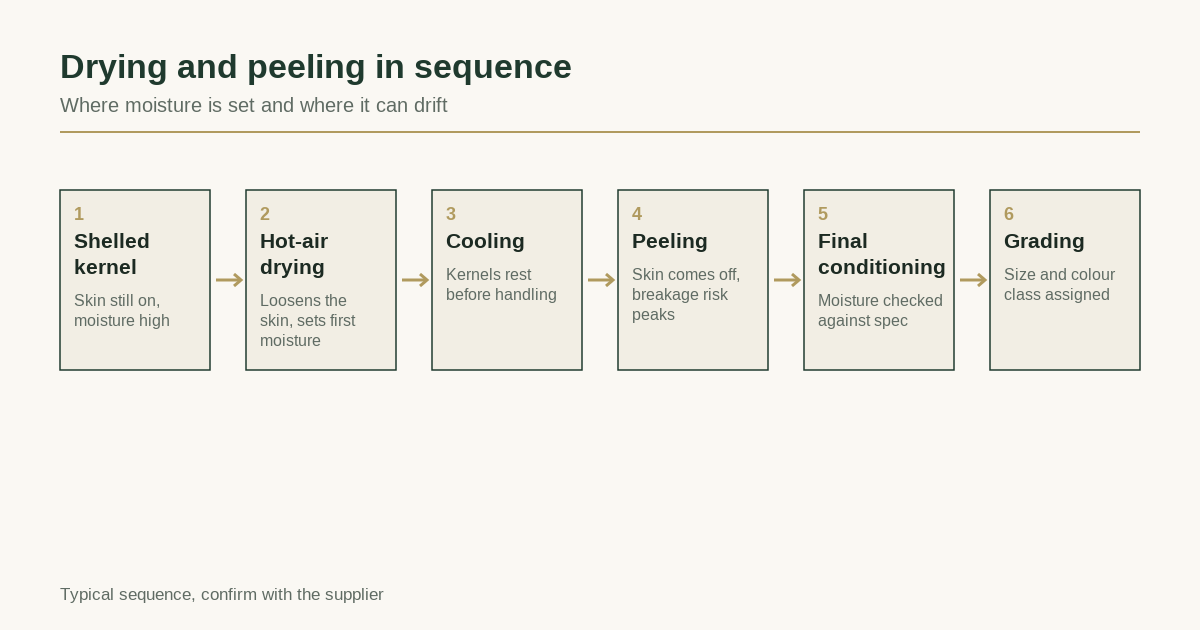
This guide explains how those two steps work in a Vietnamese plant, where moisture drifts and what to ask a processor about it.
What the drying oven does
A shelled cashew kernel comes off the cutter still wearing its thin brown skin and still carrying moisture from the steamed shell. It goes into a hot-air drying oven where trays or racks of kernels sit for several hours at moderate heat. Plants run different times and temperatures, usually in the range of a few hours at a controlled setting, so check the specific process rather than assuming a standard.
The oven does two things at once. It drives off moisture so the kernel will keep, and it shrinks the skin so it loosens. Both depend on the same heat, which is why a plant cannot adjust one without affecting the other.
Why too much heat is a problem
Cashew kernels are about half oil by weight, and heat acts on that oil. Pushed too far, the oven tints the kernel from pale ivory toward amber. That is the origin of the scorched classes, and our guide to scorched cashew grades explains what they mean for price. Heat also dries the kernel brittle, and brittle kernels snap in peeling and packing, which turns wholes into pieces.
There is a quality side too. Heat accelerates the oxidation that eventually makes oil go rancid, so a plant that dries too hot may shorten the shelf life of what it ships. Our guide to cashew moisture and storage covers how moisture and heat shape the shelf life figure.
Why too little drying is just as costly
Underdried kernels keep a higher moisture, and the skin stays tight. Peeling becomes slow, leaves skin behind and tears the surface. The kernel moves into the pack at a moisture the oven should have removed, and the risk lands on the buyer weeks later as mould or off flavour.
Moisture that is too high also raises food safety risk. Mould needs moisture, and some moulds produce aflatoxin. Our guide to aflatoxin and cashew food safety explains the limits importing countries apply.
The rest period
After the oven, kernels are cooled and rest in a controlled area for a period before peeling. This is a short step, but it matters. Kernels at the oven exit are hot and dry on the outside and still holding moisture inside. A rest lets that moisture even out through each kernel so the skin releases cleanly and the kernel is less brittle.
Plants that rush the rest period see more breakage in peeling. Ask whether kernels are cooled and rested before peeling and for how long.
Peeling methods
Hand peeling. Operators use a small knife or a brush to lift the skin. It is slow, and results depend on skill, but a good crew removes skin cleanly with little breakage.
Air-assisted peeling. A compressed air peeler blows the loosened skin off the kernel. It speeds the first pass, and operators then finish what remains by hand. It suits kernels that dried evenly, and it is gentle enough when set right.
Brush or tumble peelers. Some plants use mechanical brushes. They work faster, but they can scuff the kernel and raise breakage if kernels are not uniformly dried.
Whichever method is used, a second inspection pass catches skin left behind. Skin on a white kernel is a defect, and our guide to skin-on cashews shows the exception: a product sold deliberately with the skin.
Where moisture drifts
| Stage | What can go wrong | What it causes |
|---|---|---|
| Oven | Too hot or too long | Scorching, brittle kernel, shorter shelf life |
| Oven | Too cool or too short | High moisture, tight skin |
| Rest | Skipped or rushed | Uneven moisture, breakage in peeling |
| Peeling floor | Humid air, long wait | Kernels take moisture back |
| Pre-pack hold | Open trays in damp weather | Moisture rises before sealing |
The peeling floor deserves attention. Dry kernels are hygroscopic and pick up moisture from humid air. In the wet season a plant on the coast sees a real moisture rise if kernels wait in open trays. A good plant limits the hold time and checks moisture again at packing.
Need a price for this grade? Request a quote
How moisture is measured
Plants check moisture with an oven loss test, where a sample is weighed, dried and weighed again, or with a moisture meter calibrated for cashew kernels. The oven test is the reference method and the meter is the quick check on the line.
Ask which method the plant uses, how many samples it takes per batch and how the meter is calibrated. A plant that tests only at the oven and not at packing misses the drift on the peeling floor.
What to put in the spec
Write the moisture limit as a maximum percentage and name the test method. Ask for the figure on the certificate of analysis for your lot, not a general plant average. Our guide on what to check in a cashew spec sheet lists the other fields to pin down, and the free spec sheet tool builds one for you.
What to check on a counter sample
- Kernel snaps cleanly and is not rubbery or soft.
- No skin left on the surface or in the folds.
- Colour is even for the stated class.
- No stale or oily smell when you open the sample.
- A moisture reading from your own lab or a third party matches the processor’s figure.
Our sample approval guide sets out the full routine and how to keep a sealed reference for arrival day.
A worked example of moisture drift
Picture a lot dried to a moisture right on target, then peeled in a humid week. Kernels leave the oven and cool on open trays. Peelers work through them over several hours, and trays wait at the end of the line for the grading team. In dry weather that waiting changes almost nothing. In a humid week the kernels at the bottom of the stack gain moisture. By the time they reach the packing table, one end of the lot reads on target and the other end reads higher.
Nothing in that story is a failure of the oven. The loss happened on the floor. This is why a certificate that quotes a single moisture figure for a lot deserves a question: was it measured at the oven, at the sorting table or at packing? A figure taken at packing, from several tins, is the one that matches what you will open. If your product has a tight moisture window, such as a roast line that needs a predictable bake, ask for readings from the first and last tins of the lot.
What buyers who roast or grind should ask
If you roast the kernel yourself, moisture feeds directly into roast behaviour. Kernels at higher moisture take longer to reach the same colour and can come out less crisp. If you grind the kernel into butter or paste, higher moisture raises water activity in the finished product and shortens its life. In both cases the target should be set by your process, not copied from a generic cashew spec. Tell the processor what you will do with the kernel and ask what moisture range they can hold lot after lot. A tight range is worth more to a production line than a slightly lower average.
Seasonal and storage effects
Plants on the humid south coast face a different moisture challenge in the rainy months than in the dry season. Ask whether the plant changes its oven schedule or its hold times by season, and whether packing rooms are climate controlled. A plant that can describe its wet-season routine has usually met the problem before and found a fix.
Next step
If moisture matters for your product, state the maximum in your requirement and name the test method. We price it with a Vietnamese processor that runs your grade, and you get one detailed quote. Send a requirement and we reply within 24 business hours.
Frequently asked questions
What moisture should cashew kernels have after drying?
Contracts commonly cap moisture at around five percent for packed kernels, but the exact limit is whatever your spec states. Kernels need to be dry enough to stay crisp and shelf-stable and not so dry that they turn brittle and break. Ask the processor for its target and its measured range.
Why do cashew kernels have to be dried before peeling?
The brown skin sits tight against the kernel until heat shrinks it. A drying oven shrinks the skin so it lifts away, which lets operators or air peelers remove it without taking flesh with it. Peeling an undried kernel tears the surface and raises breakage.
Can cashew kernels be re-dried if moisture is too high?
Sometimes, but it is not free. A second pass through the oven can lower moisture, though it risks tinting the kernel and pushing it into a darker colour class. The better answer is to control moisture at the first pass and check it before packing.
VietCashew supplies Vietnamese cashew kernels on one quote. We publish no prices, because a cashew quote is only valid for days. How an order runs and what we publish.
Need a price for this grade?
Send the requirement. We reply within 24 business hours with one detailed quote for the packed kernels.
Request a quote