Guides / Quality
Buying Cashew Kernels from Vietnam as a QA Manager: Five Stages and the Paper to Hold at Each
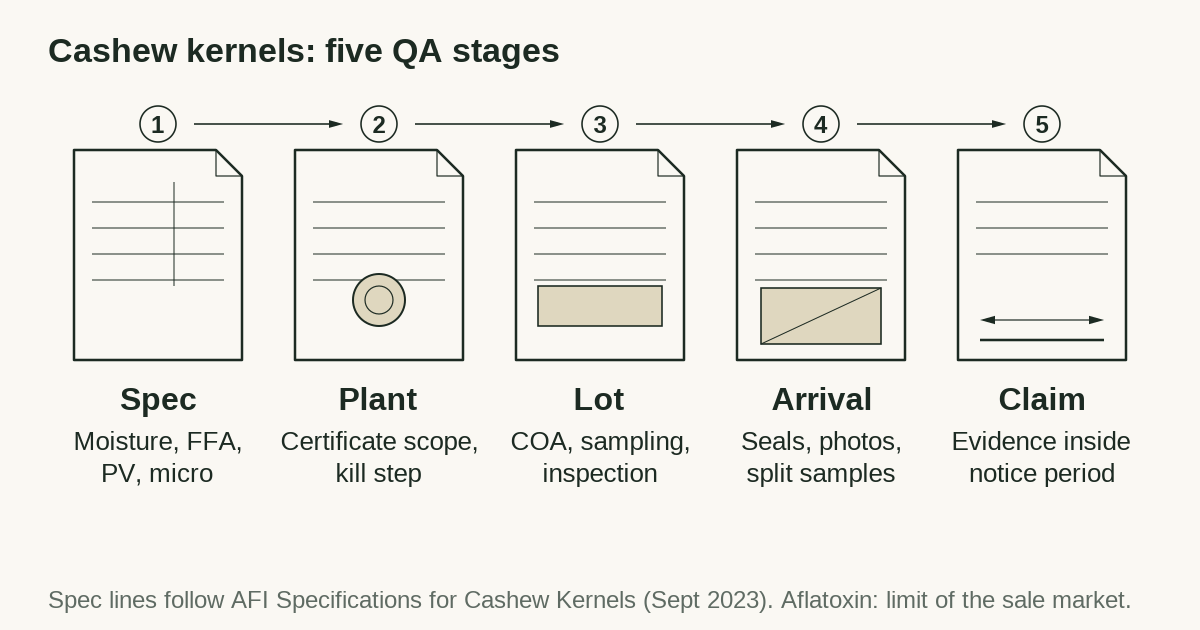
A QA manager buying cashew kernels from Vietnam makes five decisions, in this order: the spec lines, whether the plant is fit to supply you, how each lot is sampled and released, what you check when the container lands, and what evidence you keep in case the lot fails. This guide gives one checklist per stage and routes you to the post that goes deep on each. It adds no new theory and invents no case study; the numbers below come from the AFI specification, an industry document from a US trade association, and from our other posts.
When your requirements are set, send them to us and we reply with one detailed quote for kernels from a Vietnamese processor that runs your grade.
Stage 1: write the spec you will test against
The decision here is which lines the lot is judged on. A spec with only a grade name is a request for an argument at the port.
The AFI specification, updated in September 2023, gives a usable base for the lines a laboratory can measure:
| Line | AFI value | Note |
|---|---|---|
| Moisture | 3% to 5% | Loss on drying at 105 C on a moisture balance, or an equivalent method |
| Free fatty acids | At most 1.5% as oleic acid | AOCS Ca 5a-40 or equivalent |
| Peroxide value | At most 5 meq/kg | AOCS Cd 8b-90 or equivalent |
| E. coli | Not detectable | |
| Salmonella | Negative per 375 g | |
| Listeria monocytogenes | Negative per 125 g | |
| Staphylococcus aureus | Under 10 CFU/g | |
| Aflatoxin | Within the tolerance of the country where the goods are sold | See the limits page |
| Foreign material | Hair, glass, metal, stones and other hard or sharp objects prohibited | Harmless extraneous matter under 0.01% |
Checklist for the spec:
- Name the grade, the standard it follows and its date, not only the count.
- Write moisture with its method line, because a meter and a laboratory give different numbers.
- State whether the product is raw or heat treated, and ask for the validated kill step if the latter.
- Name the market’s aflatoxin limit and the sampling plan used to test it.
- Add the inspection point: the AFI text asks that all shipments are inspected prior to loading.
- Say how the lot is marked: AFI lists product, producer, grade, weights, origin, allergen marking and lot codes, and asks the packing list to match lot codes to quantities.
Read next: what to check on a cashew spec sheet, moisture test methods, aflatoxin limits by country and Salmonella and micro specs.
Stage 2: approve the plant before you approve the lot
The decision is whether this plant is fit to supply your product, not whether it holds a logo.
Checklist for the plant:
- Confirm who you are talking to: the registered company, the packing site and any toll processor.
- Match the scope of any certificate against the site that packs your lot. Look up each certificate in its register and match the fields, as in verifying a BRCGS, IFS or SQF certificate.
- For a heat treated product, ask for the validation pack of the kill step. See kill step validation for what a pack contains.
- For a US importer, ask for the plant’s FDA food facility registration number. FDA registrations renew every two years between 1 October and 31 December, and FDA’s notice of 29 September 2026 says a registration is treated as expired if not renewed by 31 December 2026. In January 2027, ask for the renewal confirmation.
- Send a supplier questionnaire and read the answers against documents. Our importer questionnaire guide lists the sections and where plants lose points.
- Plan a visit, in person or by video, and run the trace test: pick a finished lot code and ask the plant to walk it back to the raw nut intake.
Read next: how to check a Vietnamese cashew processor, certifications compared and a cashew factory visit.
Stage 3: sample, test and release each lot
The decision is what evidence lets a lot ship, and what lets you accept it.
The AFI sampling plans count 50 lb cartons. Plan A covers fewer than 51 cartons and takes 3. Plan B covers 51 to 350 cartons and takes 6. Plan C covers 351 to 800 and takes 13. Plan D covers 801 to 2,100 and takes 21. AFI asks for about 275 to 500 g from each carton, a total sample of at least 3,500 g, and collection from three or more sites in each package. Tightened inspection, which doubles the sample, is optional for reinspection or for lots with a history of failure. For supersacks or totes, the AFI text says to use plan C.
On analysis, AFI says to determine breakage in a 1,000 g composite sample, defects in a 500 g composite and the count in a one pound composite of whole kernels, and to examine at least 200 whole kernels for insect damage. Two things matter here for QA: the sampling plan is a contract term, and aflatoxin sampling is a different method from the quality sampling.
Checklist for the lot:
- Fix the sampling plan in the contract by name and date.
- Require a certificate of analysis tied to the lot code, with the method named for every line. See how to read a cashew certificate of analysis.
- Require a pre-shipment inspection report with photos. See what a good inspection report shows.
- Approve a counter sample before production and keep it sealed. See counter, pre-shipment and retained samples.
- Write the release rule: who holds the lot until results arrive and who may release it.
- Count the kernels the same way the contract does: counting a kernel sample.
Read next: the cashew lot sampling plan and cashew kernel defects.
Need a price for this grade? Request a quote
Stage 4: check the container when it lands
The decision is whether to accept the delivery, and the proof you collect decides every later claim.
Checklist for arrival:
- Photograph the container number and the seal intact before the doors open.
- Photograph the load as it sits and any damage in place.
- Draw the sample under the contract plan, from across the load and not from the carton by the door.
- Split it into three parts: one for your test, one retained for the seller and one sealed for an independent laboratory. Date and sign the seals.
- Check the cartons against the packing list and lot codes.
- Look for condensation, odour transfer, crushed tins and lost vacuum, which are transit problems more than supplier problems.
Read next: how a container is loaded and what goes wrong and moisture, packing and storage.
Stage 5: handle a failure so the claim holds
The decision is which of four situations you are in. The remedy depends on it.
| Situation | What it is | Usual route |
|---|---|---|
| Inside tolerance, wrong end | Within the contract, but not what you hoped | A pricing talk for next time, not a claim |
| Outside a commercial tolerance | Count, defects, moisture or free fatty acids beyond the spec | A claim, often settled by an allowance or a credit |
| Food safety failure | Aflatoxin over the limit, microbiological failure, live infestation, foreign matter | The lot cannot be sold; reporting duties may apply; not a discount |
| Transit damage | Wet cartons, crushed tins, lost vacuum | Usually insurance |
Checklist for a claim:
- Notify the processor the same day with facts, not a formal claim.
- Check the notice period in the contract before anything else.
- Hold the evidence together: a described sampling plan, a named laboratory and method, the retained sample for the seller and photographs with the container and seal.
- Add the original counter sample, sealed and dated.
Read next: what to do when a container fails on arrival.
The supplier file
Keep one folder per supplier. If an auditor, a customer or a regulator asks, you answer from the file.
| Item | Stage | Why |
|---|---|---|
| Signed spec with standard and date | 1 | The yardstick for everything else |
| Certificate and register check | 2 | Scope and date for the packing site |
| Kill step validation pack | 2 | For heat treated product |
| Questionnaire answers with attached documents | 2 | Written position of the plant |
| Counter sample and results | 3 | The physical reference |
| COA and inspection report per lot | 3 | Evidence tied to lot codes |
| Arrival photos, sample splits and results | 4 | Evidence for any claim |
| Claim log | 5 | Pattern across lots |
One more thing for the calendar
Rules that touch cashew imports in the EU, US and UK have dates in 2027. The one to put in your diary is 14 December 2027, when the EU Forced Labour Regulation applies: raw nut origin by lot is useful evidence. Our 2027 import calendar has the dates.
When your spec is written, send the requirement and we will price it with a Vietnamese processor that runs your grade. You get a reply within 24 business hours.
Sources
The AFI specification was read in October 2026. Links to the other posts above carry their own sources. This page is not legal advice.
Sources
- Association of Food Industries (AFI), Specifications for Cashew Kernels, updated September 2023
- FDA, FDA reminds food facilities of biennial renewal requirements, 29 September 2026
- Baker McKenzie, EU publishes guidelines on the application of the EU Forced Labour Regulation, 24 August 2026
Frequently asked questions
Which test lines belong in a cashew kernel spec?
The AFI Specifications for Cashew Kernels, updated September 2023, give a base set: moisture 3% to 5% by loss on drying at 105 C, free fatty acids at most 1.5% as oleic acid, peroxide value at most 5 meq/kg, E. coli not detectable, Salmonella negative per 375 g, Listeria monocytogenes negative per 125 g and Staphylococcus aureus under 10 CFU/g. Aflatoxin follows the limit of the country where the goods are sold.
How many cartons should be sampled from a cashew lot?
The AFI sampling plans for 50 lb cartons are plan A for fewer than 51 cartons (3 cartons), plan B for 51 to 350 (6), plan C for 351 to 800 (13) and plan D for 801 to 2,100 (21). Collect about 275 to 500 g from each carton, with a total sample of at least 3,500 g, from three or more sites in each package. Tightened inspection doubles the sample and is optional.
Is a BRCGS or IFS certificate enough to approve a cashew plant?
No. A certificate shows that a site and a scope passed an audit on a date. You still need to confirm the register entry matches the plant that packs your lot, then test the lot itself. The certificate also says nothing about the specific kernel grade, moisture or aflatoxin result of your shipment.
What should a QA file hold for each cashew supplier?
The signed spec, certificate and register check, the validated kill step if the product is heat treated, the counter sample and its test results, each lot's certificate of analysis tied to the lot code, the inspection report and your arrival results. Keep the retained sample sealed and dated. It is the evidence that decides a claim.
VietCashew supplies Vietnamese cashew kernels on one quote. We publish no prices, because a cashew quote is only valid for days. How an order runs and what we publish.
Need a price for this grade?
Send the requirement. We reply within 24 business hours with one detailed quote for the packed kernels.
Request a quote