Guides / Quality
Reading a Cashew Certificate of Analysis Before You Compare Suppliers
A cashew certificate of analysis, or COA, is the seller’s own report of what was measured on a sample of one lot. Read it in four passes: does it tie to your lot, does each line name a method and a unit, does each result meet the limit you wrote in the contract, and who made the measurement. This guide walks the lines of a typical kernel COA, gives the trade reference for each and lists the gaps that make two suppliers’ certificates impossible to compare.
What a COA is and what it is not
A COA is a statement by the seller or a laboratory about a sample. It supports a lot release and a shipment, and it is the document most buyers receive with the container papers. It is not a guarantee about every kernel in the lot, and it is not the same as a third-party inspection report. See our reference page on the cashew inspection report for the inspector’s version.
Treat it as one piece of evidence. Your rights come from the contract: the spec, the inspection point, whose result binds and the remedy.
Pass 1: does the COA belong to your lot?
Look at the header before the numbers.
- Product and grade. For example whole kernels, W320, with the colour class named.
- Lot, production and date codes. These should match the codes on the packing list. The AFI cashew specification asks that the shipper’s packing list detail lot, production and date codes with the quantities, for traceability and so that sampling is representative.
- Quantity covered. One COA can cover one lot or a blend. A certificate for 20 tonnes tested on one carton says little.
- Sampling basis. How many cartons, how much weight, drawn by whom and when.
- Test date and signatory. A named person and a date after production and before shipment.
A COA with no lot code describes nothing in particular. Ask for the lot code before you ask for anything else.
Pass 2: the lines, with the trade reference
The table uses the AFI cashew kernel specification, a trade document that buyers can write into contracts. It is a reference, not a law, and your contract can be stricter.
| COA line | What to check | AFI reference |
|---|---|---|
| Count per pound | Counted on whole kernels in a one-pound composite sample | W320 is typically 300 to 320 per pound and W240 220 to 240 |
| Broken and lower size | Percentage by weight | Broken kernels in wholes not over 10 percent, lower size grade not over 10 percent |
| Defects and damage | Insect, mould, rancid, adhering matter, scrapes, by grade | Serious damage limits are in the grade table, for example insect damage max 0.5 percent |
| Moisture | Result, method and temperature | 3 to 5 percent, loss on drying at 105 degrees Celsius, AACCI 44-15 modified or an equivalent that correlates with AOAC 925.40 |
| Free fatty acids | As oleic acid, solvent extracted sample | Max 1.5 percent, AOCS Ca 5a-40 or equivalent |
| Peroxide value | meq per kg, solvent extracted sample | Max 5, AOCS Cd 8b-90 or equivalent |
| Salmonella | Sample size in the result | Negative per 375 g |
| E. coli | Non-detectable | Non-detectable |
| Listeria monocytogenes | Sample size in the result | Negative per 125 g |
| Staphylococcus aureus | CFU per g | Less than 10 |
| Aflatoxin | Unit, method and reporting limit | Must meet the tolerance of the country of sale |
The AFI text says the FFA and peroxide samples must be prepared by solvent extraction, Soxhlet or equivalent, and must not be cold-pressed. A COA that does not say how the fat was extracted lets two laboratories report different numbers for the same kernels. For the background on these two tests see peroxide value and free fatty acids.
Moisture: why the method line matters
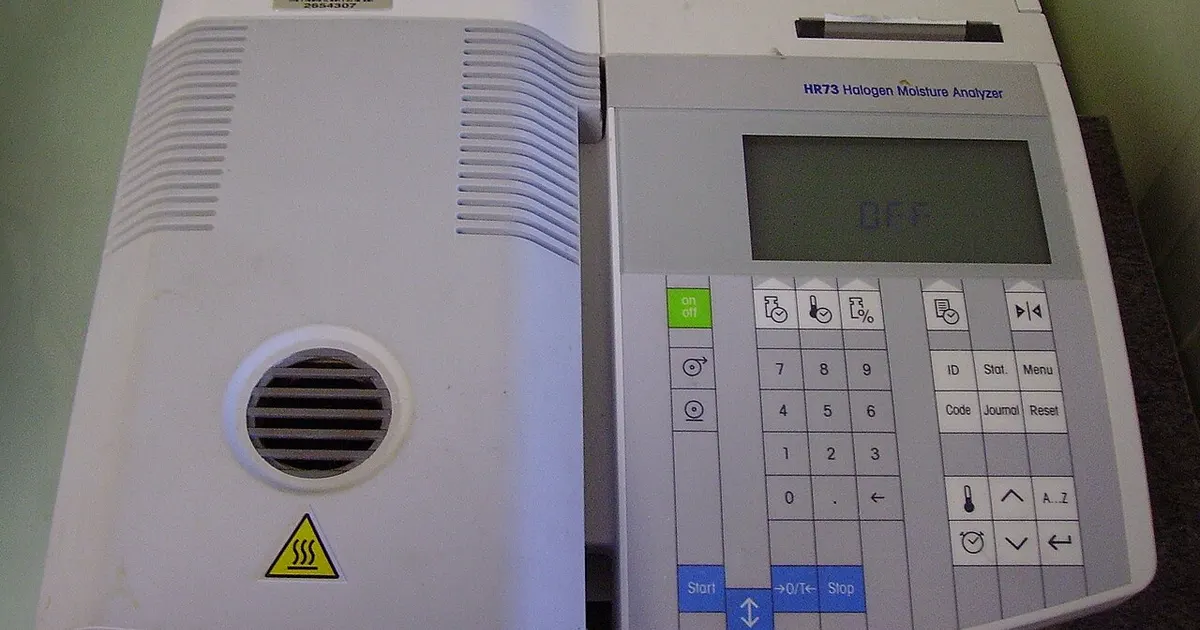
The moisture result is the line most likely to change between laboratories. The AFI specification names a loss on drying method on a moisture balance at 105 degrees Celsius, with a modified AACCI method and an equivalent that correlates with the AOAC nut method or a vacuum oven. Our page on moisture test methods sets out the options. For the COA the rule is simple: the method and temperature appear on the line, and the same method sits in your contract. If your own laboratory uses a different method, expect a small difference and agree how you will settle one.
Need a price for this grade? Request a quote
Aflatoxin: unit, limit and reporting level
Aflatoxin is a mould toxin. Results come in micrograms per kilogram, the same as parts per billion. Check four things.
- Which aflatoxins. B1 alone, or the sum of B1, B2, G1 and G2. The EU sets both, and the US uses the total.
- The limit the lot must meet. As of October 2026, Regulation (EU) 2023/915 sets 5.0 for B1 and 10.0 for the total in tree nuts to be sorted or treated before sale, and 2.0 and 4.0 in tree nuts sold on as they are or used as ingredients. FDA’s compliance policy guide, revised June 2021, says food with total aflatoxins above 20 ppb may be considered adulterated. See the page on aflatoxin limits by country.
- How the lot was sampled. Aflatoxin sits unevenly, so a result from a small sample carries more risk than one from a plan. See the lot sampling plan.
- The reporting limit. “Not detected” means below the laboratory’s limit of quantification, which differs between laboratories. Ask for the number.
A line that says only “pass” or “within limits” tells you the seller’s judgment and hides the result. Ask for the figure.
Pass 3: who measured it
The same number means different things from different laboratories.
- Plant laboratory. Fast, and under the plant’s control. Fine for routine release, but it is the seller grading its own paper.
- External commercial laboratory. More independent. Ask for its name and city, and whether the report is its own letterhead rather than a plant template.
- Accredited laboratory. ISO/IEC 17025 is the standard for the competence of testing laboratories. The joint ISO, ILAC and IAF communique of April 2017 says laboratories accredited to it operate a recognised quality management system. Accreditation is held for a stated scope, so ask for the certificate and check that the specific tests and methods on your COA sit inside it.
None of these is wrong. Choose which you want and write it into the contract, particularly for aflatoxin and microbiology.
Why two suppliers’ COAs do not compare
Before you score supplier A against supplier B on a table, check that the lines are like for like.
- Different moisture methods or temperatures.
- Different sampling bases: one carton against a plan.
- Count by weight from a loose bag against a one-pound composite of whole kernels, as AFI describes.
- Salmonella reported “negative” without saying per 25 g or per 375 g.
- Aflatoxin reported as B1 by one and as total by the other.
- Different units, such as percent against mg per kg, on the same line.
Ask both suppliers for the same lot-level COA format, or send each the same line list and methods from your spec.
Red flags on a COA
- No lot or production code.
- Identical results across several different lots. Possible, but ask for the raw laboratory sheet.
- No laboratory name, no signatory or no date.
- A scanned copy with edited fonts or misaligned fields.
- Results for a sample dated before the production date.
- “Pass” in place of a figure.
Fitting the COA into your contract
Write four things beside the spec: the COA is required for each lot, it carries the lot codes on the packing list, it lists the methods you named and it is issued by the laboratory type you chose. Then say which result binds if your own pre-shipment or arrival test disagrees. The AFI specification adds that a delivery is acceptable if it is equal to or better than the approved pre-shipment sample, and it asks for two sealed pre-shipment samples, one kept sealed for a dispute. See the sample and approval process and what to do when a lot fails on arrival.
To lay out these lines for every quote, use the spec sheet checklist and send the full spec with your requirement. The tighter the spec, the easier the COAs are to compare.
Sources
- AFI, Specifications for Cashew Kernels (updated September 2023): moisture, FFA, peroxide value, microbiology, aflatoxin, sampling and grading methods
- Regulation (EU) 2023/915 on maximum levels for certain contaminants in food, Annex I sections 1.1.6 and 1.1.7 (EUR-Lex)
- FDA, Compliance Policy Guide Sec. 555.400, Aflatoxins in Human Food (revised June 2021)
- ILAC, ISO partnership page: joint communique on ISO/IEC 17025 (April 2017)
Frequently asked questions
What should a cashew certificate of analysis show?
At minimum the product and grade, the lot and production codes that match the packing list, the sampling basis, the test date, each result with its unit and method, the laboratory name and a named signatory. A certificate without a lot code describes nothing in particular. Ask for the lot code before you compare any number.
Is a certificate of analysis proof the cashew lot is safe?
No. It reports what was tested on the samples drawn. It cannot show what was missed between samples, and aflatoxin in particular sits unevenly in a lot. Pair it with a sampling plan, an independent pre-shipment sample and a contract that says which result binds if two laboratories disagree.
What limit should the aflatoxin line meet?
The limit of the market where the lot will be sold. The AFI specification says aflatoxin must meet the tolerance of the country of sale. As of October 2026 the EU legal maximum for tree nuts sold on as they are is 2 micrograms per kilogram for B1 and 4 for the total, and FDA treats food above 20 ppb total as potentially adulterated.
Why do two cashew COAs for the same grade look so different?
Because the methods, sample sizes, units and reporting limits can differ even when the grade code is the same. Moisture by an oven and by a halogen balance can read differently, and a result shown as not detected depends on the lab's reporting limit. Compare methods and limits before you compare numbers.
VietCashew supplies Vietnamese cashew kernels on one quote. We publish no prices, because a cashew quote is only valid for days. How an order runs and what we publish.
Need a price for this grade?
Send the requirement. We reply within 24 business hours with one detailed quote for the packed kernels.
Request a quote