Guides / Grades
How to Count and Check a Cashew Kernel Sample Before You Accept a Grade
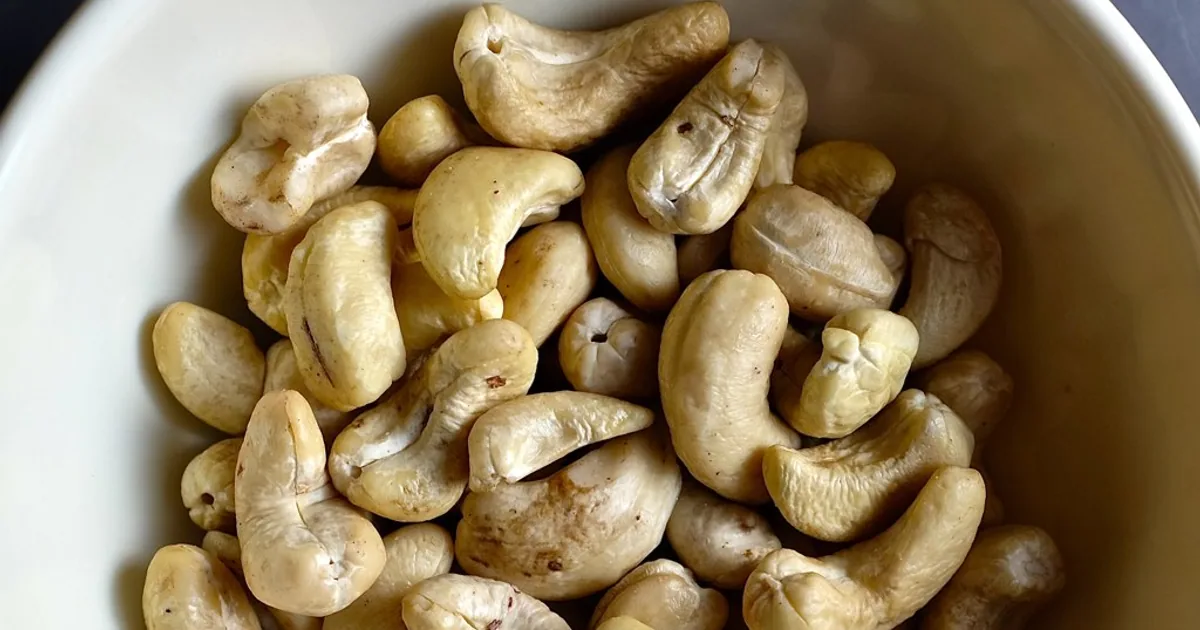
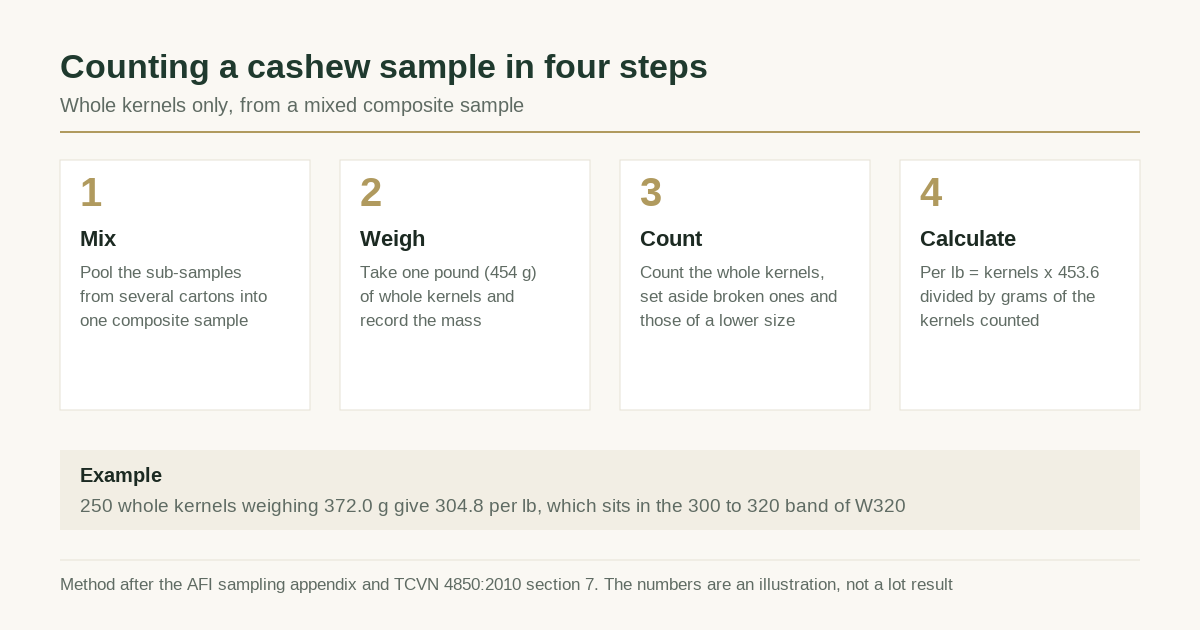
To find the cashew kernel count per pound of a sample, mix a composite from several cartons, weigh one pound of whole kernels, count them and divide: kernels per pound equals the count times 453.6 divided by the grams of the kernels counted. This post is part of our guide to which cashew grade to buy, and it walks through the count that both the AFI specification and the Vietnamese TCVN 4850 describe, then adds what a cut test can and cannot show.
The method below follows public texts. The count itself is simple. The mistakes happen in the sampling and in what you leave out of the pound.
What you need and who does it
You need a sealed sample drawn from the lot, a clean white tray, a scale that reads to 0.01 g (TCVN 4850:2010 weighs to the nearest 0.01 g), a counter and a record sheet. An independent inspector or your own laboratory does the work. Our sample-approval guide says a few hundred grams is enough for a quick check of count per pound, while the AFI and TCVN methods count one pound (454 g) of whole kernels, so use the larger draw for a contract count. Do not count a counter sample and call it the lot: it shows what a processor can make, and only a sealed draw shows the goods you will receive. The note under the AFI tolerance table asks for two sealed pre-shipment samples for approval, one of which stays sealed for arbitration.
Step 1: take a composite sample
The AFI sampling plan for 50 lb cartons asks for 3 cartons for lots of fewer than 51 cartons, 6 for 51 to 350, 13 for 351 to 800 and 21 for 801 to 2,100. It asks for roughly 275 to 500 g from each carton, drawn from three or more places in the package, and at least 3,500 g in total. TCVN 4850:2010 pours each carton out on a clean surface, mixes, spreads a thin layer and takes a portion from three places, with a composite of at least 3 kg.
The failure point is sampling the top layer of one carton, which may not represent the lot. Both documents draw portions from several cartons and from several places in each.
Step 2: weigh one pound of whole kernels
From the mixed composite, take whole kernels only. The AFI document counts the kernels in a one-pound (454 g) composite sample of whole kernels, and TCVN 4850:2010 uses 1 kg or 1 lb of test sample. A kernel is whole if it has the characteristic shape and not more than one eighth is broken off. Record the mass of the whole kernels to 0.01 g.
The failure point is letting broken kernels into the pound. Butts and pieces are lighter, so they push the count up and make a lot look smaller than it is.
Step 3: count and separate
Count the whole kernels and write the number down. Set aside kernels of a smaller size and weigh them with a second count. The AFI document determines the share of smaller and larger whole kernels in a 500 g composite sample and breakage in a 1,000 g composite sample, all as percentages by weight. TCVN 4850:2010 counts the whole nuts, weighs them, then counts and weighs the next lower size.
The failure point is counting twice or dropping a kernel at the edge of the tray. Count in groups of ten and let a second person check the total.
Step 4: calculate and compare
TCVN 4850:2010 gives the formulas. Kernels per kilogram equal the count times 1,000 divided by the mass in grams. Kernels per pound equal the count times 453.6 divided by the mass in grams. The share of next lower size is its mass divided by the mass of the test portion, times 100.
| Step | Reading in the example | Result |
|---|---|---|
| Whole kernels counted | 250 | Input |
| Mass of those kernels | 372.0 g | Input |
| Kernels per pound | 250 x 453.6 / 372.0 | 304.8 |
| Kernels per kilogram | 250 x 1,000 / 372.0 | 672 |
| Lower size kernels in 500 g | 6 kernels, 8.4 g | 1.68% by weight |
The example is an illustration, not a lot result. A count of 304.8 falls inside the 300 to 320 band that the AFI document and TCVN give for W320, and the lower-size share of 1.68% is below the AFI limit of 10% and the TCVN limit of 5%.
What a good result looks like
A good result has three parts: the count sits inside the band of the named document, the lower-size share and the broken share are under the tolerance written in the order and the record shows the lot code, the carton numbers sampled, the date and who counted. Counts near the edge of a band need a second composite. The bands leave gaps. The AFI table lists nothing for 241 to 299 per pound, so a count of 270 fits no listed grade there, and the order should say which grade applies in that case. Our guide to W320 against W240 covers the buying side of that choice.
Need a price for this grade? Request a quote
Cut test: what the standards say and what they do not
None of the cashew texts we read describes a cut test. The AFI method examines whole kernels for insect damage and serious damage, 200 whole kernels or 200 g of broken grade by one option, and leaves rancidity to a sensory panel. TCVN 4850:2010 asks for kernels free of live or dead insects and mould visible to the naked eye or at magnification of ten times where needed.
FDA’s method for shelled tree nuts is the nearest public procedure, and its scope names cashews. It examines at least 100 nuts using the naked eye or up to 10X magnification, classes a kernel as insect-damaged, mouldy, rancid, otherwise decomposed or dirty, and uses a sequential plan at a 5% defect action level. For Brazil nuts, in its in-shell procedure, it says to cut the kernel in two or more pieces and examine the cavity and surfaces for mould, and to taste kernels suspected of rancidity. That is a regulator’s examination method, not a cashew contract term.
So if you want internal inspection, write it into the order: how many kernels are cut (100 is a defensible start, taken from FDA’s minimum), how they are cut, what the examiner looks for and what counts as a reject, using the AFI definitions of insect damage, mould and rancidity. We found no public acceptance limit for a cashew cut test.
Checklist to copy
- Named document and edition for the grade and the count band.
- Composite sample drawn from the cartons the plan requires, sealed and recorded.
- One pound or one kilogram of whole kernels weighed to 0.01 g.
- Whole kernels counted twice and written down in groups.
- Lower-size and broken shares in percent by weight, against the order’s limits.
- Count per pound calculated with 453.6 and checked against the band.
- A second composite when the count is near a band edge.
- Cut examination only if the order says how many kernels and what is a reject.
- A retained sample for each party, sealed and dated.
A spec line for the count
Grade W320, first quality fancy, 300 to 320 whole kernels per pound, counted on a composite sample drawn and sealed by [inspector], on a one-pound sample of whole kernels weighed to 0.01 g. Kernels of the next lower size up to ___% by weight. Broken kernels and pieces up to ___% by weight. Retained samples for buyer and seller.
Fill the blanks from the standard you name, which our guide to cashew kernel standards compares. Build the full sheet in our spec sheet tool and send the requirement. We reply within 24 business hours with one detailed quote from a Vietnamese processor that runs your grade. The full decision is in our guide to which cashew grade to buy.
See also: every grade band in both units is in our cashew count per kg table.
Sources
- Association of Food Industries, Specifications for Cashew Kernels (updated September 2023), Appendix I sampling plan and analytical methods
- TCVN 4850:2010 Nhan hat dieu (Cashew kernels), bilingual text published by VINACAS, sections 6 and 7
- FDA Macroanalytical Procedures Manual, V-10 Nuts and Nut Products Methods (page current as of 3 November 2017)
- Standard for Cashew Kernels, UNECE Standard DDP-17 text adopted 8 November 2012 for a trial period, copy hosted by the African Cashew Alliance
Frequently asked questions
How many kernels per pound is W320?
Under both the AFI specification updated in September 2023 and TCVN 4850:2010, W320 is 300 to 320 whole kernels per pound. The UNECE text we read gives a maximum of 320. Count against the band in the document your contract names.
How do I convert a count to kernels per pound?
Multiply the number of whole kernels by 453.6 and divide by their mass in grams. For kernels per kilogram, multiply by 1,000 and divide by the same mass. TCVN 4850:2010 prints both formulas, and the AFI document counts a one-pound composite sample of whole kernels.
How many kernels should I cut open?
No cashew standard we read sets a number. FDA's method for shelled tree nuts, whose scope names cashews, examines at least 100 nuts. A contract can borrow that number and say what counts as a reject, since we found no public acceptance limit for a cashew cut test.
Can I count a counter sample instead of the lot?
You can, and it shows what a processor typically makes at a grade. Only a sealed sample drawn from your lot shows that lot. The note under the AFI tolerance table asks for two sealed pre-shipment samples, one kept sealed in case of arbitration.
VietCashew supplies Vietnamese cashew kernels on one quote. We publish no prices, because a cashew quote is only valid for days. How an order runs and what we publish.
Need a price for this grade?
Send the requirement. We reply within 24 business hours with one detailed quote for the packed kernels.
Request a quote