Guides / Grades
Which Cashew Grade Should You Buy? Match Count, Colour and Form to Your Product
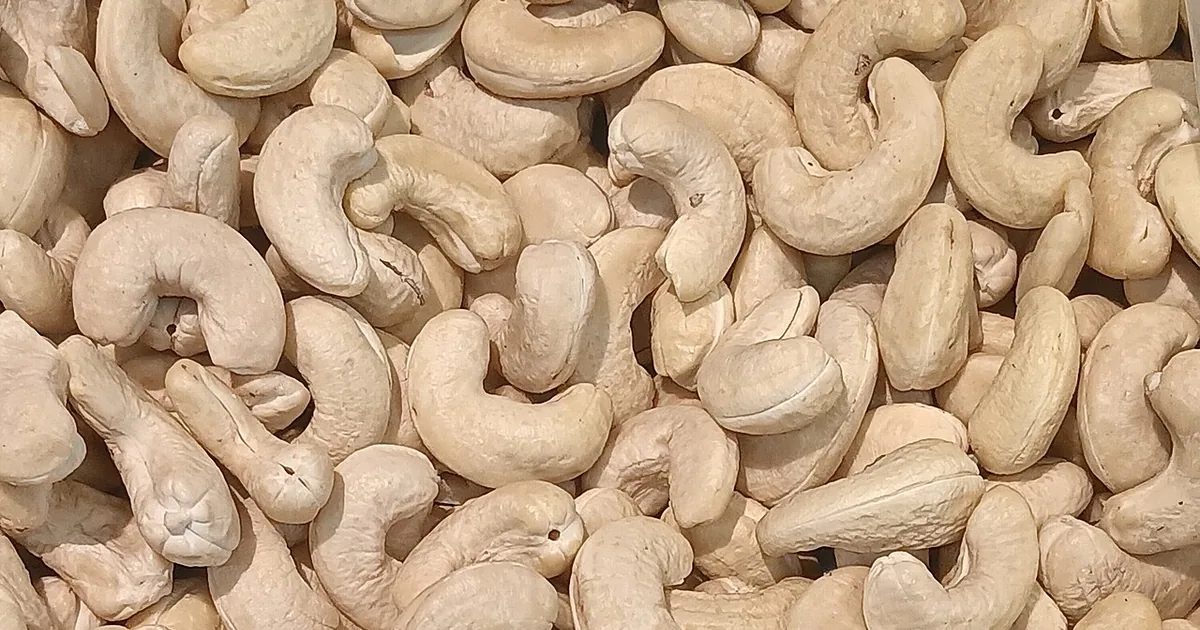
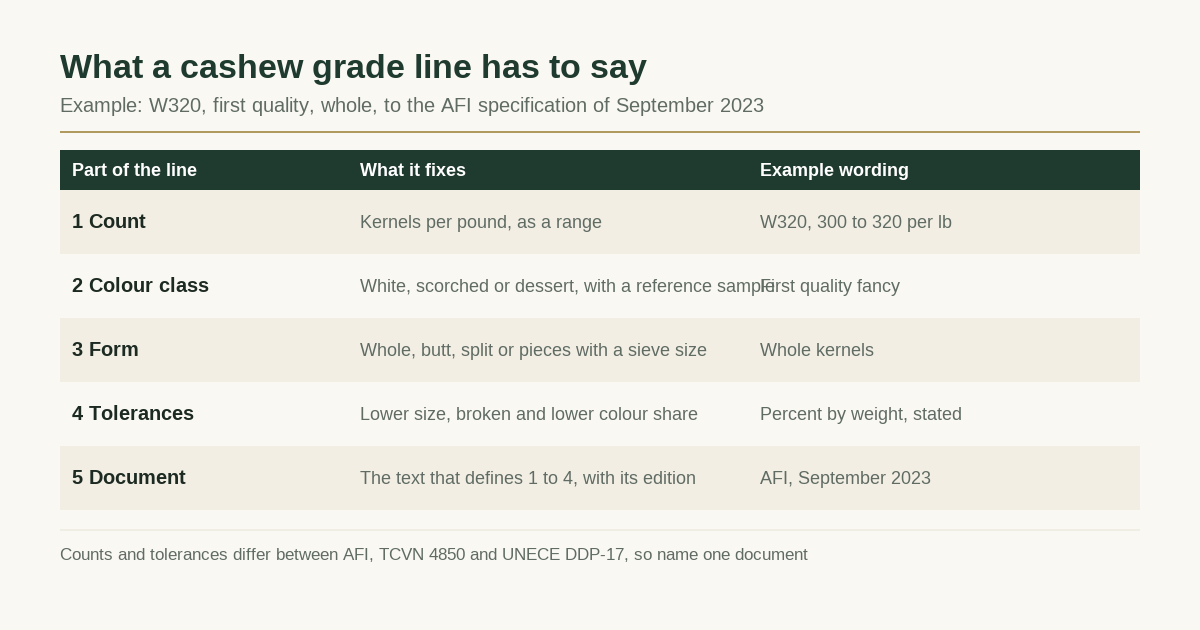
Choose a cashew grade from what the customer sees and what your line does to the kernel. A whole kernel in a clear pack needs a count and the white class, with W320 as the usual starting point and W240 where size is part of the pitch. A product that roasts, coats or seasons the nut can take scorched wholes or a small count. A product that chops, bakes, grinds or mills the kernel needs butts, splits or pieces. Then write the grade as five parts: count, colour class, form, tolerances and the document that defines them. This guide is for importers, snack and ingredient brands and private label buyers who write the grade line of a contract.
We show no price and name no processor. The counts, tolerances and colour words below come from the AFI specification, the Vietnamese standard TCVN 4850:2010 and a copy of the UNECE standard, and where we could not open a text we say so.
Last reviewed: October 2026. Standards carry the edition we read; confirm the current edition before you rely on a number in a contract.
- Start from the product, not the grade
- W320 or W240: the main size decision
- W210 and W450: the two ends of the range
- Colour classes: white, scorched and dessert
- Butts and splits
- Pieces
- Skin-on kernels
- Paste, spreads and plant milk
- Snack mixes and bakery
- Which standard to cite
- How to count and test a sample
- How colour is judged
- Checklist for the grade line of your spec
- Send the grade for a quote
Start from the product, not the grade
A grade name bundles five choices: the count, the colour class, the form, the share of other grades allowed in the lot and the document that defines them. Most buyers start with the count because it is the number on the quote. The better start is the product: which of the five does your customer see, and which does your line destroy? Kernels that will be ground do not need a count. Kernels that will be roasted and coated do not need the white class.
| Your product | Start with | Why |
|---|---|---|
| Clear pack, kernel visible, size part of the pitch | W240, or W210 where size is the selling point | The customer sees the size |
| Mainstream retail or private label pack, kernel visible | W320, white class | A middle count that many processors quote |
| Roasted, salted, coated or seasoned wholes | Scorched wholes, or W450 | The process hides the tint and the size |
| Value mixes and kitchen use | W450 or splits | Nut size is not part of the pitch |
| Cookies, brittle and toppings | Large pieces | A visible crunch |
| Cereal, chocolate and ice cream inclusions | Small pieces | They spread evenly through the product |
| Butter, paste, plant milk and fillings | Baby bits or small pieces | The kernel is ground |
Source: starting points taken from the guides linked in each section below. None of the texts we read assigns a grade to an end use, and we found no public price series by grade, so test before you commit.
A cheaper class or form does not relax the rest of the spec. The AFI general requirements apply to every shipment whatever the grade: moisture of 3% to 5%, kernels free of hard or sharp foreign objects and hair and no live infestation. A buyer who moves from W320 to pieces to save cost should keep every one of those lines and the market’s contaminant limits. Only the size and shape lines change.
Read more: what W180, W320 and LWP mean.
W320 or W240: the main size decision
The size decision is the one that moves cost most for a product with a visible kernel. In the AFI count table W240 is 220 to 240 whole kernels per pound and W320 is 300 to 320, and TCVN 4850:2010 gives the same two bands. At the top of each band a pound of W240 holds 240 kernels and a pound of W320 holds 320, so a W320 kernel averages about three quarters of the mass of a W240 kernel, 1.42 g against 1.89 g. That is the size difference the customer can see in the pack.
Our grade pages call W320 the most traded cashew grade. We found no public trade statistic by grade, so check it the practical way: ask three processors for both counts on the same enquiry, in the same pack and on the same day, and compare the gap. Put both counts in your real pack at your real fill weight, and look at them under your retailer’s light before you decide.
Sizing also needs a sentence in the order. The AFI document makes sizing compulsory for first quality fancy whole kernels and optional for other whole grades, so a scorched or dessert lot may arrive unsized unless you ask for a count. It limits whole kernels of a lower size to 10% by weight, and TCVN limits the next lower grade to 5%. Under the AFI text a W320 lot can therefore hold up to a tenth of its weight in smaller kernels. If the pack shows the kernels, ask for the tighter limit.
Read more: W320 or W240: which grade should you buy.
W210 and W450: the two ends of the range
Either side of the middle counts the documents agree less. For W210 the AFI table gives 180 to 210 and TCVN gives 200 to 210. For W180 the AFI table gives 140 to 180 and TCVN gives 161 to 180. Our grades page and explained guide list W180 as 170 to 180 and W210 as 200 to 210, so the W210 range matches TCVN and the W180 range matches none of the three tables we read. If you buy at the large end, write the range of your named document, not a range from a price list.
At the small end the documents agree: W450 is 400 to 450 whole kernels per pound in the AFI table, TCVN and, as a maximum of 450, in the UNECE copy. W500 appears in TCVN at 450 to 500 and in the UNECE copy as a size code of 500, but not in the AFI count table we read. A W500 contract needs a named document that carries it. The saving at the small end and the supply risk at the large end are explained in the guides below, and we found no public price series for either.
Read more: W210 jumbo cashews and W450 and W500 cashews.
Colour classes: white, scorched and dessert
Colour is a second, separate choice. The AFI specification classifies kernels as first quality fancy, second quality scorched, third quality special scorched, lightly blemished wholes and pieces and dessert blemished wholes. Scorched wholes use the same count classes as white ones: TCVN lists SW240 at 220 to 240 and SW320 at 300 to 320 per pound, and LBW at 240, 320 and 450.
| Class (AFI wording) | What the text allows | Share limit |
|---|---|---|
| First quality fancy | Uniform colour: white, light yellow or pale ivory | None stated for colour |
| Second quality scorched | Yellow, light brown, light ivory, light ash-grey or deep ivory | None stated |
| Third quality special scorched | Deep yellow, brown, amber, light to deep blue. May be slightly shrivelled or immature | None stated |
| Lightly blemished wholes | Light brown lines, swirls or loops | Not more than 40% of kernels affected |
| Dessert blemished wholes | Dark brown lines or pitted spots | Not more than 60% of kernels affected |
Source: AFI specification, quality and grading. Our colour guide states that a scorched or deeper class suits products where roasting, coating or milling hides the tint and not a clear pack. Test it in your own product, and we found no public price series for the discount.
Read more: scorched cashew grades and dessert wholes and LBW.
Butts and splits
A split is one half of a kernel split lengthwise, and a butt is a kernel broken crosswise that keeps at least three eighths of the whole, both as the AFI specification defines them. Both count as broken kernels. A whole grade may hold up to 10% of broken kernels and pieces by weight under the AFI text and 5% under TCVN at packing, so some butts and splits sit inside any W320 lot. The count tables belong to whole kernels, so a lot of splits is ordered by name, colour class and the share of pieces allowed, not by a W code.
Splits and butts suit buyers whose product still shows the nut but not its full size. They are a smaller step than pieces in cost, and we found no public price figure for the gap. The codes differ between documents. TCVN uses WB and WS for white butts and splits and SS for a scorched split, while SSW is a second scorched whole there and BB means blemish butt in TCVN and baby bits in trade usage, so write the words in the order.
Read more: cashew splits and butts specs.
Pieces
Pieces are classed by sieve, not by count. The three texts publish openings, and they differ.
| Class | AFI (2023) | TCVN 4850:2010 | UNECE copy (2012 text) |
|---|---|---|---|
| Large pieces | Pass 8.00 mm, retained on 6.30 mm | Not passing 4.75 mm, passing 8.0 mm | Not passing 4.75 mm |
| Small pieces | Pass 6.30 mm, retained on 2.80 mm | Not passing 2.8 mm, passing 4.75 mm | Not passing 2.80 mm |
| Baby bits | Pass 2.36 mm, retained on 1.70 mm | Not passing 1.7 mm | Not passing 1.70 mm |
Sources: AFI Table 2, read from extracted PDF text; TCVN 4850:2010 section 3 and Table 2; UNECE DDP-17 section III as reproduced.
Our pieces guide says each facility sets its own screen. The documents give a basis you can name, but large pieces start at 6.30 mm in the AFI text and 4.75 mm in the other two, so “LWP” alone is not a spec. Write the pass and retain apertures in millimetres, and add the dust and fines limit if your line blows fines around.
Read more: cashew pieces explained.
Skin-on kernels
None of the three texts has a skin-on class. The UNECE copy defines kernels as obtained by shelling and peeling, TCVN defines the kernel as the edible part after peeling and the AFI document treats adhering testa as a defect that it scores by area. TCVN limits kernels with adhering testa to less than 1.5% by mass, with the pieces of skin under 2 mm in aggregate. The UNECE copy tolerates adhering testa at 3% in Extra and Class I and 5% in Class II.
A skin-on lot therefore needs its own written spec: the count basis, since skin adds weight and shifts the count; the skin colour range; how much partial skin you accept; and the limit for loose skin and dust in the pack. Ask the processor which count basis it uses, and test the lot roasted if that is how it will be sold.
Read more: skin-on cashew kernels.
Need a price for this grade? Request a quote
Paste, spreads and plant milk
When the kernel is milled, size and shape are not seen, so the starting point is the cheapest grade that meets the quality limits. Our butter guide points to baby bits, small white pieces and large white pieces, and to scorched wholes where the butter is roasted, because roasting hides the tint. For a raw butter or a white plant milk it advises against dark kernels, since a tan or grey cast shows in the product. Our plant milk guide says the same about scorched grades and lists baby bits and small white pieces as the lowest-cost usable forms.
Three things still belong in the order even for a ground product: the colour class, the free fatty acid and peroxide limits (the AFI text gives 1.5% as oleic acid and 5 meq/kg) and the fines limit if dust matters to your mill. Whole grades add cost without adding to the product. Raw kernels used for milk or cheese also raise a food safety question, covered in our guide below.
Read more: which kernel grade for cashew butter and cashews for plant-based milk and vegan cheese.
Snack mixes and bakery
A mix puts the cashew among other ingredients, so the buyer’s question is whether anyone judges the mix by cashew size. Our snack mix guide suggests W450 or splits for a value mix, W320 or SW320 for an everyday mix, W240 or W320 where the cashew is a visible feature and SW or SSW for a roasted seasoned mix. Pieces suit clusters and bars.
Bakery and confectionery work from pieces: large pieces for cookies, brittle and toppings, small pieces for chocolate, cereal and cakes, with small pieces or baby bits for ice cream and fillings. In each case ask for the sieve apertures and a dust limit, since the product will show the fines. Allergen labelling and moisture belong in the order too.
Read more: cashews for trail mix and snack mixes and cashew pieces for bakery, chocolate and ice cream.
Which standard to cite
Three documents define most of what a grade means in a contract, and their count bands do not match.
| Grade | AFI (2023) | TCVN 4850:2010 | UNECE copy (2012 text) |
|---|---|---|---|
| W180 | 140 to 180 | 161 to 180 | Maximum 180 |
| W210 | 180 to 210 | 200 to 210 | Maximum 210 |
| W240 | 220 to 240 | 220 to 240 | Maximum 240 |
| W320 | 300 to 320 | 300 to 320 | Maximum 320 |
| W450 | 400 to 450 | 400 to 450 | Maximum 450 |
Counts are whole kernels per pound. Sources: AFI count table; TCVN 4850:2010 Table 2; UNECE DDP-17 section III as reproduced by the African Cashew Alliance. We could not open UNECE’s own site, so the UNECE column is directional, and the ASEAN standard (ASEAN Stan 20:2011) was found only as a catalogue entry. For ISO 6477 see our reference page.
Tolerances differ too. Kernels of a lower size are limited to 10% by weight in the AFI text and 5% in TCVN, and broken kernels in wholes to 10% against 5%. The same lot can pass one document and fail the other. Name one document and its edition, say which governs if a processor sheet differs and put the tolerances in the order.
Read more: cashew kernel standards compared.
How to count and test a sample
The count is simple. Draw a composite from the cartons the sampling plan requires, take one pound (454 g) of whole kernels, count them and weigh them. Kernels per pound equals the count times 453.6 divided by the grams. For example, 250 whole kernels weighing 372.0 g give 304.8 per pound, inside the 300 to 320 band of W320. The AFI method also determines the share of lower-size kernels in a 500 g composite and breakage in a 1,000 g composite, by weight.
A cut test is a different check. None of the cashew texts we read describes one, and the nearest public procedure is FDA’s method for shelled tree nuts, which names cashews and examines at least 100 nuts by eye or up to 10X magnification. If you want internal inspection, write the number of kernels, the way they are cut and what counts as a reject into the order.
Read more: how to count a cashew kernel sample.
How colour is judged
In the texts we read colour is judged by eye against written colour words, under defined light. The AFI document asks for full spectrum lighting. TCVN 4850:2010 asks for a thin layer on a white table under non-direct natural light or equivalent artificial light. The AFI document adds a roast test: kernels fried in clear vegetable oil at about 149 degrees Celsius for 2 to 3 minutes, with limits on spotting, scorched tips and uneven roast.
The words differ between documents: a light ash-grey kernel is white in TCVN and second quality in the AFI text. The 40% and 60% limits on blemished classes are shares of kernels in the AFI text, and we read the Vietnamese column of TCVN as shares of kernel surface. We found no public instrument limit. A 2023 study separated white from scorched kernels from image colour features at 98.4% to 99.8% accuracy, but it is a laboratory study, not a trade spec. Keep a sealed reference sample.
Read more: the cashew kernel colour standard.
Checklist for the grade line of your spec
Use this list to turn a grade name into a grade line. Each item answers one of the questions above.
- Document and edition: the standard that governs (for example AFI, September 2023) and which document wins if a processor sheet differs.
- Count: the code and the band printed in that document, in kernels per pound.
- Colour class: the class by the document’s own name, with the basis for any “affected” share.
- Form: whole, butt, split or pieces, with sieve openings in millimetres for pieces.
- Tolerances: kernels of a lower size, broken kernels and the next lower colour class, in percent by weight.
- Moisture: the limit and method, which the AFI text sets at 3% to 5% by loss on drying at 105 degrees Celsius.
- Reference sample: a sealed pre-shipment sample, with a second sealed for arbitration.
- Sampling and inspection: the plan, who inspects before loading and who pays.
- Chemical and micro lines: the lines your market requires, since a grade does not set them.
- Roast test or cut test: only if the order states the method and the reject limit.
Red flags: a grade named without a document, a count given as one number, “LWP” with no sieve, “scorched” with no class and a processor sheet that quotes a tolerance looser than the one in your order. A grade also does not set the aflatoxin, residue or microbiological limits of the market where the lot is sold. Our guide to cashew food safety for importers covers those.
Read more: cashew food safety for importers.
Send the grade for a quote
Once you know the grade line, send the requirement with the count, colour class, form, tolerances and document. We reply within 24 business hours with one detailed quote from a Vietnamese processor that runs your grade. An NDA is available on request.
Ask each processor to confirm the grade against the same document and to send a counter sample, then compare quotes on the same line. Quotes that name different documents or tolerances are not the same offer, whatever the price. A counter sample shows what a processor typically makes at the grade, and the sealed sample drawn from your lot shows what you will receive, so keep the two apart in your records.
Read more: the grade reference table lists the counts we use as typical ranges.
Sources
- Association of Food Industries, Specifications for Cashew Kernels (updated September 2023)
- TCVN 4850:2010 Nhan hat dieu (Cashew kernels), bilingual text published by VINACAS
- Standard for Cashew Kernels, UNECE Standard DDP-17 text adopted 8 November 2012 for a trial period, copy hosted by the African Cashew Alliance
- ASEAN Standards and Technical Regulations registry, ASEAN Stan 20:2011 Cashew Kernels (catalogue entry)
- FDA Macroanalytical Procedures Manual, V-10 Nuts and Nut Products Methods (page current as of 3 November 2017)
- Baitu, Gadalla and Oztekin, Traditional Machine Learning-Based Classification of Cashew Kernels Using Colour Features, Journal of Tekirdag Agriculture Faculty 20(1), 2023 (abstract page)
Frequently asked questions
Which cashew grade should I buy for a retail pack?
Work back from what the shopper sees. A kernel visible in a clear pack needs a count and the white class, and W320 is the usual starting point with W240 where size is part of the pitch. A roasted or coated product can take scorched wholes. Quote two counts on the same day and test both in your pack.
What does W320 mean?
It is a count class for whole kernels. The AFI specification updated in September 2023 and TCVN 4850:2010 both give 300 to 320 whole kernels per pound for W320, and the UNECE text we read gives a maximum of 320. The W stands for white wholes in the trade, and the colour class is a separate part of the grade.
Which standard should my contract name?
Name one document and its edition. The AFI specification is free, was updated in September 2023 and carries a sampling plan and a roast test. TCVN 4850:2010 and the UNECE text give different bands and tolerances at some counts. Say which document governs if a processor sheet differs.
How many broken kernels can a whole grade contain?
The AFI specification allows broken kernels or pieces in wholes of up to 10 percent by weight, and the UNECE copy we read shows 10 percent. TCVN 4850:2010 says broken kernels shall not exceed 5 percent by mass at packing. State the limit in the order, because the documents differ.
Do cashew pieces have a count per pound?
No. Pieces are classed by the sieve openings they pass through and are retained on, in millimetres. The AFI, TCVN and UNECE texts give different openings for large pieces, small pieces and baby bits, so write the apertures into the contract.
How do I check a grade on arrival?
Take a sealed composite sample, weigh one pound of whole kernels, count them and calculate kernels per pound as the count times 453.6 divided by the grams. Compare the result and the lower-size and broken shares with the order. Keep a sealed retained sample for each party.
VietCashew supplies Vietnamese cashew kernels on one quote. We publish no prices, because a cashew quote is only valid for days. How an order runs and what we publish.
Need a price for this grade?
Send the requirement. We reply within 24 business hours with one detailed quote for the packed kernels.
Request a quote