Guides / Sourcing
Cashew Kernels for Dairy-Free Milk and Cheese: Grade, Raw Safety and Spec
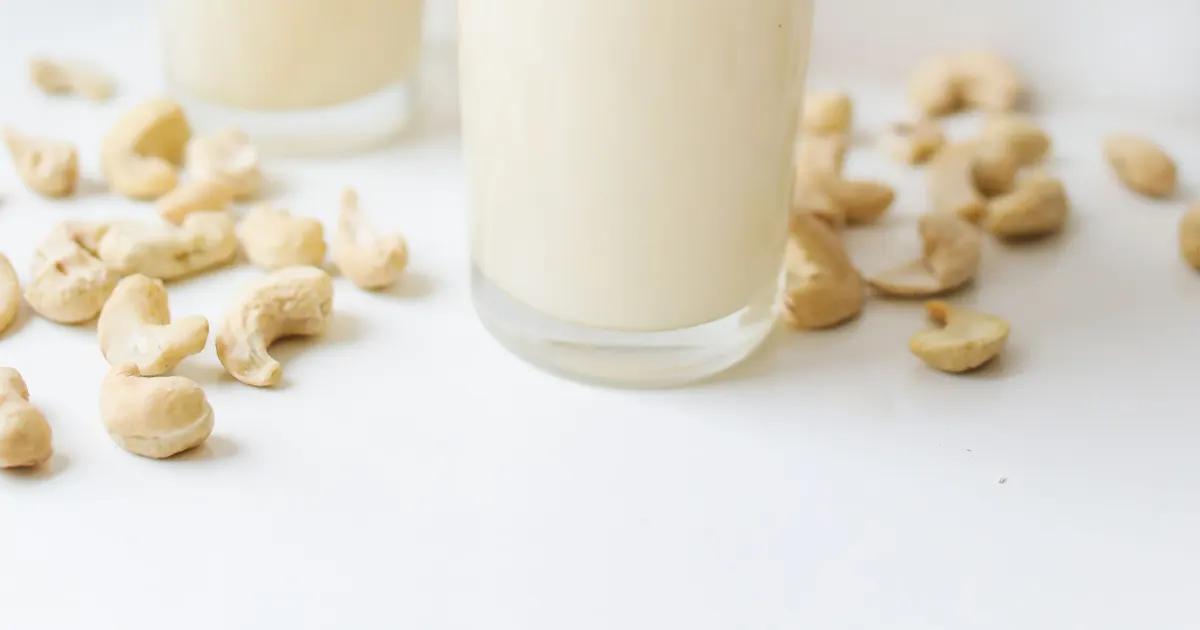
Cashews have become one of the main ingredients in dairy-free products. Blended with water they make a creamy, neutral milk. Soaked, blended and cultured they make a soft cheese. The reason is simple: a kernel is about half fat and has a mild flavour that does not fight with other ingredients.
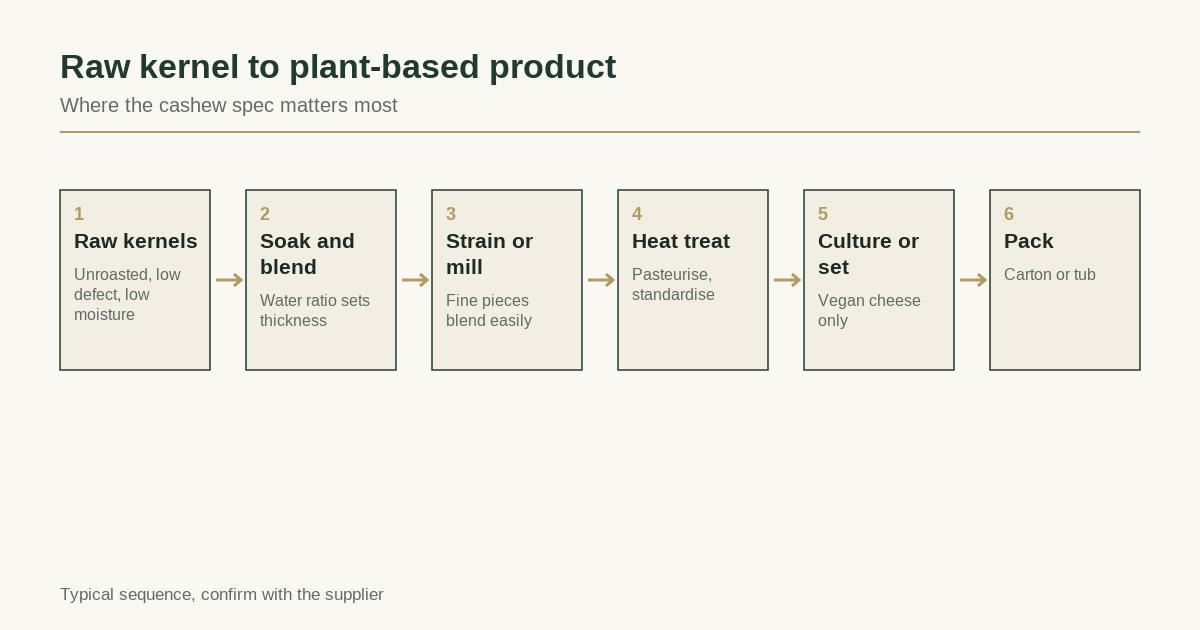
This makes the buying decision different from a snack. A brand does not need a pretty nut. It needs a clean, fresh, consistent raw ingredient with a good safety record. This guide covers what to buy and what to check.
What the kernel does in these products
In milk, the kernel supplies fat, a little protein and body. Blending with water makes an emulsion, and straining removes coarse solids. The nut percentage in commercial milks is often small, so the kernel is a significant cost in a product that is mostly water, and its flavour sets the taste of the drink.
In cheese, the blended kernel forms a creamy base that can be cultured, set or aged. The kernel supplies fat and structure, and any off flavour carries straight through. A stale kernel makes a stale cheese.
In both, shape disappears. A whole kernel and a piece give the same result when blended, so the premium for whole kernels buys nothing.
The grades that suit these products
Baby bits (BB) and small white pieces (SWP). The lowest-cost usable forms, pale in colour and easy to blend. A good fit for milk and for cheese where a fine texture is wanted. Our guide to cashew pieces describes the grades.
Large white pieces (LWP). A little larger, still low in cost and clean in colour. Useful for cheese bases where a slightly coarser blend is fine.
Small whole grades such as W450. Used by some makers for convenience or for a product line that also uses the kernel whole. They cost more than pieces and give no benefit in a blended product. Our guide to W450 and W500 covers the grade.
Scorched grades. Avoid them for pale products. The amber tint and the heat history can add colour and a slightly toasted note to a white milk or cheese.
Raw kernels and food safety
Most plant-based makers use raw, unroasted kernels so the milk and cheese stay mild and white. Raw does not mean untreated. The nut shell is steamed or roasted before shelling to release the kernel, and kernels are dried, but that is not a validated step for killing harmful bacteria in the finished kernel. Raw nuts in general have been linked with salmonella outbreaks in several markets, which is why some customers and regulators expect a documented treatment step.
If you use the kernel without a kill step of your own, ask the processor what treatment it applies, what log reduction it has validated and how it verifies it. If you apply a heat step in your own plant, such as pasteurising the milk, confirm that your process covers the risk. Our guide to BRCGS, IFS and FSSC certification explains what a certificate covers, and our guide to aflatoxin and food safety covers the limits for contamination. We do not certify any plant, and you should check each claim and its scope with the processor.
Flavour and freshness
Because the product is mild, any off note shows. A stale, paint-like or cardboard smell in the kernel will carry into the milk. Open a sample, smell it and taste a few kernels. Set limits for free fatty acid and peroxide value in the spec, and ask for the figures on the lot certificate.
Freshness depends on moisture, packing and storage. Our guide to moisture, storage and shelf life explains how to hold stock. For a raw product, keep the kernel sealed and cool until the day you use it.
Specification points
| Point | Why it matters for milk and cheese |
|---|---|
| Raw, unroasted | Keeps flavour and colour neutral |
| Low defects | Spots and skin show as specks in a white product |
| Low moisture | Slows staling, helps shelf life |
| Free fatty acid and peroxide limits | Control stale and rancid notes |
| Foreign matter limits | Stones and shell damage mills and ruin batches |
| Treatment record | Supports your food safety case |
Consistency matters for cultures
Vegan cheese makers rely on cultures that turn the blended kernel into a flavoured, set product. A change in the kernel, such as higher moisture, a different fat level or a rancid note, can change how the culture behaves. Keep the kernel consistent from lot to lot, and test each new lot in a small batch before it goes into full production. Our sample approval guide describes a routine that suits a production line.
Need a price for this grade? Request a quote
Allergen and labelling points
Cashew is a tree nut allergen and must be declared. If your plant also handles dairy, soy or other nuts, your labelling and cleaning rules must match the real risk. Ask the processor which allergens are handled in its plant, since that feeds into your own risk assessment. Check the labelling rules in your market, because they differ between countries and between product types.
Pack and logistics
Ingredient buyers often use the 25 lb vacuum tin or a flexi bag, since volumes are large and the kernel is used up within weeks. Check that your handling equipment can empty a tin cleanly and that the carton size fits your racking. If you use a lot of kernel, a full container may be a few months of supply, so plan storage conditions and rotation. Our guide to MOQ and container maths shows how container size translates into volume.
Common mistakes
Paying for whole kernels. Whole kernels give no benefit when blended. Pieces cost much less.
Skipping the smell test. A kernel can look perfect and smell stale. Smell every sample and every lot.
Assuming raw means safe. Check the treatment step and your own process.
Ignoring lot-to-lot drift. A small change in fat or moisture can change your product. Test each lot.
Questions to put to a processor
- Which piece grades do you hold in raw, unroasted form?
- What heat or kill step does the raw kernel go through, and how is it verified?
- What free fatty acid and peroxide figures do you see by lot?
- Which allergens are handled in your plant?
- Can you hold a standing supply and keep lots consistent?
A small trial before you scale
Before you move a recipe to a new supplier or grade, run a bench trial. Weigh the kernel, soak it for the time your process uses, blend with your usual water ratio and strain. Taste the milk plain and in coffee, since coffee shows any bitterness or stale note quickly. Leave a sample in the fridge for a few days and look at separation and smell. For cheese, run a small culture batch and compare firmness, tang and colour with your reference batch.
Record the yield of milk per kilo of kernel and the amount of pulp left after straining. A kernel with higher moisture or a different fat level changes both numbers, and the difference feeds straight into your cost per litre. If two grades taste the same but one gives a better yield, the extra yield can outweigh a higher price.
Soaking, water and sediment
Soaking softens the kernel and eases blending, though plants differ on soak times and some skip it with powerful blenders. The soak water carries off dust and fine skin, which is a reason to check the skin and dust levels in the spec. Pieces with a lot of loose skin or fines can leave grey specks and sediment in a white milk. Ask the processor for a low-skin, low-fines option and check a counter sample under a bright light. If you use a fine filter, a small amount of fines is manageable, but a coarse filter lets them through into the finished product.
Next step
If you make plant-based milk or cheese, describe the process in the requirement: raw kernel, the grade you want, your safety needs and the volume. We price it with a Vietnamese processor that runs it, and you get one detailed quote. Send a requirement and we reply within 24 business hours.
Frequently asked questions
Which cashew grade is best for plant-based milk?
Pieces such as baby bits or small white pieces are the usual choice, because the kernel is blended and strained and shape is irrelevant. The priorities are clean flavour, low defects and a raw, unroasted kernel with a documented safety step.
Do cashews for vegan cheese need to be raw?
Most makers use raw, unroasted kernels because roasting adds colour and flavour that clash with a mild, white cheese. Raw kernels need clear food safety controls, so ask the processor what heat or treatment step the kernel has gone through.
Why is rancidity such a problem in cashew milk?
The milk is made from finely blended kernel with a lot of exposed oil, and any stale or rancid note in the kernel carries into the drink and the cheese. Check the smell of every lot and set limits for free fatty acid and peroxide value.
VietCashew supplies Vietnamese cashew kernels on one quote. We publish no prices, because a cashew quote is only valid for days. How an order runs and what we publish.
Need a price for this grade?
Send the requirement. We reply within 24 business hours with one detailed quote for the packed kernels.
Request a quote