Guides / Grades
W450 and W500 Cashew Kernels: The Smallest Wholes and Where They Pay Off
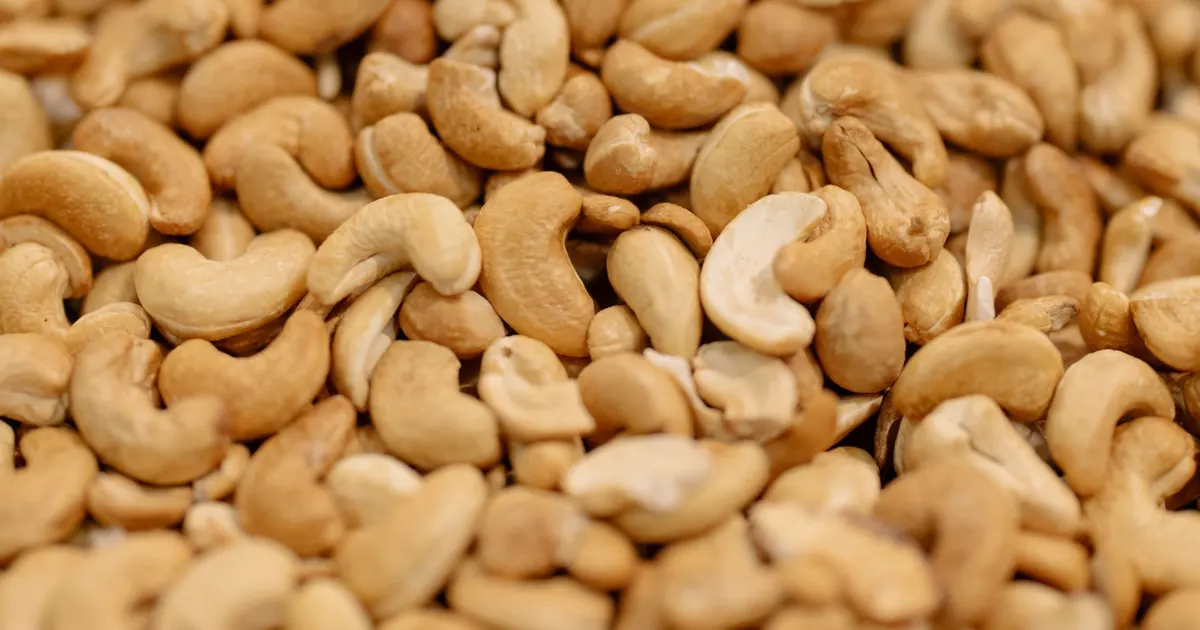
There is a point on the cashew size ladder where whole kernels stop looking like a feature and start looking like an ingredient. W450 sits at that point. It is the smallest count still sold as a whole kernel in the common grade ladder, and for the right product it is the best value in the range.
This guide covers what W450 and the smaller W500 mean, who buys them, what to watch for and how to confirm a lot before you order.
What the numbers mean
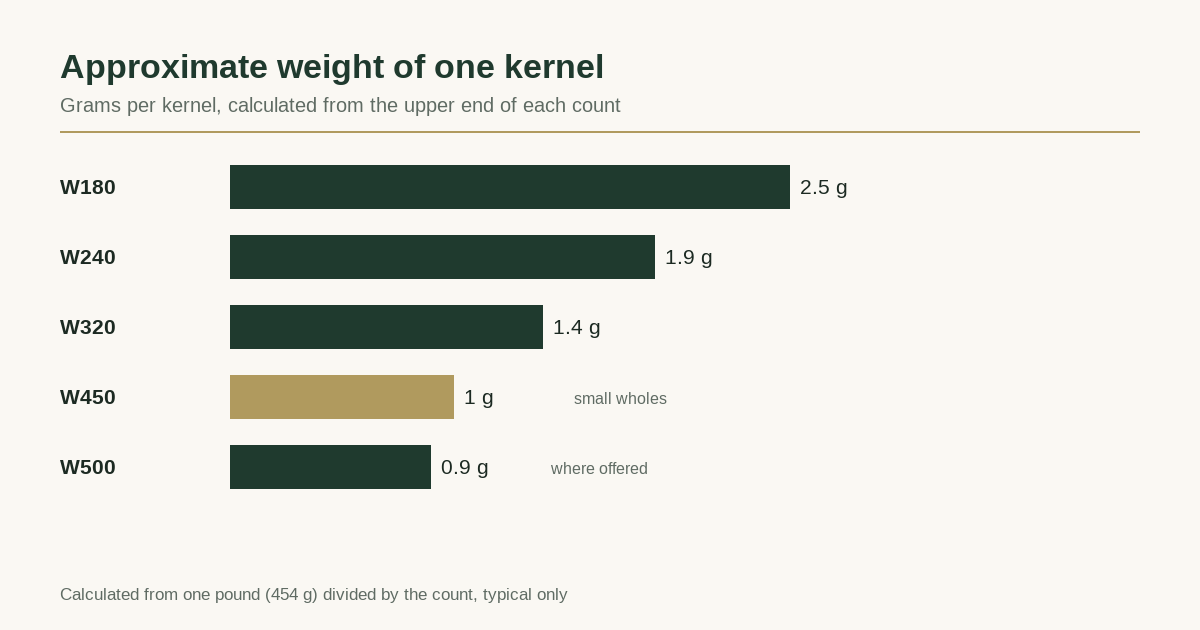
A W grade is a count per pound. W450 means about 400 to 450 whole white kernels fill one pound, under the AFI and CEPC definitions used across the cashew trade. Because the count is so high, each kernel is small. Using the upper end of each range and dividing one pound, about 454 grams, by the count gives the approximate weight of one kernel: roughly 2.5 grams for W180, 1.9 for W240, 1.4 for W320 and 1.0 for W450.
W500 is the next step down on some price lists, usually read as about 450 to 500 kernels per pound, around 0.9 grams per kernel. It is less widely used than the named grades above it, and not every processor holds it. Treat it as a size band to be defined in the contract, not as a universal standard. Our guide to Vietnam cashew grades shows the main ladder, and the W450 reference page covers the grade on its own.
Why small wholes cost less per kilo
The raw nut crop yields kernels in a spread of sizes. The largest kernels are a smaller fraction and carry the highest price. Small kernels are plentiful, so they cost less per kilo. A processor does not choose to make W450. It is what a large part of the crop yields once the bigger counts are sorted out.
That means W450 is usually the easiest whole grade to source in volume. Most plants hold it, quote it quickly and can fill a container without a long wait. It also means the price spread between W450 and W320 tends to be steadier than the spread at the large end. Our guide to price factors for cashew kernels shows how count, colour and season combine.
Who buys W450
The buyer for W450 is one whose product does not depend on kernel size.
Trail mix and snack mixes. In a blend with raisins, seeds and other nuts, a small cashew is just one of many pieces. Our guide to cashews for trail mix covers how to choose among grades for a mix.
Cereal, granola and bars. The kernel is a mix-in among oats, grains and binder.
Coated and flavoured nuts. A coating hides the kernel, and a small kernel takes a more even coat than a large one with a deep curve.
Value packs and bulk. Where the shelf price is the selling point, a smaller whole kernel supports a lower price without moving to pieces.
Food service. A kitchen cooks the kernel into a dish. Size matters less than cost per portion.
Ingredient use. Where kernels are chopped, ground or blended, small wholes act as a clean, cheaper starting point.
Where W450 falls short
A clear pouch of premium roasted cashews gains nothing from W450. The shopper sees small kernels and may read them as less generous. Gift packs and visible toppings also lose out. If your customer judges the product by the look of the kernel, step up to W320 or W240. Our comparison of W320 and W240 shows how to decide.
W450 also has more kernel surface area per kilo than a large grade. Small kernels pick up salt and coating faster, and they can take up oil and moisture faster in humid storage. In practice that is a small effect, but it justifies a close look at packing and moisture on the lot.
How W450 compares
| Grade | Typical count per lb | Approx. grams per kernel | Typical buyer |
|---|---|---|---|
| W240 | 220 to 240 | 1.9 | Premium retail |
| W320 | 300 to 320 | 1.4 | Mainstream retail, food makers |
| W450 | 400 to 450 | 1.0 | Mixes, coated nuts, value packs |
| W500 | About 450 to 500 | 0.9 | Where offered, ingredient and value use |
The weights are calculated from the count and are only a guide.
Count consistency matters more at the small end
A lot sold as W450 should hold kernels within the band, but small kernels are harder to size-grade tightly. Screens separate kernels by their narrowest dimension, and small differences in shape make a bigger relative difference. Some W450 lots contain a share of kernels that would count into W500 or into pieces.
Ask how the plant screens the grade and what share of kernels falls outside the count range. A sample counted on a pound is the quickest check. If your product uses a fixed kernel count per pack, or if your equipment is sensitive to size, set a tighter range in the contract.
Also check the share of broken kernels. A small whole kernel is easy to break, so a W450 lot can carry more splits and pieces than a W320 lot. The spec should state the limit.
Need a price for this grade? Request a quote
What to write in the contract
- Grade by code and count range, with W500 defined if you use it.
- Colour class: W for white, SW for scorched, and so on.
- Maximum share of splits and pieces in the lot.
- Defect limits: spotted, skin, insect-damaged, shell.
- Moisture limit and packing format.
- Counter sample from the production run.
Our guide to what to check on a cashew spec sheet lists the rest, and the spec sheet tool builds the document.
Pairing W450 with the scorched classes
Many buyers of small wholes also use the scorched classes to cut cost further. SW450, the scorched version of W450, is the same size with a light amber tint, and it suits roasted and seasoned products. Quote W450 and SW450 on the same enquiry to see the gap. Our guide to scorched cashew grades explains the trade-offs.
Questions to put to a processor
- What count range do you run for W450, and how do you check it?
- Do you offer W500, and what count range do you define for it?
- What share of splits and pieces do you allow in a W450 lot?
- How consistent is the grade between lots?
- Can I have a counter sample from the run that will fill my order?
A cost check you can run in an afternoon
Take your current finished product and replace the cashew grade with W450 in a small batch. Weigh the cashew content by weight, since small kernels fill the same weight with more pieces. Check whether the label claim still holds: if your recipe is by weight, nothing changes, but if the pack promises a kernel count or a minimum number of whole cashews, the claim shifts. Then ask three colleagues who have not seen the recipe to taste and look at both versions. Record whether they spot a difference and which they prefer.
If nobody can tell and the label is unaffected, calculate the saving per kilo of finished product, not per kilo of kernel. A kernel price gap looks large in isolation, but the cashew may be only a fraction of the recipe by weight. The saving per pack is the number that decides whether a change is worth the effort of qualifying a new grade.
Handling small kernels on your own line
Small kernels flow differently. They pack more densely, fall through screens and gaps that hold a large kernel, and can bridge or clog hoppers designed for bigger pieces. A coating drum or seasoning tumbler may need a lower fill level or a different speed to coat evenly. Check whether your metal detector or optical sorter needs a different setting for the new size. A short trial run before the first full container saves downtime later, and the processor can often supply a few kilograms for the test.
For how W450 sits against the other counts, colours and forms, see our guide to which cashew grade to buy.
Next step
If small whole kernels fit your product, say which grade and colour class and what volume you need. We price it with a Vietnamese processor that runs it, and you get one detailed quote. Send a requirement and we reply within 24 business hours.
See also: the W500 reference page sets out how TCVN 4850 and the UNECE text define the smallest white whole grade.
Frequently asked questions
How many kernels are in a pound of W450 cashews?
W450 covers roughly 400 to 450 whole white kernels per pound under the AFI and CEPC count definitions. It is the smallest count still classed as a whole kernel in the common grade ladder.
Is W500 a standard cashew grade?
W500 appears on some price lists for kernels in the band below W450, typically read as about 450 to 500 per pound, but it is less widely used and not every processor offers it. Confirm the count range in writing and ask for a counter sample before you treat it as a grade.
Are small cashew kernels lower quality?
No. A small whole kernel is held to the same colour, moisture and defect limits as a large one. It is a size class. What changes is how the kernel looks and how many fit in a pack, which matters in a clear pouch but not in a mix or a coating.
VietCashew supplies Vietnamese cashew kernels on one quote. We publish no prices, because a cashew quote is only valid for days. How an order runs and what we publish.
Need a price for this grade?
Send the requirement. We reply within 24 business hours with one detailed quote for the packed kernels.
Request a quote