Guides / Sourcing
Which Cashew Grade Belongs in a Trail Mix or Snack Mix, and Why
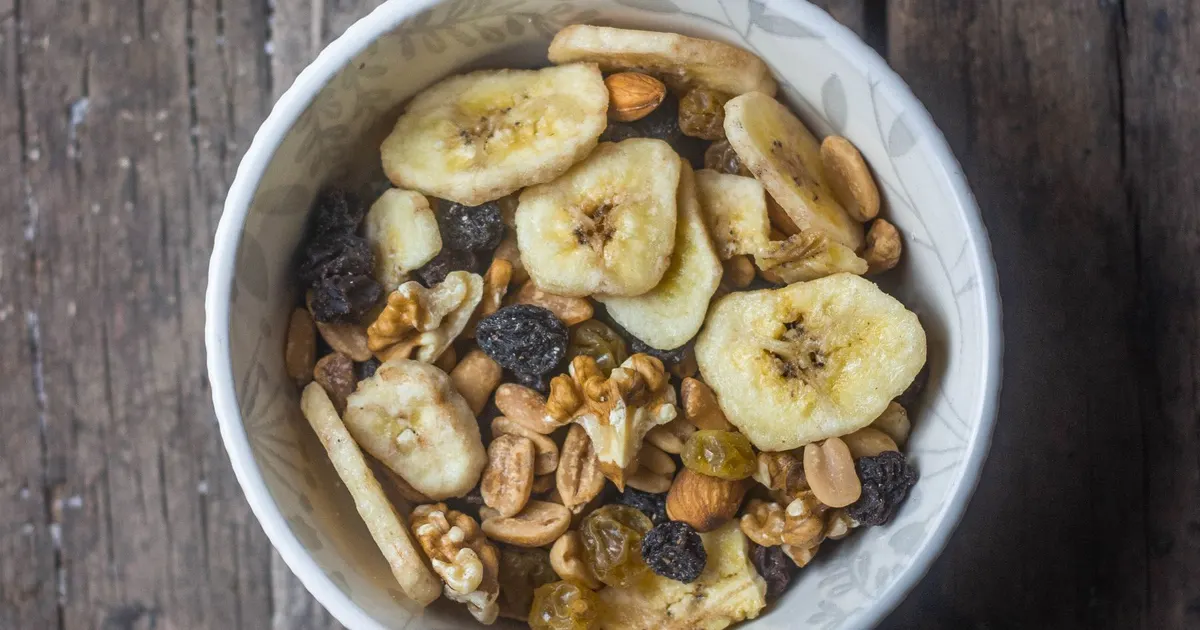
In a bag of trail mix, the cashew is one of five or six components. The shopper sees colour, variety and a promise of energy, and rarely checks which nut is which size. That makes trail mix and snack mix one of the best places in the cashew trade to save money, as long as the saving does not undermine the look, the crunch or the shelf life.
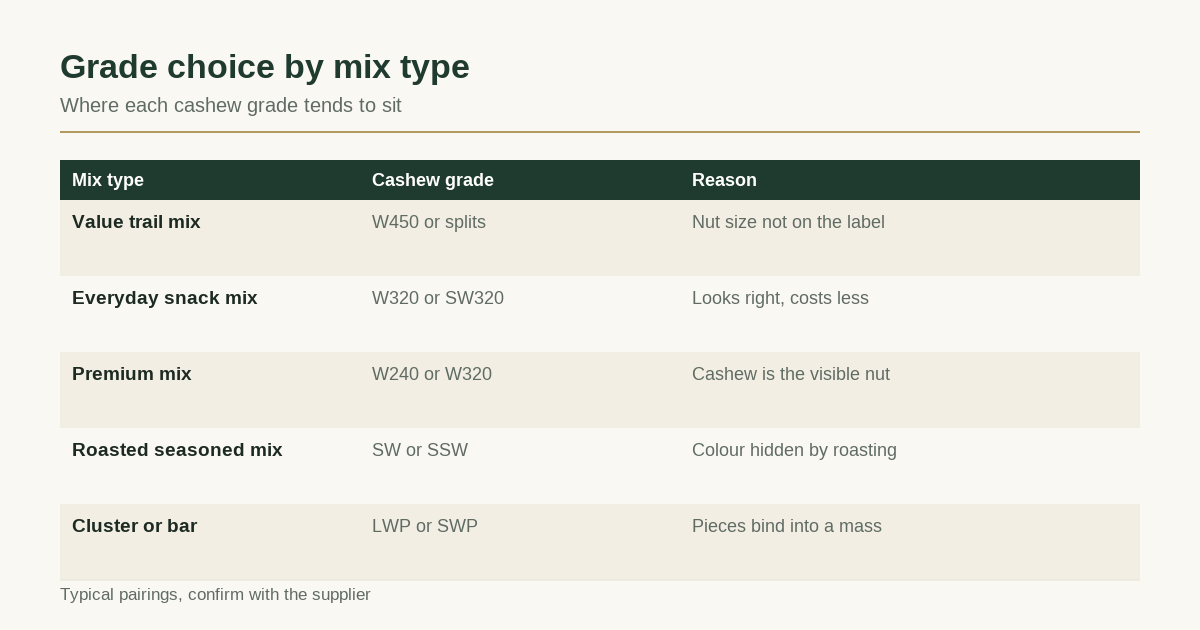
This guide shows how to choose a cashew grade for a mix, what to check in the blend and where mixes go wrong.
Start with the picture on the pack
Open a competitor’s mix and lay it on a tray. Look at the ratio of sizes. Almonds are long, raisins are small, peanuts are round and cashews are curved. A cashew in the middle of that range reads as normal. A very large cashew dominates and a very small one disappears. The right grade is the one that sits comfortably in the range of your other ingredients.
Then look at how the nuts will be handled. A mix that is tumbled with seasoning, packed in a stand-up pouch and shaken on the way home needs kernels that survive some abuse. Smaller kernels and splits resist breakage better in a mix than large wholes, which have more length to snap.
The grades that suit mixes
W450. The smallest whole kernel in the common ladder, at about 400 to 450 per pound. In a mix it reads as a whole cashew, costs less than W320 and blends with raisins and seeds. Our guide to W450 and W500 explains the grade.
W320. The workhorse. It is the grade most buyers default to and the one most processors hold in volume. For a mix that features the cashew, or where the other nuts are large, W320 holds its place. See the W320 reference page.
Splits. A split is a kernel separated cleanly into two halves along the natural seam. It still looks like a cashew and costs less than a whole. Splits are popular in mixes because they fill the bag and cost less per kilo.
Scorched grades. SW and SSW kernels have an amber tint. In a roasted or seasoned mix the colour disappears, and the saving is a good one. Our guide to scorched cashew grades explains the classes.
Pieces. Large white pieces and butts suit mixes where the cashew acts as a crunchy inclusion, such as clusters, bars and bakery mixes. Our guide to cashew pieces covers the piece grades.
Choose by mix type
| Mix type | Cashew grade | Why |
|---|---|---|
| Value trail mix | W450 or splits | Nut size is not a selling point |
| Everyday snack mix | W320 or SW320 | Looks right, costs less than larger grades |
| Premium mix | W240 or W320 | The cashew is a visible feature |
| Roasted seasoned mix | SW or SSW | Colour is hidden by the roast and seasoning |
| Cluster or bar mix | LWP or SWP | Pieces bind into a mass |
Moisture migration
The biggest technical risk in a mix is moisture moving between ingredients. Dried fruit such as raisins, banana chips and cranberries holds a good deal more water than a cashew. Over weeks, water moves from the fruit to the nuts. The nuts soften, lose crunch and can pick up a stale taste, while the fruit hardens.
You control this in four ways.
Start with dry kernels. Check the moisture limit in the cashew spec and ask for readings from the lot. Our guide to moisture, storage and shelf life explains the limits.
Choose drier fruit or coat it. Fruit coated with a thin layer of oil or a barrier loses and gains moisture more slowly.
Use a barrier pack. A foil-lined pouch slows moisture exchange with the room, though not between the ingredients inside it.
Keep the shelf life realistic. A mix with high fruit content may only keep its crunch for months, not a year. Test it before you print a date on the pack.
Salt, oil and seasoning
If you season the mix, check that the cashew is compatible. A kernel roasted and salted in the plant can be mixed with unsalted ingredients, but the salt migrates to adjacent pieces and changes the taste. A dry-roasted kernel takes seasoning differently from an oil-roasted one. Run a small batch and taste it after a week.
Allergens and labelling
A mix that contains cashew must declare it, and most mixes contain several tree nuts and sometimes peanut. Cross-contact risk comes from shared equipment. Ask the processor which allergens are handled in the plant, how lines are cleaned and what the cleaning verification is. Your own labelling must match the real risk. Check the rules in your market, since declaration rules differ.
Need a price for this grade? Request a quote
What to put in the spec
- Grade by code and count range, colour class and the share of splits and pieces allowed.
- Moisture maximum and the test method.
- Defect limits: spotted, skin, shell, insect-damaged.
- Pack format: 25 lb vacuum tin, flexi bag or other.
- A counter sample for a blend trial before the first container.
Our guide to what to check on a cashew spec sheet covers the full list, and the spec sheet tool builds the document.
A common mistake
Many mixes are designed with a premium kernel in the trial batch and a cheaper one in production. The trial wins approval and the production batch looks different. Use the cheaper grade in the trial from the start, and keep a counter sample of it as the reference. If you cannot decide between two grades, run both in the same mix and compare cost per pack.
Questions to put to a processor
- Which of W450, W320, splits and SW do you run in volume?
- What share of pieces do you allow in a W320 or W450 lot?
- What moisture do you pack at, and can you hold it lot to lot?
- Which allergens are handled in your plant?
- Can you send counter samples of two grades for a blend trial?
A worked blend trial
Suppose you plan a mix of cashews, almonds, raisins and pumpkin seeds. Start by weighing out three batches of one kilogram each, identical except for the cashew: one with W320, one with W450 and one with splits. Mix each batch by hand to the same ratio, pack small samples in the real pouch and photograph each one laid flat. Show the photographs to a few people who buy mixes and ask which looks the most generous, without telling them the grades.
Then taste a sample from each batch at the start and again after two weeks in a warm cupboard. Note the crunch of the cashew, the taste and whether the pouch contents look different. The answer often surprises: many people cannot separate W450 from W320 in a mix, and splits can look fuller because the pieces fill gaps. If so, the cheapest of the three that holds its crunch is your answer, and the saving per pack can be worked out from the cashew share by weight.
Packaging the mix
Mixes sit on the shelf for months, so the pack matters as much as the ingredients. A foil-lined stand-up pouch with a zip gives a good barrier against light and air. A clear pouch shows the mix but lets in light, which speeds the staling of nut oil. If you choose clear film, keep the shelf life shorter and tell customers to store the pack away from sunlight. Add a best-before date based on your own test results, not on the longest figure a supplier quotes for the kernel alone.
Cost per pack, not per kilo
Compare grades by what they do to the cost of the finished pack. If the cashew is fifteen percent of the mix by weight, a gap in kernel price between two grades shrinks to a small number per pack once it is multiplied by that share. Do the sum for each grade you are considering and put the results side by side with the other ingredients. Often the larger saving sits elsewhere in the recipe, and the cashew choice is better made for look, crunch and supply than for a few cents.
Also think about supply. A grade that every processor holds, such as W320, can be reordered at short notice from several sources. A narrower grade may tie you to one plant. If your mix sells in volume, the ability to switch supplier without changing the product is worth more than a small price edge.
Next step
If you make a mix, describe it in the requirement: the ingredients, the cashew share and the shelf life you need. We price it with a Vietnamese processor that runs your grade, and you get one detailed quote. Send a requirement and we reply within 24 business hours.
Frequently asked questions
What cashew grade is best for trail mix?
Most trail mix makers use W450, W320 or splits, because the cashew is one ingredient among many and nobody judges the mix by the size of one nut. Choose the smallest grade that still looks right beside your other nuts and fruit.
Can I use scorched cashews in a snack mix?
Yes, if the mix is roasted or seasoned. Roasting and coating hide the light amber tint of scorched kernels, and the saving is real. Avoid scorched kernels in a raw or lightly salted mix where a pale nut is part of the look.
Why do cashews go soft in a trail mix?
Dried fruit holds more moisture than nuts, and moisture moves from the fruit to the nuts over time, which softens them. Control it by using dry kernels, choosing drier fruit, using a barrier pack and keeping the shelf life realistic.
VietCashew supplies Vietnamese cashew kernels on one quote. We publish no prices, because a cashew quote is only valid for days. How an order runs and what we publish.
Need a price for this grade?
Send the requirement. We reply within 24 business hours with one detailed quote for the packed kernels.
Request a quote