Guides / Grades
Which Cashew Kernel Standard to Cite in a Contract: AFI, UNECE or TCVN
A cashew contract should name one standard and its edition, because the cashew kernel standards in use do not give the same numbers. This post is part of our guide to which cashew grade to buy, and it sets the AFI specification, the UNECE standard and Vietnam’s TCVN 4850 side by side so you can pick one and write it into the order with the tolerances you expect.
We publish no standard of our own and name no processor. Read the two tables below first, because three of the six documents were not read in full.
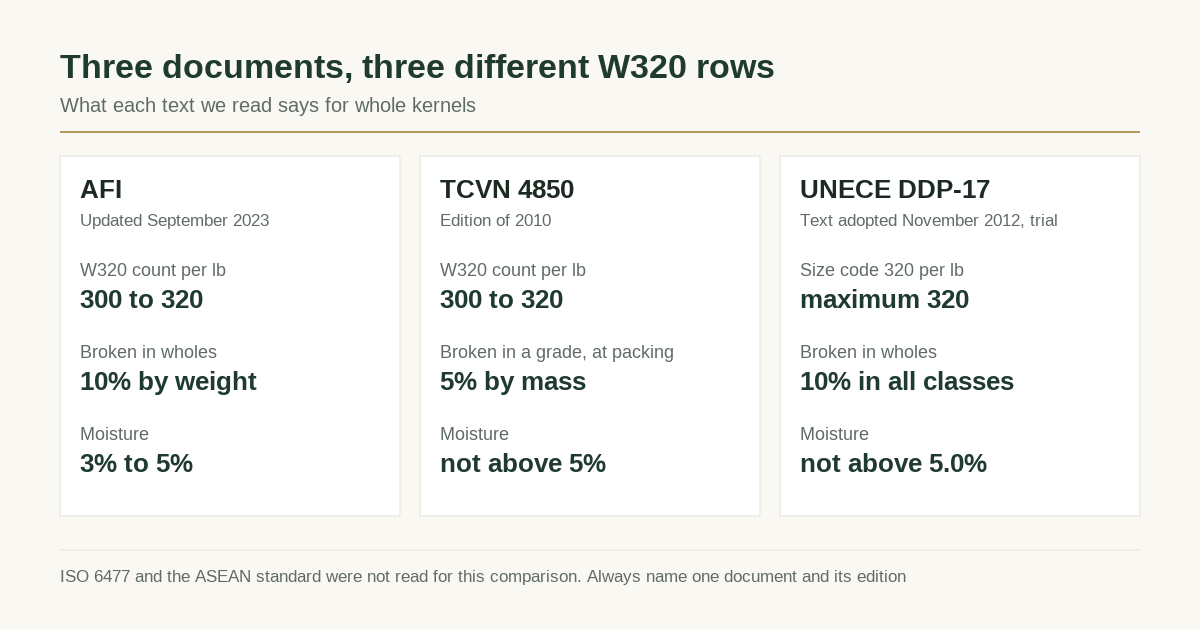
| Criterion | AFI (2023) | TCVN 4850:2010 | UNECE copy (2012 text) |
|---|---|---|---|
| Count basis | Whole kernels per pound | Whole kernels per pound | Maximum count per pound |
| Broken in wholes | 10% | 5% | 10% |
| Moisture | 3% to 5% | Not above 5% | Not above 5.0% |
Naming the wrong document costs you a dispute at the arrival count: the same lot passes at 10% broken and fails at 5%.
The cashew kernel standards we read and could not
| Document | Issuer | Edition we read | Status of our reading |
|---|---|---|---|
| Specifications for Cashew Kernels | AFI Nut and Agricultural Products Section | Updated September 2023 | Read in full, 9 pages |
| TCVN 4850:2010 Cashew kernels | Vietnamese national standard | 2010, bilingual file published by VINACAS | Read in full. We did not check the national register for a later edition |
| UNECE Standard DDP-17 | UNECE | Text adopted 8 November 2012 for a one-year trial | A copy hosted by the African Cashew Alliance. UNECE’s site refused our requests, so the current edition is unread and this column is directional |
| ISO 6477 | ISO | TCVN’s bibliography lists the 1988 edition | Not read. We did not open ISO’s catalogue, so check the current edition. See our ISO 6477 reference page |
| ASEAN Stan 20:2011 | ASEAN ministers for agriculture and forestry | 2011 | Catalogue entry only. The full text did not open |
| CEPC grade definitions | Cashew Export Promotion Council of India | Not opened | TCVN 4850:2010 lists a CEPC document of 1975 in its bibliography |
Counts per pound side by side
| Grade | AFI (2023) | TCVN 4850:2010 | UNECE copy (2012 text) |
|---|---|---|---|
| W150 or W160 | Not in the count table | W160: 120 to 160 | Size code 150: maximum 150 |
| W180 | 140 to 180 | 161 to 180 | Maximum 180 |
| W210 | 180 to 210 | 200 to 210 | Maximum 210 |
| W240 | 220 to 240 | 220 to 240 | Maximum 240 |
| W280 | Not in the count table | 260 to 280 | Not listed |
| W320 | 300 to 320 | 300 to 320 | Maximum 320 |
| W400 | Not in the count table | 350 to 400 | Not listed |
| W450 | 400 to 450 | 400 to 450 | Maximum 450 |
| W500 | Not in the count table | 450 to 500 | Maximum 500 |
Counts are kernels per pound of whole kernels. Sources: the AFI count table, TCVN 4850:2010 Table 2, UNECE DDP-17 section III as reproduced by the African Cashew Alliance.
Three points follow from the table. First, the documents agree at W240, W320 and W450 and disagree at the large end: W180 starts at 140 in the AFI table and at 161 in TCVN. Our grades page and the explained guide list W180 as 170 to 180, a range we did not find in any of the three tables, so use the range of the document you name. Second, the UNECE copy gives a maximum count, not a band. Third, the bands leave gaps: the AFI table lists nothing for 241 to 299 per pound or for 321 to 399, so a lot averaging 340 per pound belongs to no listed grade in that document. That is why the tolerance for kernels of a lower size matters as much as the band.
Per kilogram, the AFI table gives 660 to 706 for W320, TCVN gives 660 to 705 and the UNECE copy gives a maximum of 706. Convert at 453.6 g to the pound and do not mix the two units inside one contract.
Colour classes
The three texts do not use the same classes. The AFI document has five: first quality fancy, second quality scorched, third quality special scorched, lightly blemished wholes and pieces and dessert blemished wholes. TCVN 4850:2010 uses codes such as W, SW, SSW, LBW, BW and DBW. The UNECE copy has three classes: Extra, described as “white”, Class I, “scorched” or “lightly blemished” and Class II, “scorched seconds” or “dessert”. A buyer who writes “scorched” without a document may get a different class from one standard to the next. Our guide to the kernel colour standard shows the words each text uses and how colour is judged.
Tolerances for broken, lower size and moisture
| Line | AFI (2023) | TCVN 4850:2010 | UNECE copy (2012 text) |
|---|---|---|---|
| Lower size grade in a sized whole lot | Up to 10% by weight | Next lower grade up to 5% by mass | Wholes of other sizes up to 10%, by number |
| Broken kernels or pieces in wholes | Up to 10% by weight | Up to 5% by mass at packing | Up to 10% |
| Pieces in butts and splits | Up to 10% by weight | No such line found | Up to 10% |
| Moisture | 3% to 5% by loss on drying at 105 degrees Celsius | Not above 5% by mass, toluene distillation method | Not above 5.0% |
| Micro and chemical lines | E. coli, Salmonella, Listeria, Staphylococcus, peroxide value and free fatty acid | None found in the text | None found in the copy |
Sources: AFI specification; TCVN 4850:2010 sections 5.1 and 7; UNECE DDP-17 section IV as reproduced.
The tolerances differ by a factor of two on broken kernels. A lot that meets the AFI limit can fail the TCVN one, so the same W320 lot is “in spec” under one document and out under the other. The AFI document also carries the micro and chemical lines. The other two texts did not, so a contract that names only TCVN needs those lines written in. Legal limits of the destination market apply on top, as in our guide to cashew food safety for importers.
Need a price for this grade? Request a quote
Sieve sizes for pieces
The three texts do publish sieve openings for pieces and they differ. Our pieces guide says each facility sets its own screen. The documents do give a basis you can name.
| Class | AFI (2023) | TCVN 4850:2010 | UNECE copy (2012 text) |
|---|---|---|---|
| Large pieces | Pass 8.00 mm, retained on 6.30 mm | Not passing 4.75 mm, passing 8.0 mm | Not passing 4.75 mm |
| Small pieces | Pass 6.30 mm, retained on 2.80 mm | Not passing 2.8 mm, passing 4.75 mm | Not passing 2.80 mm |
| Baby bits | Pass 2.36 mm, retained on 1.70 mm | Not passing 1.7 mm | Not passing 1.70 mm |
The AFI table allows no more than 5% by weight of the pieces to pass through the sieve on which they must be retained, and a footnote limits large pieces retained on the 8.00 mm sieve to 50% by weight unless the buyer has approved an exception. We read the AFI table layout from extracted PDF text, so check the printed table before you copy it.
Sampling and test methods
The AFI document specifies a sampling plan by lot size for 50 lb cartons: 3 cartons sampled for lots of fewer than 51 cartons, 6 for 51 to 350, 13 for 351 to 800 and 21 for 801 to 2,100. It asks for 275 to 500 g from each carton and a total of at least 3,500 g, then counts the whole kernels in a one-pound (454 g) composite sample. TCVN 4850:2010 asks for 3 to 13 cartons by lot size under routine inspection, a composite of at least 3 kg and a count in 1 kg or 1 lb of test sample. The UNECE copy refers moisture methods to its standard layout annex, which we did not read. Our guide to counting a cashew kernel sample works through the procedure.
Which one to name
| Situation | Reasonable choice | Check first |
|---|---|---|
| US buyer or a lot sold in the US | The AFI specification, with its date | It is free and carries sampling, roast test and micro lines |
| The processor’s sheet cites TCVN 4850 | Ask which edition it uses and keep it, or state the AFI numbers instead | TCVN’s 5% broken limit is tighter than the AFI 10% |
| A tender or customer names UNECE | The current UNECE text, with its code and year | Read the current edition, which we could not |
| A tender requires ISO 6477 | Name the edition the tender states | We did not read ISO 6477 or its catalogue, so confirm the current edition |
Name one document as primary and say which governs when a processor sheet differs. Do not name two documents as equals.
Wording for a contract
Cashew kernels, W320, first quality fancy, to the Specifications for Cashew Kernels of the AFI Nut and Agricultural Products Section, updated September 2023. Count per pound as in the count table of that document. Where this order states a different tolerance, this order governs.
For TCVN, replace the first sentence with “to TCVN 4850:2010” and add the micro and chemical lines your market needs. The order can also carry its own table of tolerances, which removes the dispute about which text applies.
Common misreadings
- “W320 means exactly 320 per pound.” Two documents give a band of 300 to 320 and the third gives a maximum.
- “The standards agree.” They agree at the middle of the range and differ on broken limits, large counts and sieve sizes.
- “The English column of the bilingual TCVN file is the standard.” It is a translation, and the two columns differ in places, for example the share of affected kernels against the share of affected surface for lightly blemished wholes. Have someone who reads Vietnamese check the Vietnamese column.
- “A newer standard is a better one.” Edition and use in the trade matter more than age. Check which document your processor’s sheet follows.
What to write in your spec
- The standard, its issuer and its edition or date.
- The grade by code and by count band as printed in that document.
- The colour class by the document’s own name.
- Lower size, broken and lower colour tolerances in percent, with the basis (weight or number).
- Pass and retain sieve apertures for any pieces.
- The sampling plan, the laboratory or inspector and the sealed retained samples.
- Which document governs when the processor sheet differs.
Send the lines with your requirement through our requirement form and we reply within 24 business hours with one detailed quote from a Vietnamese processor that runs your grade. For the full decision, return to our guide to which cashew grade to buy.
Sources
- Association of Food Industries, Specifications for Cashew Kernels (updated September 2023)
- TCVN 4850:2010 Nhan hat dieu (Cashew kernels), bilingual text published by VINACAS
- Standard for Cashew Kernels, UNECE Standard DDP-17 text adopted 8 November 2012 for a trial period, copy hosted by the African Cashew Alliance
- ASEAN Standards and Technical Regulations registry, ASEAN Stan 20:2011 Cashew Kernels (catalogue entry)
Frequently asked questions
Which standard defines W320?
No single one. The AFI specification and TCVN 4850:2010 both give 300 to 320 kernels per pound for W320, and the UNECE text we read gives a maximum of 320. Name the document and its edition in the contract so both sides count against the same band.
What is UNECE DDP-17?
It is the UNECE standard for cashew kernels. The copy we read states that it was adopted on 8 November 2012 for a one-year trial. UNECE's own site refused our requests, so we could not read its current edition and the table below is directional.
Does the AFI count table include W500?
Not in the table we read. It lists 180, 210, 240, 320 and 450 per pound. TCVN 4850:2010 lists W500 at 450 to 500 per pound and the UNECE copy lists a size code of 500, so a W500 contract needs a named document that carries it.
How many broken kernels can a whole grade contain?
The AFI specification allows broken kernels or pieces in wholes of up to 10 percent by weight. TCVN 4850:2010 says broken kernels shall not exceed 5 percent by mass at the time of packing. The UNECE copy shows 10 percent. State the limit in the order.
VietCashew supplies Vietnamese cashew kernels on one quote. We publish no prices, because a cashew quote is only valid for days. How an order runs and what we publish.
Need a price for this grade?
Send the requirement. We reply within 24 business hours with one detailed quote for the packed kernels.
Request a quote