Guides / Grades
How Cashew Kernel Colour Is Judged: Reference Words, Light and the Roast Test
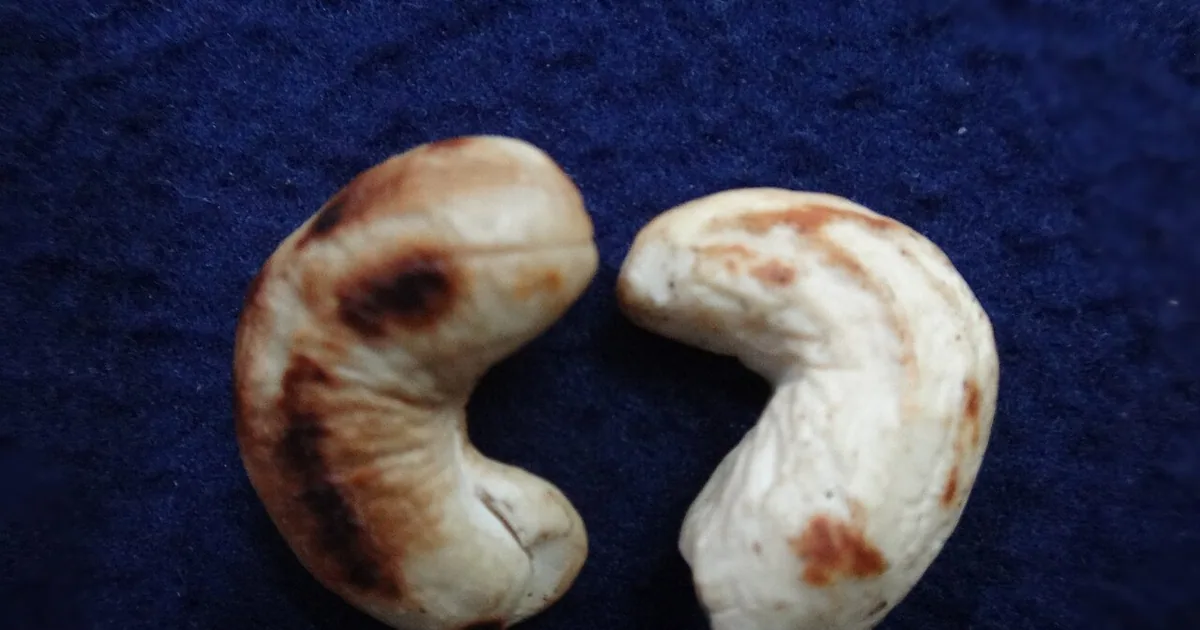
In the cashew kernel colour standards we read, colour is judged by eye against written colour words, under defined light, and a roast test confirms the class. None of them states a colour limit as an instrument reading, and we found no public figure for one. This post is part of our guide to which cashew grade to buy, and it shows the words each text uses, how the check is run and what to write so that a colour dispute has a physical reference.
We found no public figure for how far apart two colour classes sit on any instrument scale. Everything below comes from the three texts we could read and one research paper.
The colour words each text uses
| Class | AFI specification (2023) | TCVN 4850:2010 | UNECE copy (2012 text) |
|---|---|---|---|
| Top class | First quality fancy: uniform colour, white, light yellow or pale ivory | White whole: uniform colour, white, ivory white, pale ivory, light yellow or light ash gray | Extra, “white”: white, pale ivory, pale ash-grey, light yellow |
| Second class | Second quality scorched: yellow, light brown, light ivory, light ash-grey or deep ivory | Scorched whole: yellow, light brown, ivory or ash gray | Class I, “scorched” or “lightly blemished”: light brown, light ivory, light ash-grey, deep ivory, yellow |
| Lightly blemished | Light brown lines, swirls or loops, not more than 40% of kernels affected | Light brown speckles, not more than 40% affected | Inside Class I |
| Deeper classes | Third quality special scorched: deep yellow, brown, amber, light to deep blue. Dessert blemished wholes: not more than 60% of kernels affected | Second scorched, blemish (not more than 60% affected) and dark blemish wholes | Class II, “scorched seconds” or “dessert”: amber, light blue, deep brown, deep blue, discoloured, black spotted, immature, stained |
Sources: AFI specification, quality and grading; TCVN 4850:2010 Table 2; UNECE DDP-17 section II as reproduced by the African Cashew Alliance.
The words overlap and do not match. A light ash-grey kernel is white in TCVN and in the UNECE copy (“pale ash-grey”) but second quality in the AFI document, whose first quality list stops at white, light yellow and pale ivory. A buyer who writes “white” and means the AFI class may get less latitude than the TCVN class gives. Our guide to scorched cashew grades explains the classes in trade terms, and this table shows that the printed wording varies by document.
How the visual check is run
The AFI document says colour analysis of samples must be done under full spectrum lighting. TCVN 4850:2010 asks the examiner to spread the sample in a thin layer on a white table and look by naked eye under non-direct natural light, or artificial light equivalent to natural light, at the colour of each grade. Neither text gives a brightness or a colour temperature, and we found no public figure for either. That leaves room for two inspectors to disagree about the same sample under different lamps, so name the lighting in the order and keep a sealed reference sample.
The roast test
The AFI document recommends that shippers roast samples before packing, because the appearance of the roasted kernel matters for consumer acceptance, and it says the roast test also confirms the classification of a lot as first, second or third quality. The procedure fries kernels in a clear vegetable oil at about 300 to 310 degrees Fahrenheit (149 degrees Celsius) for 2 to 3 minutes, stirring several times.
| Roast defect | First quality maximum | Second quality maximum |
|---|---|---|
| Spotted | 1.00% | 2.50% |
| Scorched tips and colour variations | 2.00% | No limit |
| Deeply scorched tips | 1.00% | 2.50% |
| Dark roast | 5.00% | No limit |
| Deep roast | 2.00% | 10.00% |
| Scrapes | 10.00% | No limit |
Source: AFI specification, Appendix II. For first quality the total of defects other than scrapes cannot exceed 7%. For second quality only spotted, deeply scorched tips and deep roast have limits.
A roast is uneven under the AFI text when more than 7% of the kernels show the combined defects above, or more than 10% show scrapes, or the two together exceed 15%. For a roaster the roast test is the check that matters, because it shows the colour the shopper sees. Our guide to dessert wholes and LBW covers who can use the deeper classes.
Need a price for this grade? Request a quote
Instrument or eye
We found no standard text that sets cashew kernel colour as a colourimeter or Lab* reading. A 2023 study in the Journal of Tekirdag Agriculture Faculty classified kernels as white or scorched from the mean, standard deviation and skewness of each channel in RGB and HSV colour spaces, and reported 98.4% accuracy for its weakest model and 99.8% for its best, a random forest of 100 trees. The abstract page does not state the sample count or how the white and scorched labels were assigned.
So instruments can separate two classes in a laboratory, but that does not give you a number for a contract. A reading means something only if both sides agree on the instrument, the settings, how the sample is prepared and the reference it is compared with. We found no public instrument limit per class, so a colourimeter figure in an order is a private agreement, not a standard.
Where the texts are ambiguous
- What “affected” counts. The AFI document and the English column of TCVN say not more than 40% of the kernels are affected for lightly blemished wholes and 60% for the deeper class. We read the Vietnamese column of TCVN as 40% and 60% of the kernel surface. That is not a certified translation, and the two readings give different lots.
- Ash-grey. It sits in first class in two texts and second class in the AFI document.
- Lower class share. The UNECE copy allows kernels of the colour of the next lower class at 5% in Extra and Class I. TCVN 4850:2010 also gives 5% for the next lower grade, but its method in clause 7.2.2 treats that as a size line, so we found no TCVN colour-class share. The AFI table is laid out by grade, so we do not repeat its figures here.
How to write colour into an order
Colour class: first quality fancy as defined in the Specifications for Cashew Kernels of the AFI Nut and Agricultural Products Section, updated September 2023, judged by eye under full spectrum lighting against a sealed reference sample. Kernels of the next lower colour class not above ___% by weight. Roast test as in Appendix II of that document, limits as in its table for first quality.
For a second class lot name the class (scorched, special scorched, lightly blemished or dessert) and say whether “affected” counts kernels or surface. For the dessert and blemished classes the note under the AFI tolerance table says a delivery is acceptable if it is equal to or better than the approved pre-shipment sample, and it asks for two sealed pre-shipment samples, one kept sealed for arbitration.
What to write in your spec
- The named document, its issuer and edition, as compared in our guide to cashew kernel standards.
- The colour class by that document’s own name.
- The lighting for the check and the place it is done.
- The sealed reference sample and who holds each copy.
- The roast test, the limits and who runs it, if the product is roasted.
- The tolerance for the next lower colour class, in percent by weight.
- The basis of any “affected” share, kernels or surface.
Send the requirement with these lines and we reply within 24 business hours with one detailed quote from a Vietnamese processor that runs your grade. The whole decision is in our guide to which cashew grade to buy.
Sources
- Association of Food Industries, Specifications for Cashew Kernels (updated September 2023), quality and grading, Appendix I and Appendix II roast test
- TCVN 4850:2010 Nhan hat dieu (Cashew kernels), bilingual text published by VINACAS, Table 2 and section 7.1
- Standard for Cashew Kernels, UNECE Standard DDP-17 text adopted 8 November 2012 for a trial period, copy hosted by the African Cashew Alliance
- Baitu, Gadalla and Oztekin, Traditional Machine Learning-Based Classification of Cashew Kernels Using Colour Features, Journal of Tekirdag Agriculture Faculty 20(1), 2023 (abstract page)
Frequently asked questions
Is cashew kernel colour measured with an instrument?
In the standards we read, colour is judged by eye against written colour words, with a roast test to confirm the class. We found no public colour limit written as instrument readings. A 2023 study separated white and scorched kernels from image colour features, but that is a laboratory study, not a trade specification.
What light should a colour check use?
The AFI document says colour analysis must be done under full spectrum lighting. TCVN 4850:2010 asks for a thin layer on a white table under non-direct natural light or artificial light equivalent to it. We found no public figure for brightness or colour temperature in either text.
What is the AFI roast test?
Kernels are fried in clear vegetable oil at about 300 to 310 degrees Fahrenheit (149 degrees Celsius) for 2 to 3 minutes. A roast is uneven when spotted kernels, scorched tips, colour variations, dark roast and deep roast together exceed 7 percent, or scrapes exceed 10 percent, or the two groups together exceed 15 percent.
What does 40 percent affected mean for lightly blemished wholes?
The AFI text says not more than 40 percent of the kernels are affected. The English column of TCVN 4850:2010 says the same, but we read its Vietnamese column as 40 percent of the kernel surface. Write the basis, kernels or surface, into the order.
VietCashew supplies Vietnamese cashew kernels on one quote. We publish no prices, because a cashew quote is only valid for days. How an order runs and what we publish.
Need a price for this grade?
Send the requirement. We reply within 24 business hours with one detailed quote for the packed kernels.
Request a quote