Guides / Grades
Cashew Splits and Butts: What the Standards Define and How Much a Whole Grade May Hold
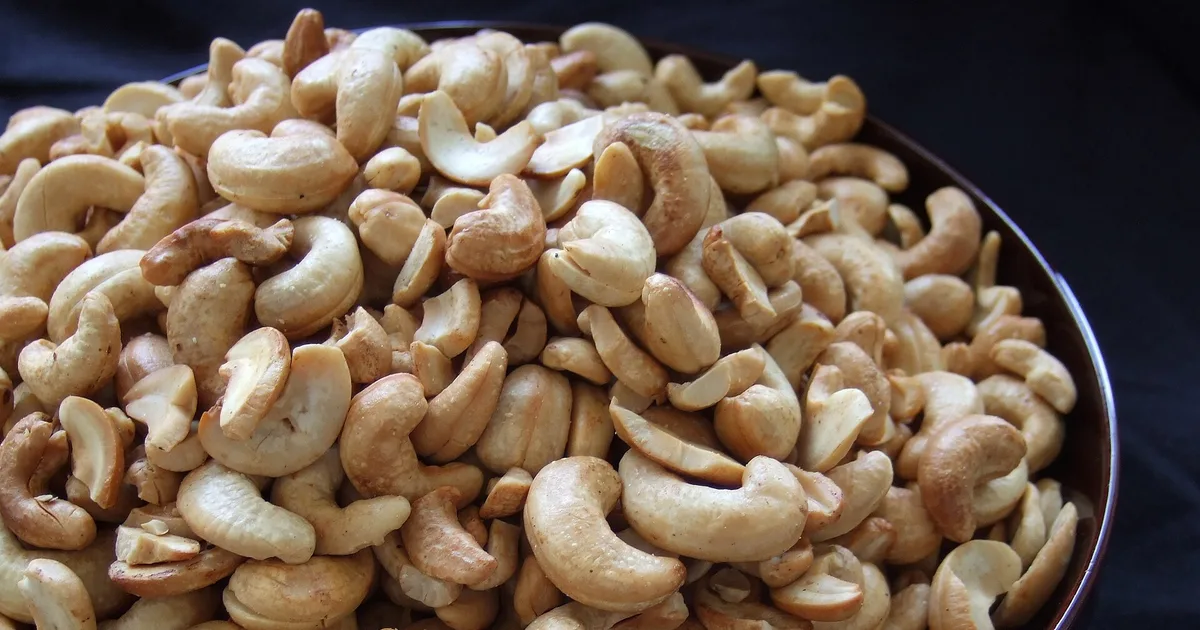
A cashew split is one half of a kernel split lengthwise, and a butt is a kernel broken crosswise that keeps at least three eighths of the whole. Both count as broken kernels, and a whole grade may hold only a stated share of them. This post is part of our guide to which cashew grade to buy, and it shows how the AFI, TCVN and UNECE texts define cashew splits and butts and what that means for the order.
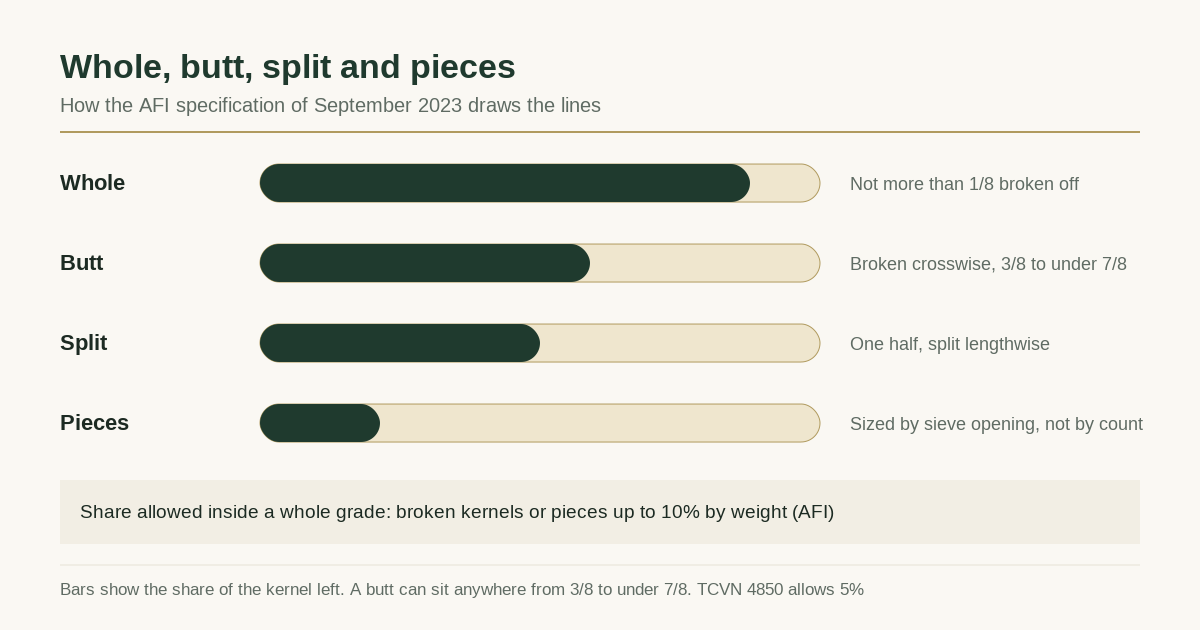
We quote no price here, and we found no public figure for the price gap between splits, butts and wholes. The definitions below come from the three texts we could read.
How three texts define the forms
| Form | AFI specification (2023) | TCVN 4850:2010 | UNECE copy (2012 text) |
|---|---|---|---|
| Whole | Characteristic shape, not more than 1/8 broken off | Whole kernel, or broken kernel where the broken part is less than one eighth | More than 7/8 intact, not more than 1/8 broken off |
| Butt | Broken crosswise, less than 7/8 and not less than 3/8 of a whole, cotyledons still attached | The same fractions, cotyledons still naturally attached | Not less than 3/8 of a whole, broken crosswise, cotyledons still attached |
| Split | One half split lengthwise, not more than 1/8 of the cotyledon broken off | One half split lengthwise, not more than 1/8 of the cotyledon broken off | Split lengthwise naturally, not more than 1/8 broken off |
| Pieces | Classed by sieve opening | Classed by sieve opening | Kernels broken into more than two pieces, sized by sieve |
Sources: AFI specification; TCVN 4850:2010 section 3; UNECE DDP-17 section I as reproduced by the African Cashew Alliance. The UNECE column rests on a copy of the 2012 trial text because UNECE’s own site refused our requests.
The three texts agree on the fractions. The AFI document sets the lines at one eighth, three eighths and seven eighths of the kernel, and the others follow. Butts sit between pieces and wholes, and splits are halves.
The share of broken kernels a whole grade may hold
| Limit | AFI (2023) | TCVN 4850:2010 | UNECE copy (2012 text) |
|---|---|---|---|
| Broken kernels or pieces in wholes | Up to 10% by weight | Up to 5% by mass at the time of packing | Up to 10% |
| Pieces in butts and splits | Up to 10% by weight | No such line found | Up to 10% |
Sources: AFI specification, quality and grading; TCVN 4850:2010 section 5.1.4; UNECE DDP-17 section IV as reproduced.
Butts and splits are part of that share. A W320 lot that meets the AFI limit can hold up to a tenth of its weight in butts, splits and pieces and still be within the grade. If your product needs clean whole kernels, that tenth is the number to bargain over, and a tighter limit is a contract term, not a grade. A lot of splits can in turn hold up to a tenth in pieces. Our guide to cashew kernel defects notes that breakage is allowed by design, and the limit above is what makes that so.
Counts do not apply, colour classes do
The count tables we read belong to whole kernels. TCVN 4850:2010 shows no count for its butt and split rows, and the AFI document treats sizing as compulsory only for first quality fancy whole kernels, so there is no W code for a split. Splits and butts come in the same colour classes as wholes: TCVN lists white, scorched, second scorched, light blemish, blemish and dark blemish butts and splits. Our guide to the kernel colour standard shows how those classes are judged.
How breakage is measured
The AFI method determines breakage in a 1,000 g composite sample and calculates percentages by weight, and it scores a kernel once even when it has several defects. TCVN 4850:2010 counts whole nuts separately from broken ones when it determines the grade. A buyer or inspector can therefore check the limit with a scale: separate the butts, splits and pieces from the composite, weigh them and divide by the mass of the sample. Our guide to counting a cashew kernel sample shows the routine that goes with it. If the limit is close, take a second composite before you reject the lot.
Splits and butts are the same kernel in another form. Ask which share of the lot is butts and which is splits, because a lot of mixed butts and splits is not the same product as a lot of splits alone, and neither the AFI nor the TCVN text sets a share between them that we could find.
Need a price for this grade? Request a quote
Codes differ between documents
TCVN 4850:2010 codes the white forms WB for a white butt and WS for a white split, and the scorched forms SB and SS. In the same table SSW is a second scorched whole and BB is a blemish butt. In trade usage BB also stands for baby bits, and our pieces guide lists splits as SP or SS. The same letters mean different things in different documents, so write the words in the order and add the code in brackets: “white splits (WS)”. Our guide to cashew pieces covers the smaller grades.
Common misreadings
- “A split is a broken nut.” It is one half of a kernel that parted along its length. Two splits make a whole kernel.
- “Butts are large pieces.” Butts are at least three eighths of a kernel with the cotyledons attached. Pieces are classed by the sieve, and large pieces start at the 4.75 mm sieve in TCVN and the UNECE copy.
- “A whole grade has no broken kernels.” It may hold up to 10% by weight under the AFI document and 5% under TCVN.
- “W320 splits is a grade.” Count belongs to wholes, so name the splits by colour class and limits.
- “The codes are the same everywhere.” They are not, as above.
How to cite splits and butts in an RFQ
Cashew white splits, to the Specifications for Cashew Kernels of the AFI Nut and Agricultural Products Section, updated September 2023: kernels split lengthwise, not more than 1/8 of the cotyledon broken off, pieces not above 10% by weight, moisture 3% to 5%. Colour class as the first quality fancy definition of that document.
For a whole grade that must stay tight, add: “Broken kernels, butts, splits and pieces together not above ___% by weight in the W320 lot.” Fill the blank with your own limit and name which document governs if it differs from the processor’s sheet.
What to write in your spec
- The form by word and code: whole, butt, split or pieces.
- The colour class by the named document’s own wording.
- The named document and its edition, as in our comparison of cashew kernel standards.
- The share of pieces allowed in splits and butts, by weight.
- The share of butts, splits and pieces allowed in a whole grade, by weight.
- The sampling plan and a sealed retained sample.
Send the requirement with these lines and we reply within 24 business hours with one detailed quote from a Vietnamese processor that runs your grade. For the full decision, return to our guide to which cashew grade to buy.
Sources
- Association of Food Industries, Specifications for Cashew Kernels (updated September 2023)
- TCVN 4850:2010 Nhan hat dieu (Cashew kernels), bilingual text published by VINACAS
- Standard for Cashew Kernels, UNECE Standard DDP-17 text adopted 8 November 2012 for a trial period, copy hosted by the African Cashew Alliance
Frequently asked questions
What is the difference between a cashew split and a butt?
The AFI specification defines a split as one half of a kernel split lengthwise, with not more than one eighth of the cotyledon broken off. A butt is a kernel broken crosswise that is less than seven eighths and not less than three eighths of a whole, with the cotyledons still attached.
How many splits and butts can a whole grade contain?
The AFI specification allows broken kernels or pieces in wholes of up to 10 percent by weight. TCVN 4850:2010 says broken kernels shall not exceed 5 percent by mass at the time of packing. Both limits cover butts and splits together with pieces.
Do splits have a count per pound?
The count tables we read belong to whole kernels, and TCVN 4850:2010 shows no count for its butt and split rows. A splits order is therefore written by name, colour class and the share of pieces allowed, not by a W code.
Are splits and butts the same as pieces?
No. Butts and splits are defined by the fraction of the kernel that remains. Pieces are classed by the sieve they pass through and are retained on. A butt must keep at least three eighths of a whole kernel, and the three texts we read do not compare butts and pieces by size.
VietCashew supplies Vietnamese cashew kernels on one quote. We publish no prices, because a cashew quote is only valid for days. How an order runs and what we publish.
Need a price for this grade?
Send the requirement. We reply within 24 business hours with one detailed quote for the packed kernels.
Request a quote