Guides / Grades
W210 Cashew Kernels: Where the Jumbo Grade Fits Between W180 and W240
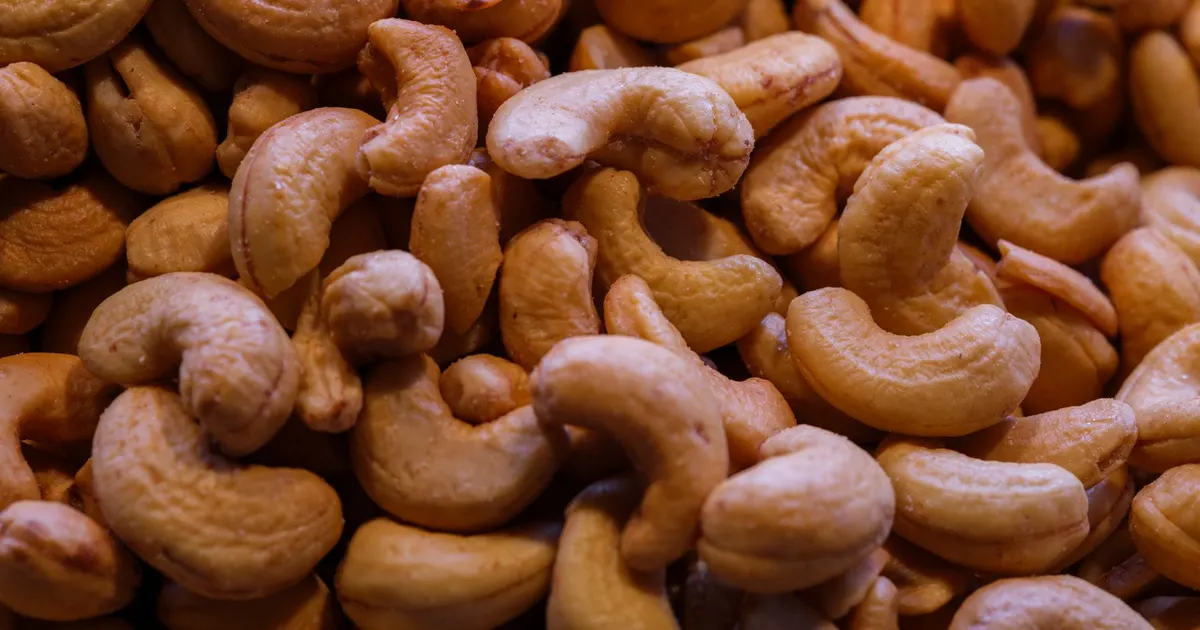
Cashew grades are a ladder of sizes. At the top sit the largest kernels, sold under names such as W180 and W210. Those two grades share the trade word “jumbo”, but they are not the same product, and the gap between them is wider than the numbers suggest. W210 sits in the middle of the large end of the ladder, and it is the grade most often chosen by a buyer who wants a visibly big kernel without paying the full W180 price.
This guide explains what W210 is, where it comes from, who buys it and what to confirm before you commit.
What the number means
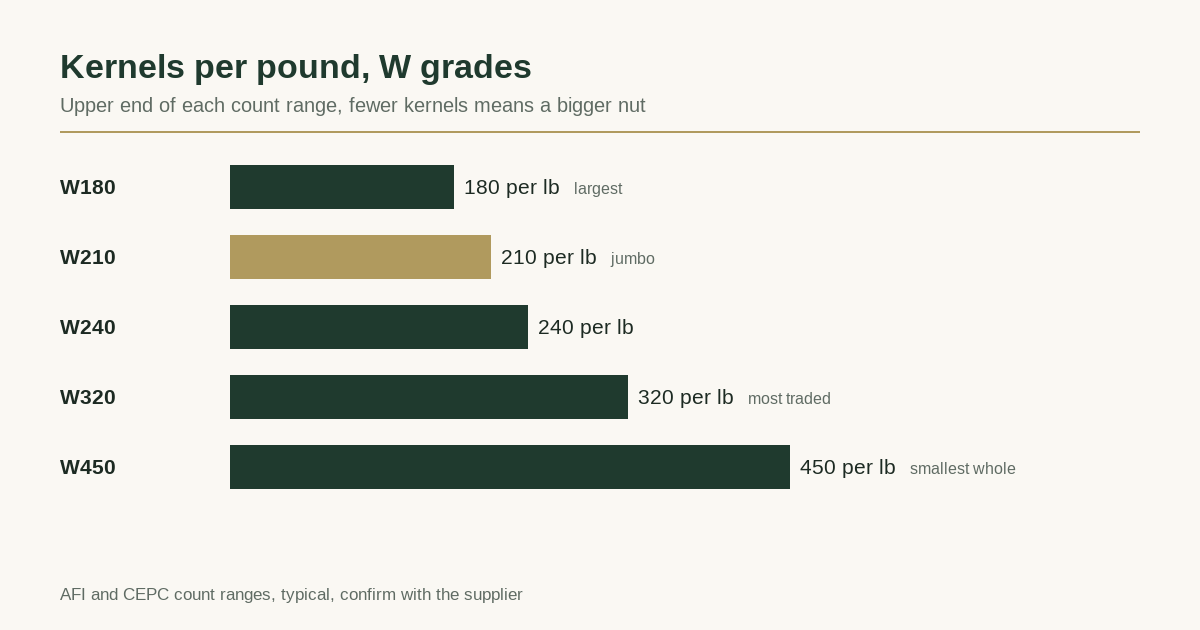
The number in a W grade is a count per pound. W210 means up to 210 whole white kernels fill one pound. The AFI table gives 180 to 210 and the Vietnamese standard TCVN 4850 gives 200 to 210, so the band depends on the document your contract names. A lower number means a bigger kernel, because fewer of them fit in a pound.
The count behind each name looks like this, from largest to smallest among the common whole grades: W180 at about 170 to 180, W210 at about 180 to 210 in the AFI table (200 to 210 in TCVN), W240 at about 220 to 240, W320 at about 300 to 320 and W450 at about 400 to 450. Our guide to Vietnam cashew grades lays out the full ladder, and the grades reference gives each grade its own page.
Note the edges. Under TCVN nothing sits between 180 and 200 or between 210 and 220, while the AFI table lets W180 and W210 meet at 180. A kernel lot that straddles two grades is usually sold as the lower-count grade it mostly fits, or blended by agreement. Ask how a plant treats the edges.
Where W210 comes from
Large kernels are a fraction of any crop. Raw nuts come in a spread of sizes, and only the biggest nuts yield the biggest kernels, and only if they survive shelling and peeling whole. So supply of large counts depends on the raw nut crop and on the plant’s skill with big nuts, not on a decision to make more.
That explains the premium. It is not margin. It reflects the smaller share of the harvest that ends up in the large grades. It also means the premium moves with the season, widening in a year when large nuts are scarce. Our guide to price factors for cashew kernels explains how grade and crop interact.
Who buys W210
The buyer for W210 is almost always someone whose customer can see the kernel.
Premium roasted and salted nuts. A tin or jar of roasted cashews with a visible big kernel looks generous on the shelf and in the hand. W210 gives that look at a lower cost than W180.
Gift boxes and hampers. A gift pack that opens to uniform large kernels carries an impression of quality that smaller grades do not.
Clear retail pouches. A pouch with a window shows the kernels. W210 reads as “big cashew” to most shoppers without the W180 price.
Specialty and ethnic retail. Some markets pay for large kernels as a matter of habit and tradition, and W210 is a mainstream way to serve them.
Premium food service. A restaurant that plates whole cashews as a feature, for example on a salad or a curry, may buy a large grade for its look.
Who should not buy W210
If your product hides the nut, W210 is a poor use of money. Cashew butter, plant milk, chocolate inclusions, coated nuts, bar clusters and baking mixes gain nothing from size. In those products a smaller whole grade or pieces serve just as well and cost less. Our guide to cashew pieces covers the grades built for ingredient use.
If you are not sure, run a blind test. Put W210, W240 and W320 in identical packs and ask a few customers or staff to pick the best. If they cannot tell, the answer is clear. Our comparison of W320 and W240 uses the same approach one step down.
W210 against its neighbours
| Grade | Typical count per lb | Typical buyer |
|---|---|---|
| W180 | 170 to 180 | Gifting, top-tier premium retail |
| W210 | 180 to 210 (AFI), 200 to 210 (TCVN) | Premium retail, gifting, visible-kernel packs |
| W240 | 220 to 240 | Premium and mid-market retail |
| W320 | 300 to 320 | Mainstream retail, food makers |
Read the table as typical positioning, not a promise. Real quotes vary by season and processor.
Availability risk
W210 is a large-count grade, so it tightens first when the crop is poor. A buyer who builds a product on W210 should check the availability across the year with more than one processor. If your volume is steady, ask about standing offtake or forward cover. If your volume is small, expect lead times to depend on what the line produced that month.
Ask also about blending. Some processors will offer a mixed W180 and W210 lot, or a W210 and W240 lot, to solve availability. Only accept a blend if your pack claim allows it. A pack that says W210 and holds a blend with W240 breaks its own description.
Need a price for this grade? Request a quote
What to confirm before you order
- The count range written into the spec, with the test method: weigh a pound, count the kernels.
- The colour class. W means white wholes. If the lot is scorched, the code is SW210 and the price differs.
- The allowed share of broken kernels and splits in the lot. A large grade with many splits spoils the point of buying it.
- The defect limits: spotted, skin-on, insect-damaged. Large kernels show defects more clearly.
- Moisture and packing. Large kernels pack in the same 25 lb vacuum tins as other grades.
- The counter sample, drawn from the production run that will fill your order.
Our guide to what to check on a cashew spec sheet lists these and the rest of the fields, and the spec sheet tool builds one for you.
How to buy it without overpaying
Quote W180, W210 and W240 on the same enquiry. The price gap between them changes by season and by processor, and a single quote tells you nothing about whether the step from one to the next is worth paying. Compare the quotes in cost per kilo and in cost per kernel. Because a W210 kernel is bigger than a W240 kernel, the cost per kilo overstates the cost per kernel, and for a product sold by count, such as pieces per pack, the per-kernel figure matters more.
Ask for a counter sample of each grade, in the same colour class, from the same plant. Weigh and count each one. Lay the kernels on a white tray and look at them as your customer would. Then decide.
A worked comparison
Suppose you run a gift tin line and your current kernel is W240. A shopper picks up the tin, looks through the window and sees a mix of sizes inside the W240 band, since 220 to 240 kernels per pound covers a real spread. Move to W210 and the band narrows to at most 210 (200 to 210 under TCVN), so the kernels look both bigger and more uniform. The visual gain comes from two things at once: size and consistency. If uniformity is what you want, ask the processor whether it can tighten the count range inside the grade, for instance 205 to 210, and what that costs in yield.
Do the maths on count per pack too. If your tin is sold at 250 g, the number of kernels in it changes with the grade: roughly 116 at W210 against 132 at W240, using the upper end of each count. Fewer, larger kernels fill the same weight. If your pack claims a kernel count on the label, build the claim from a measured count of your own samples and not from the grade code.
Questions to ask about size consistency
- What count range do you actually run inside W210, and how often do you check it?
- Do you screen for oversize and undersize kernels before packing?
- How many splits and broken kernels do you allow in a W210 lot, and can you reduce them?
- Can you supply a photograph of the line output before a shipment goes out?
Count bands at the large end differ between documents; see our guide to which cashew grade to buy.
Next step
If W210 fits your product, state the grade, the colour class, the volume and the packing in the requirement. We price it with a Vietnamese processor that runs it, and you get one detailed quote. Send a requirement and we reply within 24 business hours.
See also: the W210 reference page compares the AFI, TCVN and UNECE count bands and tolerances for the grade.
Frequently asked questions
How many kernels are in a pound of W210 cashews?
The AFI specification gives 180 to 210 whole white kernels per pound for W210, while TCVN 4850 gives 200 to 210, so write the band of your named document into the contract. A lot that counts well outside that band is not W210, so weigh a pound of the counter sample and count it before you contract.
Is W210 the same as jumbo cashew?
In everyday trade usage, jumbo points to the larger counts, W180 and W210 and sometimes W240. There is no single legal definition of the word, so always name the grade by its code and count range, not by the word jumbo.
Is W210 worth the premium over W240?
Only if the kernel size is visible to your customer and helps the sale. In a clear pack, a gift tin or a premium roasted line, the extra size shows. In a mix, a coated nut or a bar, nobody sees the difference and W240 or W320 saves money.
VietCashew supplies Vietnamese cashew kernels on one quote. We publish no prices, because a cashew quote is only valid for days. How an order runs and what we publish.
Need a price for this grade?
Send the requirement. We reply within 24 business hours with one detailed quote for the packed kernels.
Request a quote