Guides / Compliance
What a Food Importer Must Check Before a Cashew Container Ships
A food importer who buys cashew kernels has to settle seven things before a container ships: the aflatoxin limit of the market where the lot will be sold, pesticide residues against that market’s maximum residue levels, a position on Salmonella, allergen labelling, physical hazards, the processor’s food safety certificate and, for the United States, a written foreign supplier verification programme. This guide is for importers, snack brands and ingredient buyers who write the spec and sign the order. It ends in a document list and the spec lines to send with a requirement.
We name no processor here. Every limit below comes from an official text named beside it, and where we could not open the text we say so.
Last reviewed: October 2026. Figures carry the date they were checked; confirm limits and filings with your customs broker, your laboratory or counsel before you rely on them.
- Which rules apply to a cashew lot
- Aflatoxin: limits and sampling
- Pesticide residues and MRLs
- Insects, fumigation and residues
- Salmonella and microbiological specs
- FSVP for US importers
- Allergens and cross-contact
- Foreign matter and metal detection
- Food safety certificates
- Organic, kosher and halal
- Forced labour and import bans
- Documents to hold for each lot
- Spec lines to send with a requirement
Which rules apply to a cashew lot
The rules follow the market where the lot is sold, not the country where the kernels were shelled. A processor can ship the same W320 lot to three importers and each importer answers to a different regulator. So the first decision is the destination, and the second is whether the lot reaches the consumer as it is or goes to your own plant for further processing. The table sets the European Union and the United States side by side.
| Topic | European Union | United States |
|---|---|---|
| Aflatoxin | Regulation (EU) 2023/915: tree nuts placed on the market as they are, 2.0 B1 and 4.0 total; tree nuts to be sorted or physically treated first, 5.0 B1 and 10.0 total | FDA may consider food above 20 total to be adulterated (guidance, not a statute) |
| Pesticide residues | MRLs by product in Regulation (EC) No 396/2005; 0.01 mg/kg where no MRL is set | EPA tolerances in 40 CFR part 180; cashew sits in the tree nut crop group |
| Salmonella | No row for nuts in Chapter 1 of Regulation (EC) No 2073/2005 | FDA’s policy guide charges food that contains Salmonella as adulterated |
| Metals | Nickel 10 mg/kg for cashew nuts and cadmium 0.20 mg/kg for tree nuts in Regulation 2023/915 | We did not check US limits |
| Allergen label | Cashews listed in Annex II of Regulation 1169/2011 | Cashew listed among the tree nuts in FDA’s allergen guidance |
| Importer paperwork | Operators must place only compliant food on the market | Written FSVP for each food and supplier |
Aflatoxin limits in micrograms per kilogram. Sources: Regulation (EU) 2023/915 (consolidated 19 August 2026), FDA CPG Sec. 555.400 (June 2021), Regulations (EC) 396/2005 and 2073/2005 (consolidated 1 July 2026), 40 CFR part 180, Regulation (EU) 1169/2011, FDA Q&A on food allergens, Edition 5 (January 2025), 21 CFR part 1 subpart L.
Japan has its own route. A health ministry notice from February 2014 regulates total aflatoxin there at 10 micrograms per kilogram, half the US guidance figure. Other Japanese rules are compared in the guide linked below. Two points the table cannot show. First, a limit is half a rule: how the lot is sampled, who keeps the retained sample and what happens after a failure decide the outcome as much as the number. Second, the transitional article of Regulation 2023/915 gives 1 July 2025 as the date for the nickel levels, so the nickel level for cashew nuts applies to lots placed on the EU market in 2026.
Read more: Cashew Import Requirements: EU, US and Japan Compared
Aflatoxin: limits and sampling
Aflatoxin is the contaminant most likely to stop a cashew lot at the border, and the one with the clearest numbers. Regulation (EU) 2023/915 sets two limits for tree nuts, each as aflatoxin B1 and as the sum of B1, B2, G1 and G2. Tree nuts that will be sorted or physically treated before they reach the final consumer or a food ingredient line may carry up to 5.0 and 10.0 micrograms per kilogram. Tree nuts placed on the market as they are, or as the only ingredient, may carry up to 2.0 and 4.0. The regulation names almonds, pistachios, apricot kernels, hazelnuts and Brazil nuts in their own rows and does not name cashew, so our reading is that the general tree nut rows apply. Ask your laboratory to confirm that reading for your lot.
A lot sold under the higher limit carries conditions. Under Article 5 each package and the accompanying document must state that the product will be sorted or physically treated before it reaches the consumer or an ingredient line, and the lot may not go there before that treatment. Most importers buying finished kernels for sale as they are should therefore write the lower pair into the spec.
The United States works from guidance. FDA’s compliance policy guide says the agency may consider human food above 20 micrograms per kilogram of total aflatoxins to be adulterated, and its criteria for recommending import refusal need both the original and the check analysis above 20 and confirmation of which aflatoxin is present. Japan regulates total aflatoxin at 10 micrograms per kilogram, according to the 2014 ministry notice.
A lot can be saleable in one market and refused in another. If you buy for several markets, write the tightest limit that applies to your customers into the contract, or segregate lots at the contract stage rather than in the warehouse.
Sampling matters as much as the number. Aflatoxin concentrates in a few nuts, so one small sample says little about a container. Put three things in the contract: the sampling plan, a sealed retained sample split between buyer and seller and a named independent laboratory for disputes.
Read more: Aflatoxin in Cashews: Limits, Testing and Who Pays
Pesticide residues and MRLs
A maximum residue level is the highest residue of a pesticide that a market allows on a commodity. Each market keeps its own list, and the lists differ, so a clean report for one destination proves nothing for another.
| Market | Instrument | Default where no specific limit is set |
|---|---|---|
| EU | MRLs by product and substance, Regulation (EC) No 396/2005, Article 18 | 0.01 mg/kg |
| US | EPA tolerances by pesticide, 40 CFR part 180 | We did not check |
Sources: Regulation (EC) No 396/2005 (original text); eCFR 40 CFR part 180. Japan applies a positive list system with its own default, set out in the guide linked below. Database values change often and were not read for this table.
In the EU, Annex I of the regulation lists the products the MRLs apply to, and the guide linked below shows how to find the cashew entry. In the US, cashew is a member of the tree nut crop group in section 180.41 of the tolerance regulations. As one example, the glyphosate tolerance for tree nuts, crop group 14, is 1.0 ppm in section 180.364. We could not read the EU Pesticides Database or the Codex pesticide database in this session, because both load their data by script, so we quote no EU or Codex value for any named substance. Look the value up for your lot on the day and write the date beside it.
In the spec, name the destination market and the commodity, ask for a multi-residue screen covering the substances your customer cares about and state the reporting limit you need. A screen that cannot report down to the limit cannot prove a lot complies.
Read more: Pesticide Residues in Cashews: EU MRL and US Tolerances
Insects, fumigation and residues
Cashew kernels are oily and rich in protein, which suits stored product insects, and plants and shippers use sealed packs, hygiene, cold storage and fumigation to keep them out. Fumigation is where pest control meets residue law. For phosphine, the US tolerance regulation lists a tolerance for cashew of 0.1 ppm resulting from post-harvest fumigation, and a separate 0.01 ppm line for processed food. It also requires the label to tell the user to aerate the finished food for 48 hours before it is offered to the consumer. We found nothing in the texts we opened that says which line a shelled and peeled kernel falls under, so put that question to your broker or laboratory rather than assuming.
What to ask in writing is simple. If a lot or its container was treated, ask for a record that names the fumigant, the dose, the dates, the exposure and the ventilation time. If the pack is a sealed vacuum tin, ask what protects it before sealing. If you sell organic or low-residue product, say so in the requirement, because synthetic fumigants may not be allowed and the plant needs a documented alternative.
A treatment is a record of a past event, not a guarantee about the future. A lot treated at the plant can still be reinfested in a transit warehouse or on your dock if the packs are open or damaged, so the sealed pack and a clean store remain the lasting protection.
Read more: Fumigation and Pest Control for Stored Cashew Kernels
Salmonella and microbiological specs
Salmonella is the pathogen that matters in low-moisture foods. The Codex Code of Hygienic Practice for Low-Moisture Foods lists tree nuts in its scope and explains why: water activity in these foods is often well below 0.85, so Salmonella cannot multiply, yet cells can stay viable for long periods, and the infectious dose is thought to be very low. The code asks that low-moisture foods or their raw materials be treated with a validated microbial reduction step whenever feasible, and gives roasting and steam treatment followed by drying as examples. It also says end-product testing gives limited information about hygiene controls, which is why a clean test is weaker evidence than a validated process.
The law is uneven. In the EU we found no Salmonella row for nuts, tree nuts or dried fruit in Chapter 1 of Regulation (EC) No 2073/2005, consolidated 1 July 2026. In the US, FDA’s compliance policy guide sets criteria for treating a lot as adulterated when one or more composite units test positive under its sampling scheme, and the scheme asks for 60, 30 or 15 sample units depending on the product category. We did not confirm which category covers cashew kernels.
Three questions settle most buyer risk:
- Is the kernel raw or heat treated? Write it in the spec. “Raw” and “pasteurised” are not the same product.
- If it is treated, how was the step validated? Ask for the validation summary and the monitoring record, not only the word “treated”.
- If it is raw, who applies the kill step? Your own plant, or a contract processor, with its own validation.
State the sampling plan you want: number of samples, quantity per sample, method and laboratory. We found no public figure that sets a cashew-specific plan, so it is a contract term.
Read more: Salmonella and Micro Specs for Cashew Kernel Buyers
FSVP for US importers
If you are the US owner or consignee of the lot, 21 CFR 1.502 requires you to develop, maintain and follow a foreign supplier verification programme for each food you import. The same section says it must give adequate assurance that the supplier produces the food to the same level of public health protection as the US preventive controls rules, and that the food is not adulterated or misbranded for major allergens. If there is no US owner or consignee, the foreign owner must name a US agent as the importer.
| Step | Section | What you document |
|---|---|---|
| Hazard analysis | 1.504 | Written analysis of biological, chemical and physical hazards for each food, whatever the outcome |
| Supplier evaluation and approval | 1.505 | Hazard analysis, who controls the hazard, supplier performance and history, approval decision, re-evaluation at least every 3 years |
| Verification | 1.506 | Onsite audit, sampling and testing, records review or another appropriate activity, with the frequency |
| Corrective action | 1.508 | What you did when a supplier did not produce compliant food |
| Entry identification | 1.509 | Your name, email and FDA-recognised facility identifier filed with CBP at entry |
| Records | 1.510 | Kept for at least 2 years |
Source: eCFR, 21 CFR part 1 subpart L (text as of October 2026). Exemptions and alternatives in 1.501 to 1.513 may change this for your business.
The rule’s hazard list names pesticide residues, natural toxins, food allergens and physical hazards such as stones, glass and metal fragments, plus pathogens. A cashew analysis should address each one and say whether it needs a control, including a pathogen that nobody controls before the lot reaches you. Section 1.507 lets some importers of raw food rely on a customer who will control the hazard, if the paperwork says “not processed to control” the named hazard and the importer gets written assurance each year. This is a legal programme, so have your customs broker or a qualified individual set it up. We are not the importer and we cannot do it for you.
Read more: FSVP for Cashew Importers: What FDA Expects You to Hold
Need a price for this grade? Request a quote
Allergens and cross-contact
Cashew is itself a labelled allergen in both of the main import markets. Annex II of Regulation (EU) No 1169/2011 lists nuts and names cashews (Anacardium occidentale) among them, and Article 21 requires the allergen name to be emphasised in the ingredients list. In the US, tree nuts are a major food allergen, section 403(w) of the FD&C Act requires the specific type of tree nut to be declared, and Table 1 of FDA’s allergen guidance, Edition 5 of January 2025, lists cashew among the tree nuts.
That changes the question you ask the processor. On a cashew line the kernel is the declared allergen, so your label already carries it. The risk you need to assess is the other allergens that may reach your kernels: peanuts, other tree nuts, sesame and any ingredient on a shared seasoning or roasting line. Ask which products run on the same lines, how lines are cleaned between products, whether the plant tests for allergen residue and how it keeps allergen-bearing rework apart. Under FSVP the importer also verifies that the food is not misbranded for major allergens, so the evidence belongs in the file.
Read more: a separate guide on allergen cross-contact in cashew plants is planned and will be linked here when it is published.
Foreign matter and metal detection
Shell fragments, pieces of the brown skin, stones and metal can all reach a cashew tin. The FSVP rule itself lists stones, glass and metal fragments as the physical hazards an importer must consider, so a foreign matter control is a hazard control, not a nicety. Shell and skin are the common finds because they come from the nut and match the kernel in colour. Metal is rarer and more serious for a food maker.
Ask what the plant runs at the end of the line before the pack is sealed: a metal detector and an X-ray unit that can also find dense shell and stone, or one of the two. Ask how often the detector is tested, with what test pieces and what happens to rejected product. Write a limit for shell and skin into the spec as a count or a percentage that your own incoming inspection can check, and agree who pays when it is exceeded.
Read more: Metal Detection and Foreign Matter Control in Cashew Plants
Food safety certificates
A certificate is evidence about a site and a scope, not about your lot. Schemes such as BRCGS, IFS Food and FSSC 22000 audit how a facility manages food safety, and which one you ask for depends on your customer. HACCP with a clean audit history and good testing may be enough for some channels, and retail customers often ask for more. None of the legal texts we opened for this guide requires a scheme certificate to import cashew kernels.
When a processor sends a certificate, read four things. The site address must match the site that will pack your goods, not a head office or a trading arm. The scope must name the product category that includes shelled and peeled nuts. The expiry date must fall after your shipment. And the certification body that issued it should be able to confirm it in writing. Do not accept a logo on a brochure as a certificate, and do not assume a certificate for one plant covers a partner plant.
Read more: BRCGS, IFS or FSSC: Which Cashew Certification You Need
Organic, kosher and halal
These three certifications work on different logic and none is a substitute for the food safety checks above. Organic certification follows the chain, so the processor’s certificate covers the processor. Whether you also need one as importer or handler, and whether each consignment needs a transaction certificate, depends on the organic rules of your market, so ask the certifier named for that market. Kosher and halal certify the facility and the process, not the raw material, so shared lines, processing aids and cleaning agents are what an audit looks at.
For each one, ask the same four questions you ask about a safety certificate: which site, which product, which standard and which dates. Then ask what the plant does to keep certified and uncertified lots apart. A certified kernel that was packed on a line shared with uncertified product may lose its status at the dock.
Read more: Organic, Kosher and Halal Cashews: What Each One Requires
Forced labour and import bans
Regulation (EU) 2024/3015 prohibits economic operators from placing or making available on the EU market products made with forced labour, and from exporting them. Article 39 sets its date of application as 14 December 2027. It defines forced labour by reference to ILO Convention No 29, including forced child labour, and it covers products in general, not a list of commodities, so cashew kernels are inside its scope. Article 1(3) says the regulation creates no additional due diligence duty beyond other Union or national law, but holding evidence now is the sensible position.
For a buyer the practical step is to collect evidence now: where the raw nuts and the labour come from, what the processor’s own labour policy and audits say and whether the processor will answer questions on recruitment and wages. We are not a law firm, and this is not legal advice. Keep the file, date it and ask counsel before you rely on it.
Read more: a separate guide on the EU forced labour regulation and cashew importers is planned and will be linked here when it is published.
Documents to hold for each lot
Use this list as the starting file for each lot. Every item answers one of the questions above, and the last items cover the filings that sit with you, not the processor.
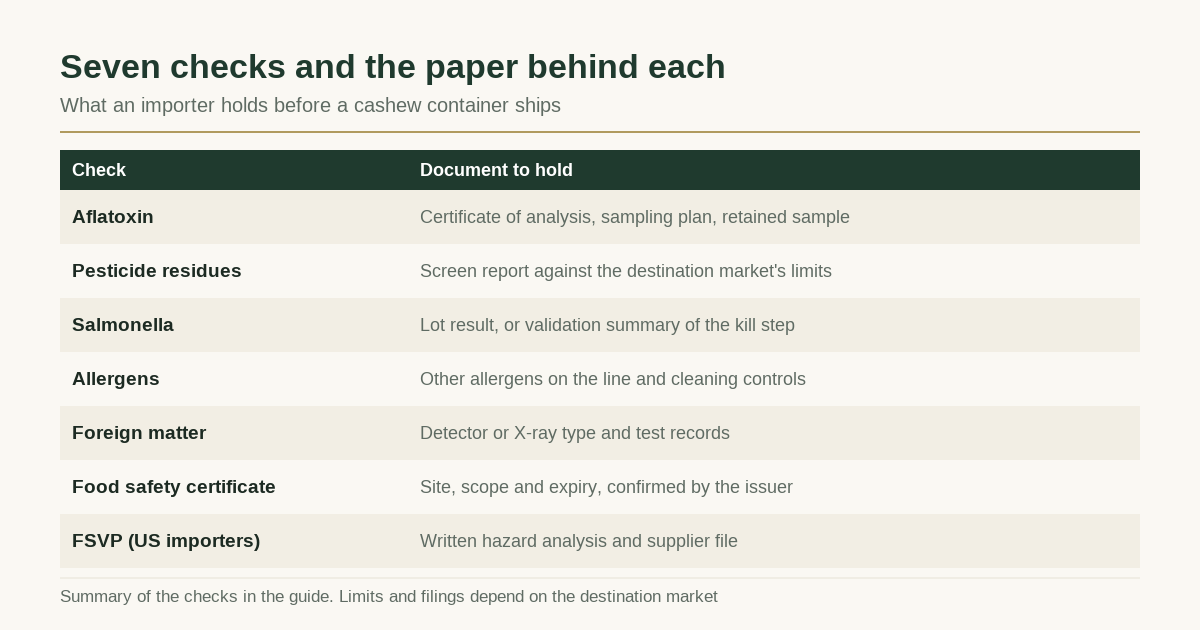
- Aflatoxin certificate of analysis: laboratory name, method, sampling plan, date and lot code. It proves the lot met the limit you wrote.
- Pesticide residue report: the substances screened, the reporting limits and the market whose MRLs were used.
- Salmonella result or kill-step evidence: a lot result with the plan, or the validation summary and monitoring record of the process.
- Treatment record, if fumigated: fumigant, dose, dates, exposure and ventilation.
- Certificate copy with site, scope and expiry, and the certification body’s confirmation.
- Allergen statement: other allergens on the line and the cleaning controls.
- Foreign matter controls: detector or X-ray type, test frequency and rejected product handling.
- Retained sample record: who holds it, sealed and dated, split between buyer and seller.
- Traceability link: the lot code tied to the production date and the raw nut intake, so a recall can be scoped.
- Your own filings: for the US, the FSVP file, the facility registration of the foreign plant and your entry identifier. For other markets, whatever your broker lists.
Read more: the spec sheet guide shows where each line sits in a contract, and the import checklist tool works backwards from your shelf date.
Spec lines to send with a requirement
A spec that names the market and the evidence you will accept gives every processor the same task, so quotes compare cleanly. These lines go into the requirement alongside grade, packing and volume. Fill the blanks from the sections above.
- Product and use: cashew kernels, grade ___, raw or heat treated, sold as they are or processed further.
- Destination market: ___. All limits below apply on the day of shipment.
- Aflatoxin: B1 at most ___ and total at most ___ micrograms per kilogram, sampling plan ___, laboratory ___, retained sample ___ kg, sealed and split.
- Residues: comply with the MRLs of the destination market; multi-residue screen covering ___; reporting limit ___.
- Salmonella: ___, or a validated kill step with its validation summary.
- Treatments: fumigation record with product, dose, dates and ventilation, or a statement that none was applied.
- Allergens: other allergens on the line and cleaning controls disclosed.
- Foreign matter: shell and skin limit ___; metal detector or X-ray at end of line, test frequency disclosed.
- Certificate: site, scope and expiry copy, confirmed by the certification body.
- Documents with each shipment: the items in the list above.
Send a requirement with these lines in the free-text box or attach the spec sheet. We reply within 24 business hours with one detailed quote from a Vietnamese processor that runs your grade. An NDA is available on request.
Read more: build the lines in the spec sheet tool and compare the answers from each processor against the same list.
See also: For reference pages on the certificates and limits named here, see the processor certificates and kernel quality hubs.
Sources
- eCFR, 21 CFR part 1 subpart L: Foreign Supplier Verification Programs for Food Importers
- Regulation (EU) 2023/915 on maximum levels for certain contaminants in food, consolidated text of 19 August 2026, EUR-Lex
- FDA Compliance Policy Guide Sec. 555.400, Aflatoxins in Human Food (June 2021)
- Regulation (EC) No 396/2005 on maximum residue levels of pesticides in or on food and feed, EUR-Lex
- eCFR, 40 CFR part 180: Tolerances and exemptions for pesticide chemical residues in food
- Regulation (EC) No 2073/2005 on microbiological criteria for foodstuffs, consolidated text of 1 July 2026, EUR-Lex
- Codex Alimentarius, Code of Hygienic Practice for Low-Moisture Foods (CAC/RCP 75-2015)
- FDA Compliance Policy Guide Sec. 555.300, Foods, Except Dairy Products, Adulteration with Salmonella
- Regulation (EU) No 1169/2011 on the provision of food information to consumers, EUR-Lex
- FDA, Questions and Answers Regarding Food Allergens, Edition 5 (January 2025)
- Japan Ministry of Health, Labour and Welfare, notice on aflatoxin M1 in milk (February 2014, Japanese, section 1 on total aflatoxin)
- Regulation (EU) 2024/3015 prohibiting products made with forced labour on the Union market, EUR-Lex
Frequently asked questions
What food safety tests should I order on a cashew lot?
At minimum, aflatoxin against the limit of the market where the lot will be sold, a pesticide residue screen against that market's MRLs and a Salmonella position: either a result or evidence of a validated kill step. Add moisture, and for the EU check the metal limits that apply to tree nuts, including nickel for cashew nuts.
Does a cashew importer need an FSVP?
If you are the US owner or consignee of the lot, FDA requires a foreign supplier verification programme for each food you import, unless an exemption or alternative in 21 CFR 1.501 to 1.513 applies to you. It starts with a written hazard analysis for the food. Ask your customs broker or a qualified individual which route fits your business.
Is there an EU limit for Salmonella in cashew kernels?
We found no row for nuts, tree nuts or dried fruit in Chapter 1 of Regulation (EC) No 2073/2005, in the consolidated text of 1 July 2026. That does not make a contaminated lot saleable, because general food law bars unsafe food. Put your own Salmonella requirement in the contract.
Which aflatoxin limit applies to cashews in Japan?
A Japanese health ministry notice from February 2014 states that total aflatoxin (B1, B2, G1 and G2 added together) is regulated at 10 micrograms per kilogram under Article 6, item 2 of the Food Sanitation Act. Confirm the current sampling protocol with your Japanese importer, because results are judged shipment by shipment.
Is a BRCGS, IFS or FSSC certificate required to import cashews?
None of the legal texts we opened for this guide requires a scheme certificate to import cashew kernels. Retail and brand customers often require one, and in the US an audit is one of the verification options an importer can choose. Ask for the certificate scope, not only the logo.
Does the EU forced labour regulation apply to cashews?
Regulation (EU) 2024/3015 prohibits products made with forced labour from the EU market and applies from 14 December 2027 under its Article 39. It covers products in general, not a list of commodities, so cashew kernels fall inside it. Keep supplier evidence now.
VietCashew supplies Vietnamese cashew kernels on one quote. We publish no prices, because a cashew quote is only valid for days. How an order runs and what we publish.
Need a price for this grade?
Send the requirement. We reply within 24 business hours with one detailed quote for the packed kernels.
Request a quote