Guides / Quality
Keeping Insects Out of Stored Cashews: Fumigation, Packing and Storage
Cashew kernels are dense, oily and rich in protein. To a stored product insect they are an ideal meal. A warm warehouse, a small gap in a pack and a few weeks are enough for an infestation to start. Most cashew lots never meet this problem, because the controls between the plant and your store are good. When one does, the lot is a total loss, and the claim is hard to settle if nobody wrote down what was done.
This guide explains how pests reach cashew kernels, the main ways they are kept out, where fumigation fits and what to ask for in writing.
Who the pests are
A few species cause most of the damage to stored nuts and dried fruit.
Indian meal moth. The larvae feed on kernels and spin silk webbing that clumps them together. Adult moths fly into stores and lay eggs on exposed product.
Red flour beetle. A small reddish beetle that attacks broken kernels and dust, and thrives in warm conditions.
Cigarette beetle. A small brown beetle that bores into packaging and feeds on stored products. It can pierce thin film and cardboard.
Check the species with an entomologist or a pest control provider if you find an infestation, because treatment depends on the pest and the stage.
How infestation starts
Infestation seldom begins inside a sealed tin. It starts in the store, in the carton and on the pallet, where eggs or larvae sit on packaging or in cracks. It starts in a container loaded in a yard with insects present. It starts in an old store with spilled product in the corners.
Kernels also carry risk from earlier in the chain. A raw nut can host insects, and a batch of kernels packed damp invites mould and mites as well as insects. A plant with weak hygiene and open trays moves risk onto the product before it is sealed.
The layers of defence
Plants and buyers use several measures that work together.
Hygiene and housekeeping. Clean floors, no spilled kernels, sealed drains, screened doors and pest traps catch the problem early. A plant that logs trap counts has an early warning system.
Sealed packaging. A vacuum tin or a flexi bag keeps insects out. A tin with an intact lid stops moths and beetles completely. Flexi bags stop them while the film is intact, though a hole lets them in. Our guide to vacuum packing and CO2 flushing describes the formats and their weak points.
Cold storage. Low temperature slows insect development. Development of most storage insects slows sharply below about 15 degrees Celsius. Cold storage extends shelf life as well. Watch for condensation when kernels leave the cold room, because it adds moisture.
Controlled atmosphere. Low oxygen or high carbon dioxide in a sealed chamber or pack kills insects over time. This is how a gas flush adds to protection when the pack is also tight.
Fumigation. Where infestation is a risk or an importing country requires it, the lot or the container is treated with a fumigant gas.
Where fumigation fits
Fumigation uses a gas, applied in a sealed space for a set time at a set dose, that kills insects at every life stage. For stored dry foods, the most widely used fumigant is phosphine, released from tablets or generators. Methyl bromide was widely used in the past and is now restricted under the Montreal Protocol, with limited exemptions for quarantine and pre-shipment uses that vary by country.
For cashews, fumigation usually applies to a storage room, a shipping container or a stack under a gas-tight sheet, and not to kernels sealed in tins, where the pack is the main protection. Some importing countries require a treatment certificate for plant products. Check the rules for your destination, and ask your processor and forwarder who will do the treatment and who will issue the record.
What treatment records should show
A proper fumigation record names the fumigant, the dose, the temperature, the exposure time, the place treated and the date. It names the treatment provider and carries a licence or authorisation number where the law requires one. It notes the ventilation period before anyone enters the space or opens the packs.
If a certificate is missing any of these, ask for a corrected version before the shipment sails. A certificate that says only “fumigated” is not enough to answer a customs or customer query.
Residues and limits
Fumigants leave residues that dissipate with ventilation. Importing countries set limits for the residue of some fumigants in food. Phosphine, for example, has a maximum residue level in many markets. A lot that was treated and sealed too soon, or in too cold a space, can carry more residue than a lot that was ventilated well.
Ask the processor how long it ventilates and whether it tests residues for export lots. If your customer has a tight residue limit or a pesticide-free claim, say so in the requirement and ask the processors whether they can meet it without fumigating the lot.
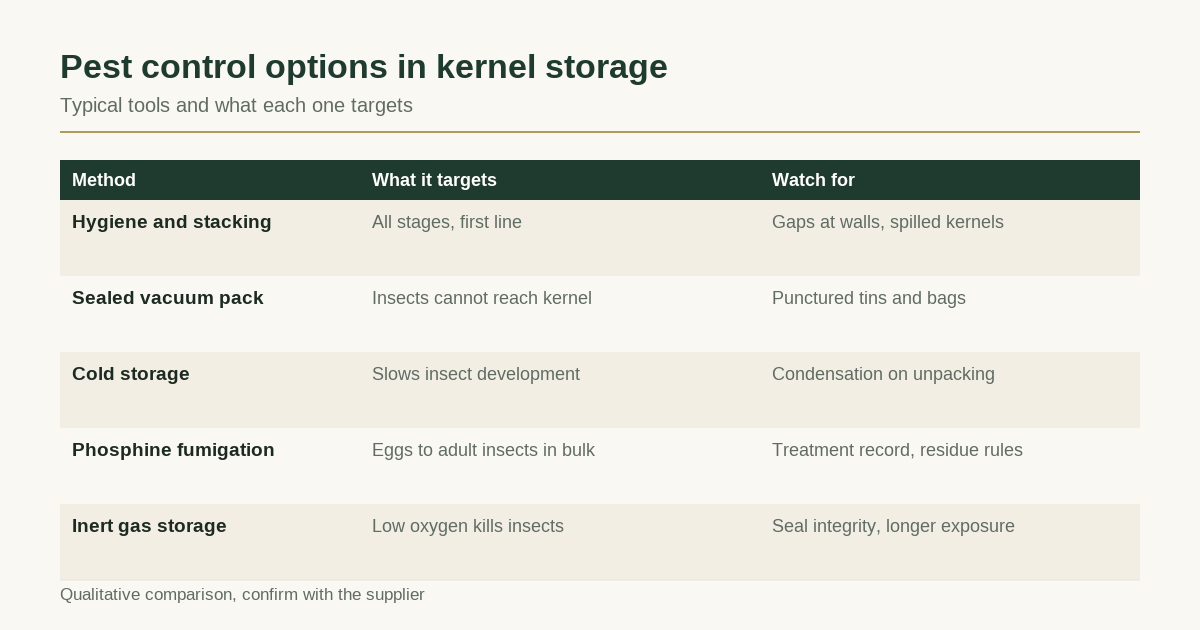
Options compared
| Method | Targets | Watch for |
|---|---|---|
| Hygiene and trapping | Early detection, all stages | Gaps at walls, spilled kernels |
| Sealed vacuum pack | Keeps insects out | Punctured tins and bags |
| Cold storage | Slows insect growth | Condensation on unpacking |
| Phosphine fumigation | Eggs to adults in bulk | Treatment record, residue rules |
| Low oxygen storage | Kills insects slowly | Seal integrity, long exposure |
Need a price for this grade? Request a quote
What to do in your own store
Store cartons off the floor on pallets away from walls and rotate stock first in, first out. Keep the area clean and free of spilled kernels. Fit insect traps and read them weekly, and record counts. Inspect open tins before use, and seal or finish them quickly. If you find evidence of insects, isolate the stock, photograph it and contact your supplier and your pest control provider before you move anything. Moving infested cartons spreads the problem.
If your store runs warm, consider a chilled room for the lots you hold longest. Our guide to moisture, storage and shelf life gives guidance on storage conditions.
Questions to put to a processor
- How do you protect stored kernels from pests before packing?
- Do you fumigate kernels, storage rooms or containers, and with which product?
- Will you supply a treatment record with the dose, dates and treatment provider?
- How long do you ventilate and do you test for residues on export lots?
- How do you inspect containers before loading?
Organic and low-residue programmes
If you buy organic cashews or sell into a market with strict residue rules, fumigation with synthetic fumigants may not be allowed. Organic standards limit the treatments a certified operator can use, and they differ between schemes. Our guide to organic, kosher and halal certification explains how to check the scope of a certificate. In these programmes plants rely more on hygiene, sealed packing, cold storage and low oxygen storage. Ask whether the plant has a documented procedure for pest control in organic lots and whether it keeps them apart from conventional stock.
A simple inspection routine on arrival
When a container arrives, check the doors, floor and walls for live insects and webbing before unloading. Pull cartons from the front, middle and back and open one tin from each. Pour the kernels over a white tray and look for webbing, fine dust, small holes in kernels and live or dead insects. Photograph anything unusual with the lot number visible. If the container smells musty or the cartons are damp, record that too and call the forwarder. A short routine at the dock settles most questions of where an infestation began, and it makes any later claim far easier to support.
Keep in mind that a treatment is a record of a past event, not a guarantee about the future. A lot fumigated at the plant can still be reinfested in a transit warehouse or on your own dock if the packs are open or damaged, so the sealed pack and clean storage remain the lasting protection after any gas has cleared.
Which residue limit applies to a fumigated kernel is a question for your broker or laboratory; the residue rules are set out in our guide to cashew food safety for importers.
Next step
If your product or customer has pesticide or residue limits, put them in the requirement. We price it with a Vietnamese processor that runs your grade, and you get one detailed quote. Send a requirement and we reply within 24 business hours.
See also: For residue limits and the records to ask for, see our reference page on phosphine residue in cashew kernels.
See also: If a buyer asks for a plant health paper with a treatment statement, see the page on the phytosanitary certificate for cashew kernels.
Frequently asked questions
Are cashew kernels fumigated before export?
Practice varies. Kernels packed in sealed vacuum tins are generally protected from insects by the pack itself, and some plants fumigate storage rooms or containers rather than the kernels. Ask each processor what treatment it uses, with what product and whether a treatment record is provided.
Which insects attack stored cashews?
Typical storage pests include the Indian meal moth, the red flour beetle and the cigarette beetle. They enter through gaps in packs, feed on kernels and leave webbing, frass and holes. A warm, humid store speeds their development.
What should I ask for if a lot has been fumigated?
Ask for the treatment certificate, the product used, the date and dose, and the exposure and ventilation times. Check that the product and any residues meet the rules of the country you import into, and that the treatment record matches your lot.
VietCashew supplies Vietnamese cashew kernels on one quote. We publish no prices, because a cashew quote is only valid for days. How an order runs and what we publish.
Need a price for this grade?
Send the requirement. We reply within 24 business hours with one detailed quote for the packed kernels.
Request a quote