Guides / Quality
Vacuum Tins, Flexi Bags and Gas Flushing: How Cashew Kernels Are Sealed
A cashew kernel is roughly half oil, and oil turns stale when it meets oxygen. Most of what a processor does at the last step of the line is an attempt to keep air away from the kernel for as long as the contract requires. The tin, the bag and the gas inside them are not packaging detail. They are the shelf life of the product.
This guide explains the main pack formats for cashew kernels, what vacuum and gas flushing do, where each one fails and what to ask a processor so you know what you are buying.
What oxygen does to a cashew
Oxygen reacts with the unsaturated fats in the kernel and produces compounds that taste stale, then cardboard-like and eventually rancid. Heat and light speed it up. Moisture speeds mould. A kernel left in open air in a warm warehouse will go off in weeks. The same kernel sealed in a good vacuum pack in a cool store will last about a year or more. Our guide to moisture, storage and shelf life walks through the four factors in detail.
Packing is where you decide how much oxygen the kernel will meet. There are two tools: pulling air out with a vacuum and replacing what is left with a gas that does not react with the oil.
The common formats
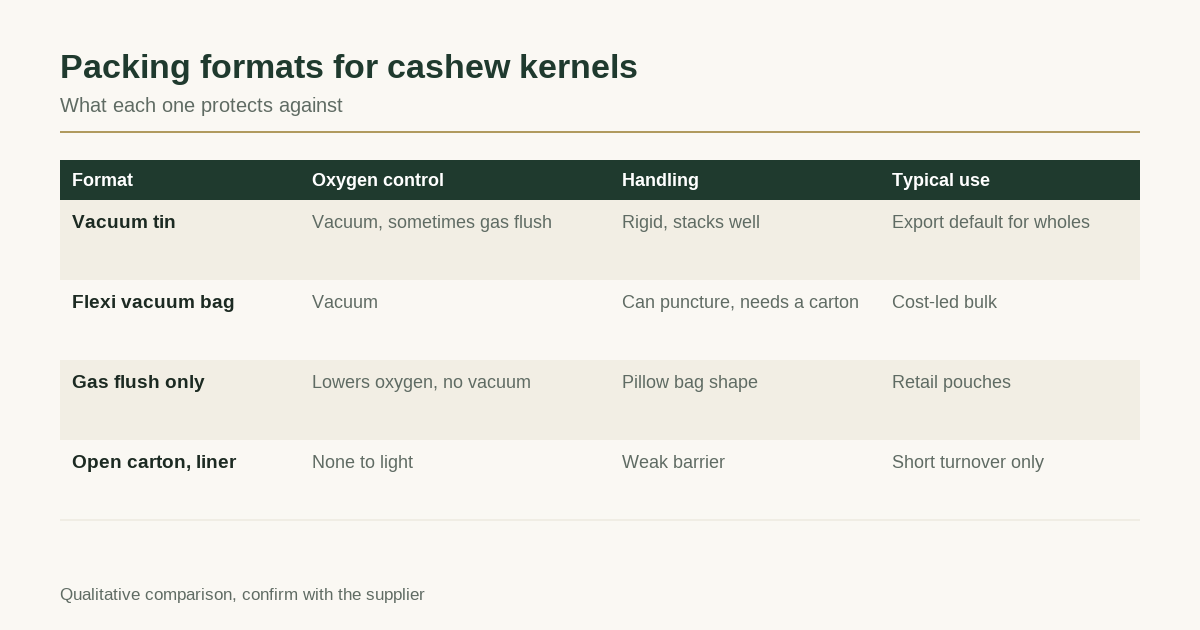
25 lb vacuum tin. A rigid tin, filled with kernels and sealed under vacuum. Two tins go in a carton. This is the long-standing export default for whole kernels. The tin resists crushing, protects against puncture and gives a clear seal indicator, because the lid pulls down slightly when the vacuum holds.
Flexi vacuum bag. A multi-layer plastic bag, commonly 50 lb net, vacuum sealed and packed in a carton. It costs less than a tin and fits more kernel into a container. It can puncture on a sharp kernel edge or a rough carton, and a punctured bag has no seal left. Our guide to container loading and transit risks covers how handling affects bag integrity.
Gas-flushed pouches and tubs. Retail packs, often sealed with an inert gas in the headspace and no vacuum, so the pouch keeps its shape. They suit shorter shelf lives and consumer handling. Private label programmes usually combine a retail pouch with a master carton. Our guide to private label cashew packaging covers formats and minimums.
Open cartons with liners. A liner in a carton gives little oxygen barrier. This is only sensible for kernels that will be used within days, such as a local reseller or a plant that repacks at once.
What CO2 and nitrogen flushing add
A vacuum removes most of the air, but a small amount of oxygen remains, and kernel surfaces hold some. An inert gas flush replaces part of the remaining atmosphere with carbon dioxide or nitrogen before the final seal. Some plants pull a vacuum, break it with gas, then pull again. The result is a lower residual oxygen level than vacuum alone.
Carbon dioxide dissolves slightly into the kernel oil and, in higher concentration, slows insect and mould activity. That is why some processors favour it in tins. Nitrogen is inert and cheaper, and it is common in pouch lines. Neither gas fixes a kernel that was packed with high moisture or with oil already turning.
Ask whether the plant flushes, which gas it uses and what residual oxygen it measures. A processor that tests the headspace can state a figure. One that does not is relying on the seal alone.
The weak points in any format
| Format | Main weak point | What to check |
|---|---|---|
| Vacuum tin | Dented or poorly seamed lid | Lid tension on arrival, seam inspection |
| Flexi bag | Puncture or pin hole | Bag firmness, carton condition |
| Gas-flushed pouch | Seal leaks, no vacuum margin | Seal strength, headspace oxygen |
| Open carton | No barrier | Turnover time |
A lost vacuum is easy to see on a tin: the lid pops up or feels loose. It is harder to see on a bag, where the bag may look tight from the kernels pressing outward. Squeeze a few bags on arrival and compare with a sealed reference bag.
Moisture at packing sets the ceiling
A perfect seal cannot fix a kernel packed too damp. Moisture near the contract maximum gives mould more to work with and speeds oxidation. A plant that packs on a humid day with kernels that sat on open trays will pack the extra moisture into the tin. Ask for moisture at packing, from several tins in the lot, and compare it to your limit.
Need a price for this grade? Request a quote
Pack weights and cartons
The standard export carton holds two 25 lb tins, about 22.7 kg net. Flexi bags of 50 lb net give a similar carton weight. Container loading and minimum order quantity follow from these weights. A 20 foot container packed with tins loads roughly sixteen metric tons of kernel, a figure we use in our guide to minimum order quantity and container maths. Flexi bags can fit a little more.
Retail packs change the arithmetic. A carton of retail pouches holds far less kernel by weight, and a container carries less product for the same volume. That is why unit cost rises for retail formats.
Shelf life claims
Many processors state a twelve month shelf life for kernels in an intact vacuum tin stored at ambient temperature. That figure assumes a moisture at packing within the spec, a good seal and a store that does not run hot. Treat it as a starting point and ask what conditions it assumes.
If your product needs a longer shelf life, say so up front. Options include a gas flush on top of vacuum, a lower moisture limit, chilled storage on arrival or a shorter reorder cycle. If your shelf life claim to retail customers depends on the supplier’s figure, get the figure and its conditions in writing.
What to check on arrival
- Tin lids are drawn down and not domed. Press a few to check for movement.
- Flexi bags feel firm, with kernels packed tight and no loose air.
- Cartons are dry, intact and stacked as shipped.
- Open one tin: the smell is clean and nutty, with no sharp or stale note.
- Record the pack date, lot number and moisture from the certificate for your files.
Questions to put to a processor
- What pack formats do you offer for this grade, and what do you recommend for my storage time?
- Do you flush with gas, and which one?
- What residual oxygen do you measure in the pack?
- What moisture do you pack at, and how is it checked?
- What shelf life do you state, and under what storage conditions?
A note on flexi bags and cartons
Flexi bags rely on the carton for mechanical protection, so carton quality matters as much as film quality. A thin carton collapses under a tall stack and a bag edge pushes through the board. Ask what carton grade the plant uses, how many layers it stacks on a pallet and whether pallets are wrapped. If your route has several handling points, a tin may cost less in the end than a flexi bag that loses a few percent of its seals to punctures.
When to ask for a gas flush
A flush adds cost per tin and a step on the line, so it is worth asking for when the benefit is clear. It makes the most sense for long storage, hot warehouses, roasted or seasoned kernels with more exposed oil, and pieces, which have more cut surface than wholes. For a fast-turning lot of white wholes going into a cool store, a good vacuum alone is usually enough. State your storage time and temperature in the requirement and let the processors recommend what they would run.
Next step
Tell us the format you need, the storage time you plan and the shelf life your customers expect. We price it with a Vietnamese processor that runs it, and you get one detailed quote. Send a requirement and we reply within 24 business hours.
Frequently asked questions
Is a vacuum tin better than a flexi bag for cashews?
A rigid vacuum tin protects the kernel better against puncture and crushing, and it keeps the seal intact through rough handling. A flexi vacuum bag costs less and packs into a container more tightly, but a puncture lets oxygen in. Match the format to your handling chain and storage time.
What is the point of flushing cashews with CO2 or nitrogen?
Cashew oil oxidises when oxygen reaches it. Vacuum removes most of the air and an inert gas flush replaces what is left, which lowers the residual oxygen further. The result is a longer shelf life under the same storage conditions, if the seal holds.
How long do vacuum packed cashews keep?
Processors commonly state around twelve months at ambient temperature for an intact vacuum tin, and shorter for bags or poor storage. The figure depends on moisture at packing and warehouse temperature, so ask for the stated shelf life in writing and the basis for it.
VietCashew supplies Vietnamese cashew kernels on one quote. We publish no prices, because a cashew quote is only valid for days. How an order runs and what we publish.
Need a price for this grade?
Send the requirement. We reply within 24 business hours with one detailed quote for the packed kernels.
Request a quote