Guides / Compliance
Which Market's Rules Should Decide Your Cashew Spec: EU, US or Japan
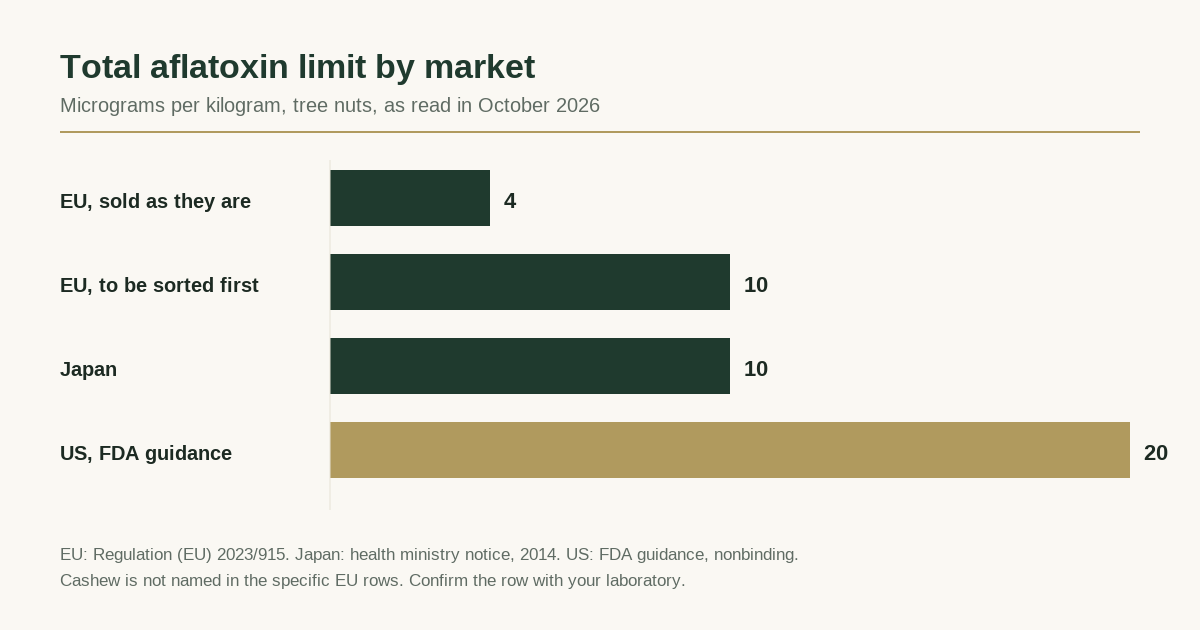
The market where a cashew lot is sold decides which limits, filings and sampling rules apply, so the spec has to start from the destination. The three largest routes differ in the number (the EU is tightest on aflatoxin), in how a lot is judged (Japan judges each shipment on its own sample) and in who files what (the US importer carries a written verification programme, the Japanese importer files a notification). This post is part of our guide to cashew food safety for importers, and it sets the three routes side by side for shelled kernels.
We file nothing for you. This is not legal advice, and a customs broker in the destination country should confirm each row. Vietnamese export paperwork is outside this post.
The three routes at a glance
| Criterion | European Union | United States | Japan |
|---|---|---|---|
| Total aflatoxin limit, micrograms per kilogram | 4.0 (B1 2.0) for tree nuts placed on the market as they are; 10.0 (B1 5.0) for tree nuts to be sorted or physically treated first | 20, FDA guidance | 10 |
| Instrument | Regulation (EU) 2023/915, Annex I rows 1.1.6 and 1.1.7 | FDA CPG Sec. 555.400, June 2021 | Food Sanitation Act, Article 6(2), per a 2014 ministry notice |
| Other contaminants we read | Nickel 10 mg/kg for cashew nuts; cadmium 0.20 mg/kg for tree nuts | We did not find a figure | We did not find a figure |
| Residues | See the pesticide guide | See the pesticide guide | See the pesticide guide |
| Microbiology | See the Salmonella guide | See the Salmonella guide | See the Salmonella guide |
| Importer duty | Imported food must meet EU food law or equivalent; traceability one step back and one forward | FSVP, foreign facility registration, prior notice | Import notification before sale |
| How a lot is judged | Separate sampling regulation, not read | Original and check analysis both above 20, identity confirmed | Shipment sample, no averaging, rework or retest, per a 2018 USDA report |
Sources: Regulation (EU) 2023/915 (consolidated 19 August 2026); Regulation (EC) 178/2002; 21 CFR part 1; FDA CPG 555.400; MHLW notice of February 2014; MHLW import page; USDA GAIN JA8061. Limits were read in October 2026.
Aflatoxin and other contaminants
The EU divides tree nuts by use. Rows 1.1.6 and 1.1.7 of Annex I set 5.0 and 10.0 for B1 and the total on tree nuts to be sorted or physically treated, and 2.0 and 4.0 on tree nuts placed on the market for the final consumer or as the only ingredient. Cashew is not named in the specific rows for almonds, pistachios, apricot kernels, hazelnuts and Brazil nuts, so our reading is that the general tree nut rows apply. Lots sold under the higher limit must carry the statement required by Article 5, and the lot may not go to the final consumer or into an ingredient line before treatment.
The EU regulation also sets metals. The tree nut section of the cadmium chapter gives 0.20 mg/kg, and the nickel chapter gives 10 mg/kg for cashew nuts, a level whose transitional date in Article 10 is 1 July 2025. The lead chapter of the version we read has no tree nut row. We found no metal figure for cashew in the US or Japanese sources we opened, which is a statement about our search, not about the law.
The US 20 figure is guidance. FDA’s policy guide says it may consider food above 20 total to be adulterated, and for import refusal its criteria need both the original and check analyses above 20 with the aflatoxin identity confirmed. Japan’s 10 comes from a Japanese health ministry notice of February 2014 stating that total aflatoxin is regulated at that level under Article 6(2) of the Food Sanitation Act.
How a lot is judged
A number means little without the protocol behind it. A 2018 report by the USDA office in Tokyo describes Japan’s protocol: since 2011 the sample size rose from 1 kg to 5 kg, the result of a shipment is not averaged, reworking is not allowed and there is no retest. It also says that once two violations by two parties from the same country occur in 12 months, all shipments of that commodity from that country are held until a test confirms compliance. The FY2026 monitoring plan points the same way: if a violation is found in monitoring, imports from the same manufacturer, the same processor or the same exporting country are put under an inspection order at once. These are 2018 and 2026 descriptions, so confirm the current protocol with your Japanese importer.
In the US, the CPG’s import refusal criteria require two analyses to agree, which leaves room for a check. The EU sets sampling methods in a separate regulation that we did not read, so we draw no conclusion about EU sampling in this post.
Need a price for this grade? Request a quote
Importer duties
EU. Article 11 of Regulation (EC) 178/2002 says food imported into the EU must comply with the relevant requirements of EU food law, or conditions recognised as at least equivalent. Article 18 requires operators to identify who supplied them and to whom they supplied, with systems that can answer an authority on demand. We found no EU equivalent of a per-food written verification programme in the texts we opened.
US. Three filings sit with different parties. The importer keeps an FSVP, built as in our guide to FSVP for cashew importers. The foreign facility must register with FDA before it begins to manufacture, process, pack or hold food for consumption in the US (21 CFR 1.225 and 1.230) and renew every other year between 1 October and 31 December of each even-numbered year. Prior notice must be confirmed by FDA at least 2 hours before arrival by road, 4 hours by rail or air and 8 hours by water, and not more than 30 days ahead through the customs interface (21 CFR 1.279).
Japan. Article 27 of the Food Sanitation Act requires the importer to notify the minister, and the ministry’s page says imported foods must not be used for sale without the notification. The importer files it, so your Japanese buyer must tell you what its filing needs.
Labels and the other tables
Allergen labelling differs in all three markets and is covered in the allergen section of our food safety guide. Residue limits and microbiological specs are in pesticide residues in cashews and Salmonella and micro specs for cashew kernel buyers.
Which route should set your spec
- You sell to the EU only. Write the 2.0 and 4.0 pair into the spec for kernels sold as they are, and ask for the nickel result if the lot is for the EU.
- You sell to the US only. The law you answer to is FDA’s, and the filing that fits is the FSVP. A tighter customer spec can still apply.
- You sell to Japan. Write 10 as the ceiling and plan for shipment-by-shipment judgement, so a marginal result is not a plan.
- You sell to several markets. Write the tightest number that applies into the contract, or segregate lots at the contract stage. A lot made to the EU pair also meets the other two aflatoxin numbers in the table, but residue, metal and label rules still differ.
The cost of picking wrong is the lot itself: a lot built to 20 can be refused where the limit is 4, with storage and re-routing on top. Our spec sheet tool is where those lines go next to the grade. For the full set of checks in one place, return to our guide to cashew food safety for importers.
See also: the EU rules for a lot landed in Rotterdam are on our page on cashew imports through the Netherlands.
Sources
- Regulation (EU) 2023/915 on maximum levels for certain contaminants in food, consolidated text of 19 August 2026, EUR-Lex
- Regulation (EC) No 178/2002 laying down the general principles and requirements of food law, EUR-Lex
- eCFR, 21 CFR part 1: FSVP (subpart L), food facility registration (subpart H) and prior notice (subpart I)
- FDA Compliance Policy Guide Sec. 555.400, Aflatoxins in Human Food (June 2021)
- Japan Ministry of Health, Labour and Welfare, notice on aflatoxin M1 in milk (February 2014, Japanese, section 1 on total aflatoxin)
- Japan Ministry of Health, Labour and Welfare, Imported Foods Inspection Services page, Food Sanitation Act import notification
- Japan Ministry of Health, Labour and Welfare, Imported Foods Monitoring and Guidance Plan for FY 2026
- USDA Foreign Agricultural Service, GAIN report JA8061: Japan's Aflatoxin Testing Protocol (21 August 2018)
Frequently asked questions
Which market has the strictest aflatoxin limit for cashews?
On the numbers, the EU. Regulation (EU) 2023/915 sets 2.0 micrograms per kilogram for B1 and 4.0 for the total on tree nuts placed on the market as they are, against 10 total in Japan and 20 total under US guidance. Cashew is not named in the specific rows, so confirm the row with your laboratory.
Does the US set a legal aflatoxin limit for cashews?
FDA works from a compliance policy guide, not a statutory number. It says FDA may consider human food above 20 micrograms per kilogram of total aflatoxins to be adulterated, and import refusal needs both the original and check analysis above 20 with the toxin identity confirmed. The guide is nonbinding on the public.
What does a Japanese importer file before cashews can be sold?
An import notification under Article 27 of the Food Sanitation Act, made to the minister. The health ministry's page says imported foods must not be used for sale without it. The importer files, not the processor, so your Japanese buyer should tell you what its filing needs.
Do EU importers need a programme like the US FSVP?
We found no equivalent written programme in the EU texts we opened. Article 11 of Regulation 178/2002 requires imported food to comply with EU food law or conditions recognised as at least equivalent, and Article 18 requires traceability one step back and one step forward. Ask your adviser about your national rules.
VietCashew supplies Vietnamese cashew kernels on one quote. We publish no prices, because a cashew quote is only valid for days. How an order runs and what we publish.
Need a price for this grade?
Send the requirement. We reply within 24 business hours with one detailed quote for the packed kernels.
Request a quote