Guides / Quality
Shell, Skin and Steel: How Cashew Plants Keep Foreign Matter Out of the Tin
A food manufacturer can forgive a pale kernel. It cannot forgive a piece of shell in a cashew butter jar or a metal fragment in a bar. Foreign matter is the part of the spec where the consequences of a miss are largest, because it turns a quality problem into a complaint, a recall or an injury.
Cashew plants face a particular version of the problem. The nut’s own shell and skin are the main foreign matter, and they look a lot like the kernel. This guide covers where foreign matter enters a cashew line, which controls catch it and what to put in a spec.
What counts as foreign matter
In the cashew trade, foreign matter covers anything in the pack that is not a kernel of the grade. Two groups matter.
Material from the nut. Fragments of shell, pieces of the brown skin, shell oil residue and bits of the nut’s inner membrane. These are not strictly foreign to the nut, but they are foreign to a kernel pack, and buyers treat them as defects.
Material from outside. Stones and soil that came in with raw nuts, wood splinters from sacks and pallets, string, plastic from liners and gloves, insects and their remains, and metal from machinery and tools. These are what a food safety programme worries about most.
Our guide to cashew kernel defects covers the defects that belong to the kernel itself. Foreign matter is the layer on top.
Where each hazard enters the line
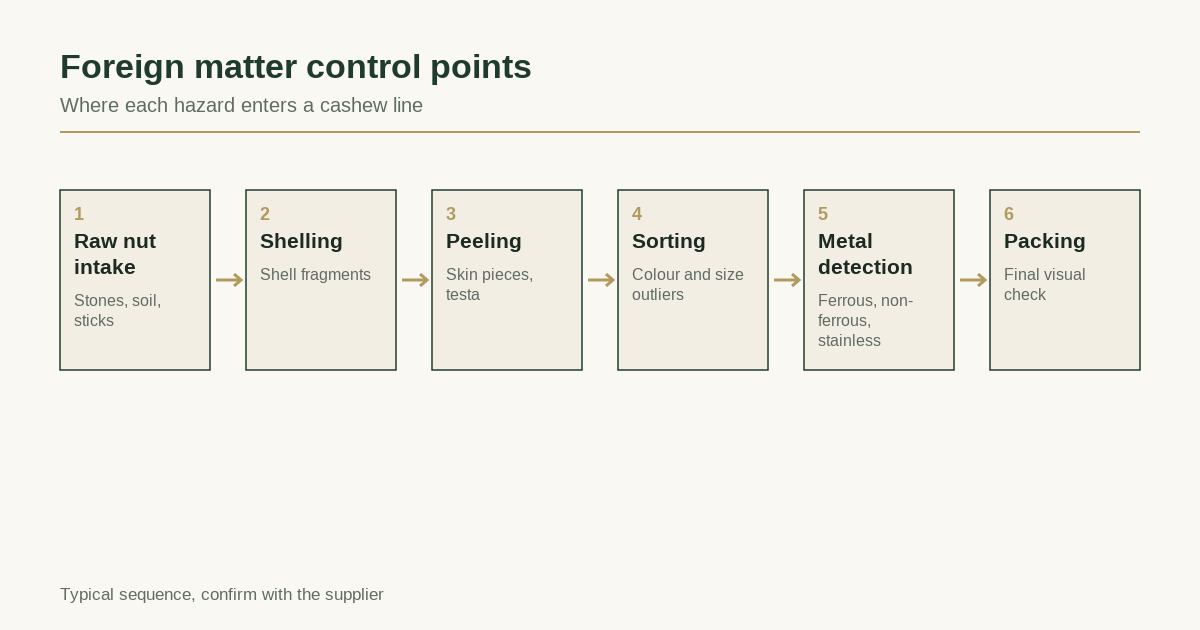
Raw nuts arrive with stones, soil and sticks. Cleaning and screening remove most of them before steaming. Shelling is the main source of shell fragments, because a cut shell can splinter and a fragment can travel with the kernel. Peeling creates loose skin. Sorting and packing add handling, and with it gloves, plastic and metal from tools.
Metal enters from wear in shelling blades, from screws and wire in machinery and from items carried in by workers. A shelling machine with cutting blades is a point where a chip can break off and ride with the kernel stream.
The controls that matter
Cleaning and screening at intake. Stones and soil go first. Plants use air classifiers, vibrating screens and sometimes magnets to take out ferrous pieces from the raw nuts.
Shell separation after cutting. Air or vibration separates kernel from shell. Plants run it more than once, because a single pass leaves fragments.
Visual grading. Hand graders pick out shell and skin that the machines miss. This is the main defence against shell, and it depends on light, training and line speed.
Colour sorting. A colour sorter rejects brown fragments that contrast with a pale kernel. It misses fragments the same colour as a scorched kernel. Our guide to colour sorters and hand grading covers its limits.
Metal detection. A detector placed after final grading checks the stream or the sealed pack for metal. It stops metal, but it does not catch stone or shell.
X-ray inspection. An X-ray unit detects dense objects whatever their material, which includes stone, glass and dense shell as well as metal. It costs more and fewer cashew plants run one.
Tool control and housekeeping. Plants that keep a register of blades, screws and knives and check them at shift change cut the chance of metal reaching the stream in the first place.
How metal detection is verified
A detector is only useful if it works on the day. Plants test with certified test pieces of ferrous, non-ferrous and stainless steel, passed through the detector at the start of a shift, at intervals during it and at the end. A record of each test shows that the detector caught the pieces and rejected them.
Ask for the test piece sizes, the test frequency and the action taken when a test fails. A good routine holds any product made since the last passing test. A plant that tests only once a day has a wide window of risk.
Remember that detection sensitivity depends on the product and the pack. A detector that catches a 2 mm ferrous piece in dry kernels may catch less in a foil-lined pack. The test should use the pack format you will receive.
What the standards expect
Retail and food manufacturing customers usually require a documented foreign matter programme under a recognised food safety scheme. Our guide to BRCGS, IFS and FSSC certification explains what those schemes cover. We do not claim certification for any plant, and you should ask for the certificate and check its scope and date.
A certificate shows that a system is in place. It does not tell you the actual rate of shell in the last lot. For that you need the lot certificate and your own sample.
Need a price for this grade? Request a quote
Controls compared
| Control | Catches | Misses |
|---|---|---|
| Screening and magnets at intake | Stones, soil, ferrous pieces | Shell, skin |
| Air and vibration separation | Loose shell | Fragments stuck to kernels |
| Hand grading | Shell, skin, spots | Fatigue errors, hidden metal |
| Colour sorter | Dark fragments | Same-colour fragments |
| Metal detector | Ferrous, non-ferrous, stainless | Stone, glass, shell |
| X-ray unit | Dense foreign bodies of any kind | Light or low-density pieces |
No single control covers everything. Plants stack them so each one catches what the previous one missed.
What to write into the spec
- Metal, glass and stone: none allowed. State it plainly.
- Shell and skin: a maximum count per kilogram or a percentage by weight, and the sample size used to check it.
- Insects and insect damage: none visible in the lot.
- Test method: visual inspection of a named sample size, and the detector and test piece routine the plant follows.
Our guide to what to check on a cashew spec sheet lists the rest of the fields, and the spec sheet tool builds the document for you.
What to do on arrival
Open several tins from different cartons and pour the kernels over a white tray. Look for shell and skin, which are the most likely finds, and for anything else that does not belong. Record what you see with photographs and keep the lot number. If you find foreign matter, stop the lot and follow the claim steps in our guide to quality claims on arrival. Early evidence is what makes a claim workable.
Questions to put to a processor
- Which detection equipment do you run, and where does it sit on the line?
- How often is it tested, with which test pieces, and what happens after a failed test?
- How many passes remove shell after cutting?
- How do you control blades, tools and loose items on the shelling floor?
- What shell and skin level do you see on recent lots of my grade?
A practical view of risk by buyer type
The right level of control depends on what you make. A buyer that repacks whole kernels for sale as a snack faces consumers who will bite into any shell fragment, so shell and skin limits matter most. A butter or paste maker mills the kernel, which can break up a hard fragment and spread it, but a stone or metal piece can damage the mill and the product. A bakery or chocolate maker may run its own metal detector or sifter downstream, which shifts some of the risk to its own line but does not remove the need for a clean supply.
State how you will use the kernel in the requirement. A processor that knows the end use can tell you which of its lines and which level of inspection fit, and may offer a hand-graded final pass for a clear-pack order.
Keep a retained sample
Ask the plant to keep a retained sample from each lot for the length of the shelf life, and keep your own from each arrival. If a complaint arrives months later, a retained sample from the same lot shows whether the foreign matter was there at shipment. Without one, the argument rests on opinion. A sealed tin kept in a cool cupboard costs very little compared with the cost of a disputed recall.
Foreign matter control is one hazard in an importer’s file; the others are laid out in our guide to cashew food safety for importers.
Next step
If foreign matter limits are strict in your product, say so in the requirement and name the detection method you expect. We price it with a Vietnamese processor that runs it, and you get one detailed quote. Send a requirement and we reply within 24 business hours.
Frequently asked questions
What is the most common foreign matter in cashew kernels?
Shell fragments and pieces of the brown skin are the most common, because they come from the nut itself and are the same colour as the kernel. Stones, soil, string and insect parts come from the raw nut and the plant. Metal is rarer but carries the highest risk for a food maker.
Do cashew plants use metal detectors or X-ray machines?
Many export plants run a metal detector at the end of the line before the pack is sealed. Some also use X-ray units that can pick out stone, glass and dense shell as well as metal. Ask which the plant runs, where it sits on the line and how often it is tested.
What foreign matter limit should I put in a cashew spec?
State a zero tolerance for metal, glass and stone, and a limit in pieces per kilogram or percent by weight for shell and skin. Name the test method, which is usually a visual inspection of a defined sample size. Ask the processor to confirm it can meet the limit.
VietCashew supplies Vietnamese cashew kernels on one quote. We publish no prices, because a cashew quote is only valid for days. How an order runs and what we publish.
Need a price for this grade?
Send the requirement. We reply within 24 business hours with one detailed quote for the packed kernels.
Request a quote