Guides / Quality
Machine and Human Eyes: How Cashew Kernels Get Their Colour Class
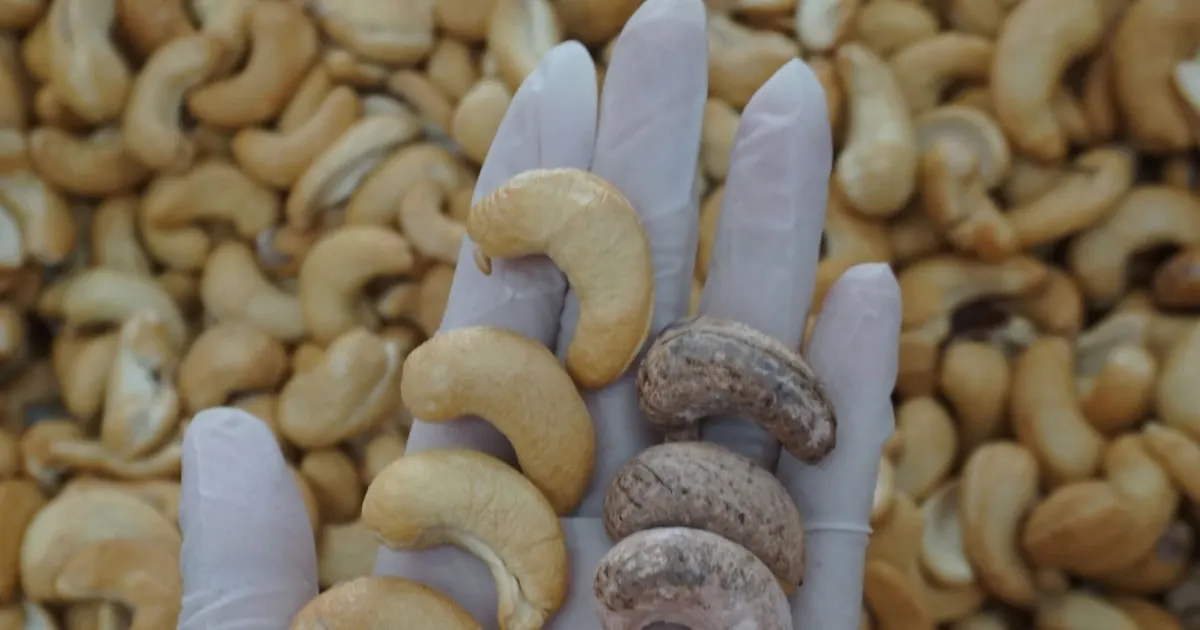
Two cashew kernels from the same crop and the same line can look different. One is pale ivory. The other is light amber at the tip, or has a faint brown speck on one face. To a roasting plant the difference is trivial. To a retailer filling clear pouches it decides whether the lot can ship. Colour class is how the trade names those differences, and sorting is how a plant puts each kernel in its class.
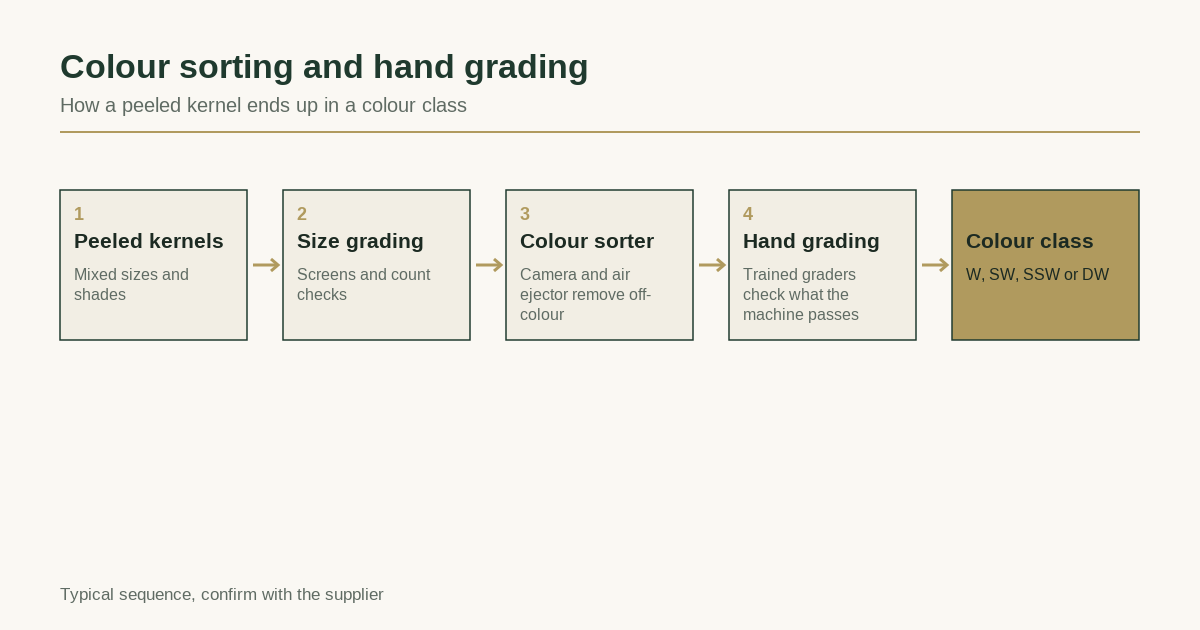
Sorting happens at the end of the line and uses two very different tools. A machine with cameras and air jets does the fast pass. People at tables do the slow, careful one. A buyer who understands both can ask sharper questions and read a certificate with more confidence.
What colour sorting is trying to achieve
Cashew trade defines a ladder of colour classes for whole kernels: white, scorched, second scorched and dessert, from palest to darkest. Our guide to scorched cashew grades explains how that ladder prices out. Pieces follow a similar split. A kernel does not carry its class in a label, it carries it in its shade, so the plant has to read that shade and decide.
The sorter and the hand graders also remove defects that are not strictly about colour: spotted kernels, remnants of skin, bits of shell, shrivelled kernels. In practice a colour class and a defect limit come as a pair. A white kernel with a dark spot is not a white-class kernel for most contracts.
How an electronic colour sorter works
A colour sorter moves kernels in a thin stream past one or more cameras, usually on a belt or a chute. The camera compares each kernel with a set of reference shades and flags any kernel outside the accepted range. A jet of compressed air then knocks the flagged kernel into a reject channel. This happens in milliseconds, so a single machine can sort a large volume per hour.
Operators set the acceptance range for each run. A tight range gives a paler accepted fraction and a larger reject fraction. A loose range gives more accepted kernels and lets more variation through. The machine does not decide what is white. The operator decides, using reference samples of each class, and the machine repeats that decision quickly.
Some machines also use infrared or other sensors that can pick out foreign material that looks similar to a kernel in visible light, such as shell fragments or stones. Ask whether the plant uses a sorter with these capabilities and which defects it is set to remove.
What a sorter does not do well
A colour camera sees surface shade. It does not see the underside of a kernel unless the kernel tumbles, and a kernel can pass with a dark spot hidden on its back. It judges shade against the references it was given, so a drift in lighting or a dirty lens shifts the result. It does not see shape well, so a chipped kernel or a split sits in the same stream as a whole one unless a separate size and shape stage removes it.
These limits are why plants keep people on the line. They are not a sign that the plant is behind. Even the best sorting lines add hand grading afterward.
What hand graders add
Hand graders sit at tables with kernels moving past on belts or spread in trays. They remove skin, shell, spotted and insect-damaged kernels and any kernel with the wrong shape or shade for the grade. Experienced graders read many defects at a glance that a camera misses, and they can feel a hard shell fragment between their fingers.
Hand grading is slow and its quality depends on training, light and fatigue. Good plants rotate graders, limit shift length, use daylight-balanced lamps and check graded output against reference samples. Ask how often the line is audited and what reject rate triggers a review.
Size grading comes first
Kernels are also graded by size before colour, because the count per pound defines the W grade. Size grading uses screens or rotating drums with openings of set diameters, and kernels fall through at their size. A plant then checks counts by weighing a pound of kernels and counting them. Our guide to Vietnam cashew grades shows the count ranges behind each name.
Size and colour interact. A colour sorter set up for W320 kernels sees a different image than one set up for W180, so plants usually sort one size at a time. Ask whether size grading comes before colour sorting and whether the sorter is calibrated per grade.
How a plant decides what goes where
| Stage | What it does | Typical limit |
|---|---|---|
| Size screens | Splits by count per pound | Cannot see colour |
| Colour sorter | Rejects off-shade kernels by camera | Misses hidden faces |
| Hand grading | Removes spots, skin, shell, shape faults | Depends on training and light |
| Final check | Samples from each batch against reference | Only as good as the reference |
Need a price for this grade? Request a quote
Why the same lot can sort two ways
A processor can sort the same raw material into different splits by changing the sorter setting. A tight setting makes a clean white fraction and a big scorched fraction. A looser setting makes a larger white fraction with slightly more variation. Neither is cheating. The setting reflects what the plant is selling that week and what its order book needs.
This is why you should ask for a counter sample from the same production run as your shipment and not from a catalogue. It is also why a very low quote for a white grade deserves a closer look at the colour spec. The spec should state the limit for off-colour kernels as a percentage by weight, and the sample should show it.
What to write into the contract
State the colour class by its code, the maximum percentage of off-colour kernels allowed in the lot and the test method, which is usually visual comparison against a reference sample under named light. Name the defect limits separately: spotted, skin-on, shell, insect-damaged. Our guide to what to check on a cashew spec sheet gives a full list, and the spec sheet tool builds one without an email wall.
If your product is sold in a clear pack, ask for a photo of the line output before packing a lot, and ask the plant to hold the reference sample for the length of the contract.
Questions to put to a processor
- Do you use a colour sorter, and what camera and sensor type is it?
- Is sorting done after size grading, and per grade?
- How many hand graders check each tonne, and how are they audited?
- Which reference samples do you use for each colour class, and how often are they replaced?
- What reject share do you see by class, and where do rejects go?
Rejects do not disappear. A plant sells them as a lower class, as pieces or as ingredient-grade kernel. The answer to the last question tells you how the plant runs its economics.
Three common mistakes
Buying on the colour name alone. “White wholes” on a quote means little without a limit for off-colour kernels. Two plants can both sell W320 with different tolerance for amber tips, and the cheaper quote often carries the looser one. Ask both for the percentage in writing.
Judging colour under the wrong light. Warehouse lighting, phone screens and warm lamps all shift how a kernel looks. A sample that looks pale under a yellow bulb may look amber in daylight. Agree a lighting standard with the plant, even if it is just a window facing north at noon, and use it for every comparison.
Treating the sorter as a guarantee. A sorter reduces variation but never removes it. A lot sorted to the tightest setting still contains kernels at the edge of the class. If your product cannot take any, ask for a tighter limit and a hand-graded final pass, and expect to pay for it.
A short routine for sample day
When a counter sample arrives, tip it onto a white tray and photograph it from above in daylight. Pull out the ten darkest kernels and the ten with visible spots, and photograph those beside the pile. Do the same with the sealed reference from the previous lot. You now have a before and after record that takes ten minutes and settles most arguments about whether a shade drifted.
Next step
If colour matters for your product, say which class you need and what share of off-colour kernels you can accept. We price it with a Vietnamese processor that runs it, and you get one detailed quote. Send a requirement and we reply within 24 business hours.
Frequently asked questions
Do cashew plants use colour sorters or hand graders?
Most use both. A colour sorter handles volume and catches shade differences a tired eye misses, and hand graders catch shape, skin, shell and spots the camera passes. The mix varies by plant and by grade, so ask which stages are mechanical and which are manual.
Can a colour sorter change the colour class of a lot?
It does not change the kernels, it separates them. Running a lot through a sorter at a tighter setting pulls darker kernels into a lower class, which leaves a paler fraction. The result is a cleaner white grade and a larger scorched fraction, so the price of each moves.
How can I check the colour class of a lot on arrival?
Keep a sealed counter sample from before shipment and compare under the same light. Spread both on a white surface in daylight or a standard light box. Judge the shade, the spotting and the share of off-colour kernels against the contract limit.
VietCashew supplies Vietnamese cashew kernels on one quote. We publish no prices, because a cashew quote is only valid for days. How an order runs and what we publish.
Need a price for this grade?
Send the requirement. We reply within 24 business hours with one detailed quote for the packed kernels.
Request a quote