Guides / Quality
Reading Cashew Kernel Defects: What Each One Is, Where It Comes From and What to Allow
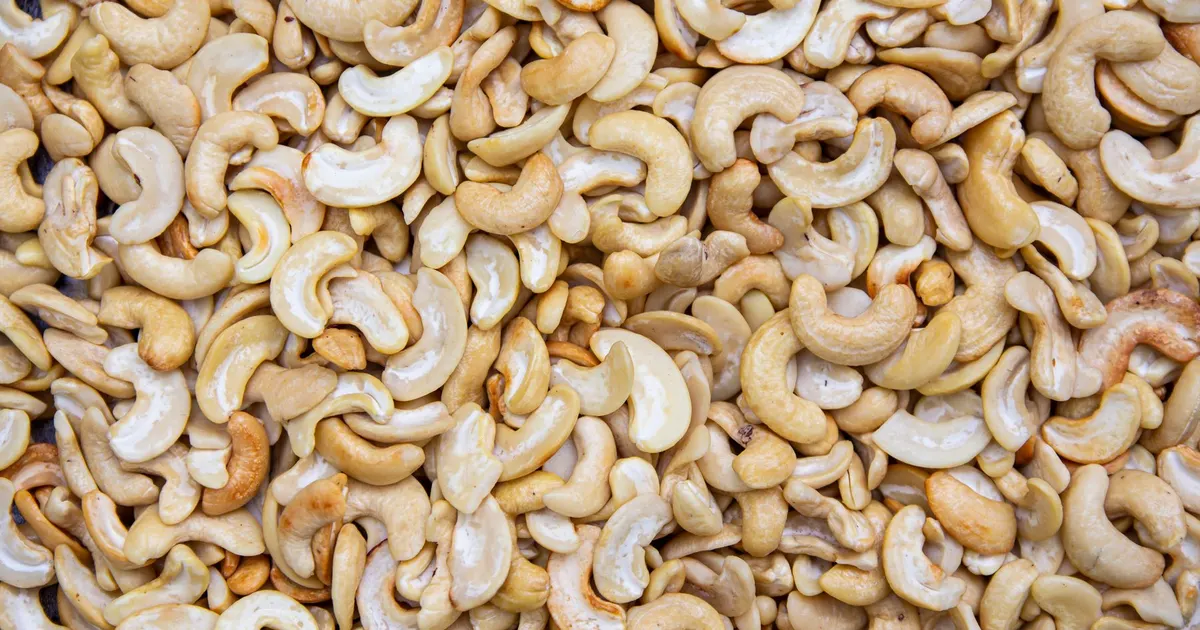
Any cashew lot contains some kernels that are not perfect. The question is how many, of what kind and whether the contract says so. Defects are where most quality disputes begin, because a pale, well-sized lot can still disappoint if one in twenty kernels is spotted or hollow. A buyer who can name the defects and set limits for each stands on firmer ground than one who writes “good quality” on an order.
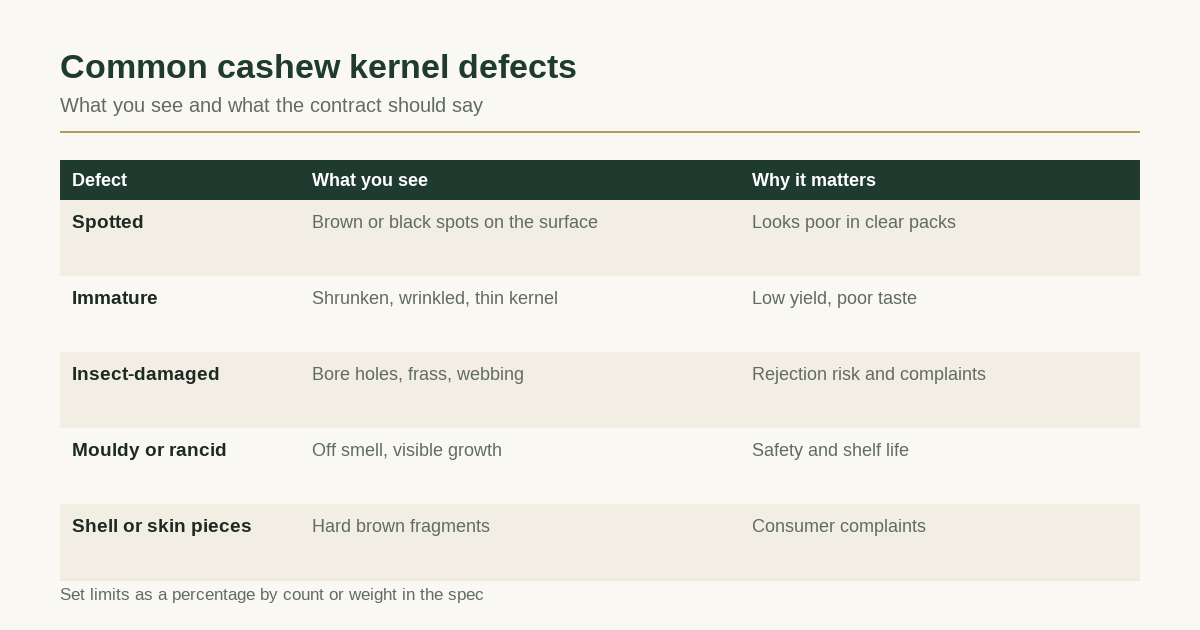
This guide covers the defects you will meet most, where each comes from, which are cosmetic and which are not, and how to put limits in a spec.
Spotted kernels
A spotted kernel carries small brown or black marks on its surface. The cause is usually shell oil that touched the kernel during shelling and then baked on in the drying oven, or bruising from handling, or the first sign of a blemish in the nut. Spots range from tiny pinpricks to patches covering part of the kernel.
Spots are mainly a cosmetic defect, but they matter a great deal in a clear pack, where they are the first thing a customer notices. They also push a kernel down the colour ladder. A spotted kernel in a white lot may drop it into the scorched class. Our guide to dessert wholes and LBW shows how the lower classes treat them.
Immature kernels
An immature kernel comes from a nut that was harvested too early or that failed to fill. It is shrunken, wrinkled and thin, sometimes pale and rubbery. It weighs less than a mature kernel of the same apparent size and tastes flat.
Immature kernels lower the yield of a lot and can distort the count, since a light kernel lets more fit in a pound. They also roast unevenly. Buyers who roast or grind should limit them, because they add little flavour and fat.
Insect-damaged kernels
Insect damage appears as small bore holes, tunnels, fine powder called frass and sometimes webbing. It can start in the field, where insects attack nuts, or in storage, where beetles and moths attack kernels. Our guide to fumigation and pest control covers prevention.
Insect damage is a serious defect. It signals a hygiene problem, it can spread to other stock and it often draws complaints from customers who find a live insect or a hole. Most specs set a very low limit or none at all, and treat a lot with visible live insects as rejectable.
Mould, off smell and rancidity
Mould shows as grey, green or white growth, or as a musty smell. It grows when moisture is too high. Some moulds produce aflatoxin, so mould is a food safety flag as well as a quality one. Our guide to aflatoxin and food safety covers the limits.
Rancidity is a stale, paint-like or cardboard smell from oxidised oil. It comes from age, heat and air. A rancid kernel cannot be fixed and a lot with a rancid smell is a rejection. Check the smell of any sample when you open it.
Skin, shell and foreign pieces
A kernel that kept patches of its brown skin counts as a defect in a white grade. Shell fragments are hard, brown and the same size as a kernel piece, and they are a safety and complaint risk. Our guide to foreign matter and metal detection covers the controls.
Broken and chipped kernels
Breakage is not always a defect, since a whole grade allows a share of splits and pieces by design. It becomes a problem when the share exceeds the limit. Chipped kernels with a bite taken from the edge are another visual flaw. State the share of pieces allowed in a whole grade, and ask how it is measured.
Defects at a glance
| Defect | What you see | Main cause | Risk |
|---|---|---|---|
| Spotted | Brown or black marks | Shell oil, bruising | Appearance, colour class |
| Immature | Shrunken, wrinkled, thin | Nut harvested early or unfilled | Yield, flavour |
| Insect-damaged | Holes, frass, webbing | Field or storage pests | Rejection, complaints |
| Mouldy | Growth, musty smell | High moisture | Safety, rejection |
| Rancid | Stale, paint-like smell | Age, heat, air | Rejection |
| Skin or shell pieces | Brown fragments | Peeling and shelling | Complaints, safety |
How to set limits
Name each defect separately. A single “defects” line lets one type hide behind another. For each, state the maximum as a percentage by weight, or the number of kernels per sample of a stated size. Be stricter on safety-related defects such as mould and insect damage, and looser on cosmetic ones such as light spotting, if your product allows.
Your limits should reflect the end use. A clear pack needs tight limits on spots and skin. A butter maker needs tight limits on mould and rancidity but can tolerate spots. Our guide to what to check on a cashew spec sheet lists the full set, and the spec sheet tool builds the document.
Need a price for this grade? Request a quote
How to measure a sample
Take a sample of a defined weight, for example 500 grams drawn from several tins. Spread it on a white tray in daylight. Sort the kernels into groups by defect, including a group of sound kernels. Weigh each group and divide by the sample weight. Record the result with photographs. Repeat on a second sample to check the spread, and keep a sealed duplicate for arrival day. Our sample approval guide describes the routine.
When a lot fails
If an arrival lot exceeds a limit, document the evidence before you move anything: photographs, weights, lot numbers and the sealed reference sample. Then follow the claim steps in our guide to quality claims on arrival. A claim backed by a counted, weighed and photographed sample is easier to settle than one based on a general complaint.
Questions to put to a processor
- What defect limits do you work to for this grade, by type?
- How do you check and record defects before packing?
- Do you keep retained samples of each lot?
- How do you handle a lot that fails your own check?
- Can you send a counter sample with a defect count from your own checks?
Defects and the end use
The same lot can be fine for one product and unsuitable for another. A lot with a few percent of light spotting works well in butter, where grinding hides it, and fails in a clear pouch. A lot with a few immature kernels works in a seasoned mix and disappoints a customer who roasts the nuts plain. Write your limits from the finished product backward: look at what the customer sees, tastes and keeps, then decide which defects would be noticed and which would not.
Tell the processor what the product is. Plants sort differently for different orders, and a plant that knows the end use can tighten a stage or choose a lot that fits. Without that information, it will aim at the common limit for the grade.
Sampling plans and counts
A single handful tells you little. Take samples from several tins across several cartons and combine them, so that the sample reflects the whole lot. A sample of at least a few hundred grams is better than a small scoop, since rare defects like insect damage may appear in only one kernel in a hundred. Record how many tins you opened and from which cartons.
If your contract allows a defect percentage by count, count kernels as well as weighing, because a few heavy defective kernels can shift a weight percentage more than a count percentage. Pick one method, state it in the spec and use it every time, so that lots can be compared fairly and the processor knows what to expect.
Photographs as evidence
Take a photograph of each defect group beside a ruler or a coin for scale, with the lot number visible in the frame. Store the photos with the weights. If a dispute arises, the images show what you found and when, and they let the processor see the same evidence without travelling. Good records build trust on both sides and shorten the time to settle any claim.
Next step
If defect limits matter for your product, say which ones and how strict. We price it with a Vietnamese processor that runs your grade, and you get one detailed quote. Send a requirement and we reply within 24 business hours.
Frequently asked questions
What is the most serious cashew kernel defect?
Mould, rancidity and insect damage carry the most risk because they affect safety and shelf life, and many contracts treat them as grounds for rejection. Spots and immature kernels are mainly quality and appearance defects, and are usually handled through a percentage limit.
How much defective kernel is normal in a cashew lot?
It depends on the grade and the contract. Premium white grades carry tight limits and lower grades carry looser ones. Set the limit in your spec as a percentage by weight or count for each defect type, and ask the processor to confirm it can meet it.
How do I check a cashew sample for defects?
Take a defined sample, spread it on a white tray in daylight and sort the kernels by defect type. Weigh each group and calculate the percentage of the sample. Compare the result with your spec and keep a sealed duplicate for arrival day.
VietCashew supplies Vietnamese cashew kernels on one quote. We publish no prices, because a cashew quote is only valid for days. How an order runs and what we publish.
Need a price for this grade?
Send the requirement. We reply within 24 business hours with one detailed quote for the packed kernels.
Request a quote