Guides / Quality
Hand-Cut or Machine-Cut Cashews: What Shelling Method Means for Your Grade
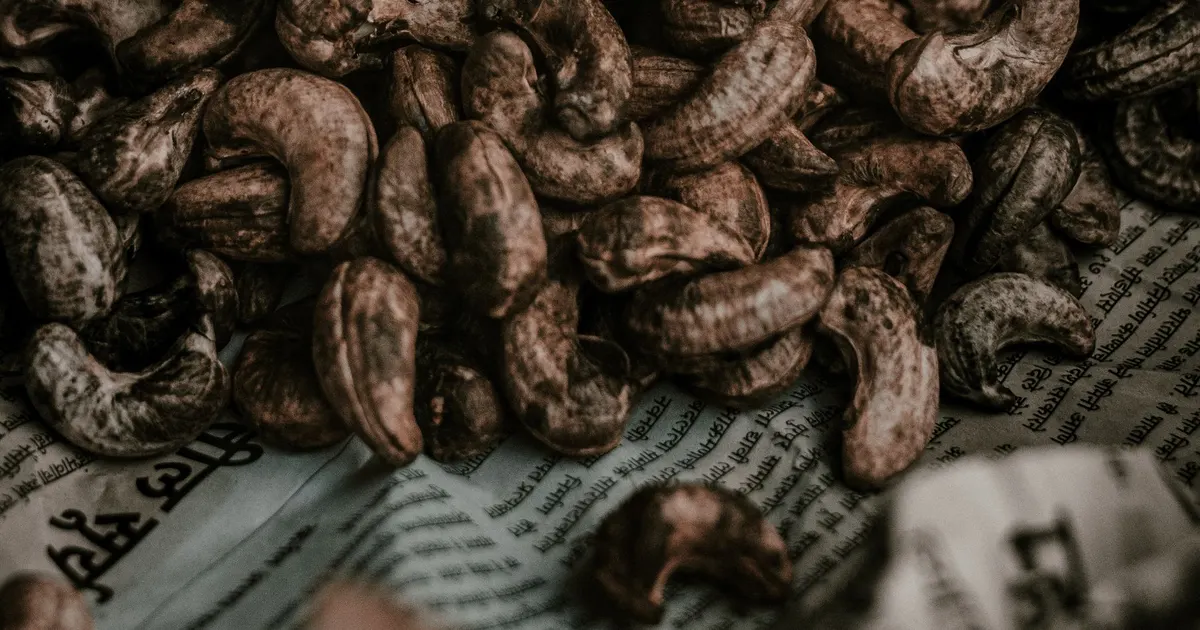
Walk into one cashew plant and you hear rows of foot presses clacking as operators cut nuts one at a time. Walk into another and a hopper feeds nuts into a machine that cuts and separates them with almost no hands on the product. Both plants ship kernels with the same grade names. The method behind those kernels still changes the whole kernel share you get, the consistency from lot to lot and the questions worth asking.
This guide explains the main shelling methods in cashew plants, what they change for a buyer and why the answer is never as simple as “automatic is better”.
Why shelling is the hard step
A cashew shell is not a smooth case. It is a curved, kidney-shaped shell with a soft honeycomb interior full of caustic shell oil, and the kernel inside is curved too. The cutting blade has to follow that curve and open the shell without slicing the kernel. Nuts vary in size and shape from one origin and crop to the next, so a fixed setting never fits every nut.
Every kernel that breaks during shelling drops from a whole grade into a piece grade, which sells for less. Our guide to cashew pieces explains how the pieces are graded. So the economics of shelling come down to whole kernel share: of the kernel that comes out of a bag of nuts, how much stays whole.
The three methods you will meet
Manual cutting. An operator places a conditioned nut into a small hand-held or bench-mounted cutter and presses a blade. The operator sees each nut, so the cut adapts to its size and shape. This takes many people per line and demands skill, but the method handles variable nuts well.
Semi-automatic cutting. A foot press, pedal or small machine does the cutting force, while the operator still places each nut and watches the cut. This is the most common setup in Vietnamese plants. It speeds the work and cuts effort while keeping a person in the loop for alignment.
Automatic cutting. Nuts are fed from a hopper, aligned mechanically, cut and separated into kernel and shell with minimal handling. These machines cut by nut size, so the nuts must be size-graded tightly first. Some plants run them on a main nut size and use manual lines for the rest.
What each method tends to change
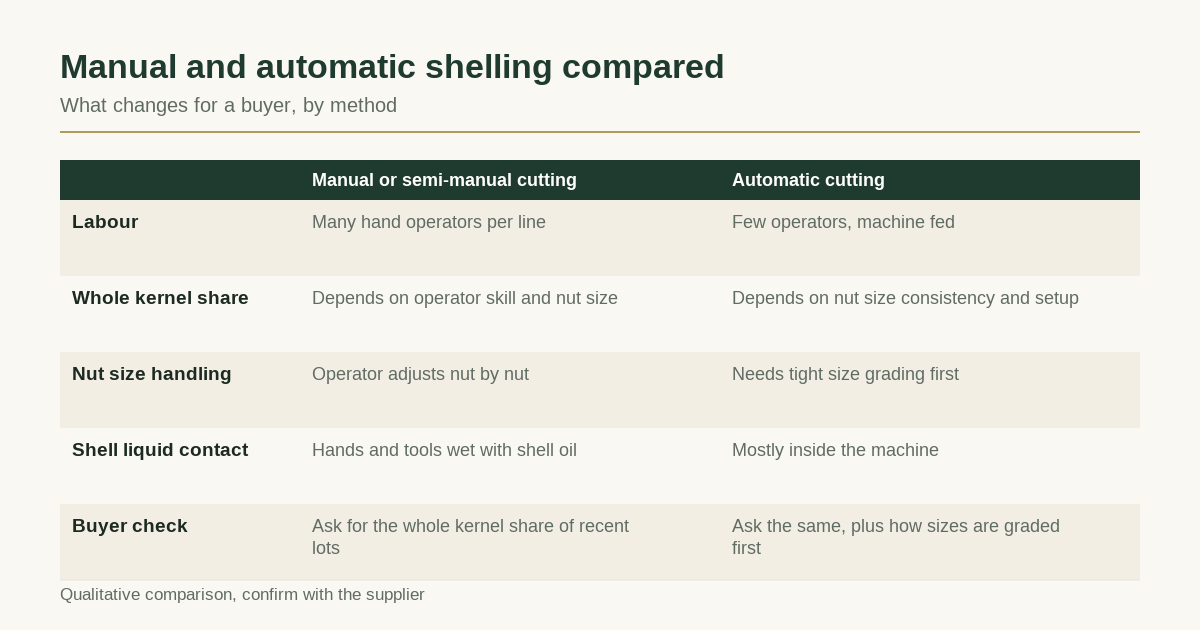
| Aspect | Manual or semi-manual | Automatic |
|---|---|---|
| Labour | High, many operators | Low per kilo, machine fed |
| Whole kernel share | Depends on operator skill | Depends on size grading and setup |
| Handling of odd nuts | Operator adapts nut by nut | Needs a tight size band |
| Consistency day to day | Varies with crew | Higher once set |
| Contact with shell oil | Hands and tools | Mostly inside the machine |
| Capital cost | Low | High |
Read the table as tendencies, not rules. A strong manual team on well-graded nuts is a good source. An automatic line set for the wrong nut size is a poor one.
Whole kernel share is the number to ask for
Shelling method matters because it feeds one number: the share of kernels that come out whole. A processor that tracks it can tell you its recent average and the range between lots. Ask for it by grade, because large nuts and small nuts behave differently.
Be careful with a single headline figure. A plant can quote a high whole kernel share because it sells the large-grade kernel and puts most of the breakage into small counts. Ask what share of whole kernels falls into the grade you want, and whether the figure is by weight.
How shelling touches the rest of the line
Shelling is not an isolated step. It sits between steaming and drying, and both of those set conditions for the cut.
A nut that was steamed too lightly has a tight shell, and the blade has to work harder, which breaks more kernels. A nut steamed too long can stain the kernel with shell oil. After shelling, kernels with shell oil on them go into the dryer with the oil baked into the surface, and that shows up later as a spotted kernel. Our guide to kernel defects shows what these look like. The processing overview in how cashews are processed shows where shelling sits in the full sequence.
Safety and shell oil
Cashew shell oil blisters skin, so shelling involves gloves, protective clothing and good ventilation. In manual lines the risk falls on operators. In automatic lines it falls more on maintenance staff. For a buyer the relevance is twofold: a plant that manages shell oil well is usually a plant that manages its line well, and shell oil carried onto the kernel is a defect you will see in the lot.
Ask about worker protection if it matters to your own supplier code. Some retail buyers require evidence of social compliance in the supply chain, and a plant with many manual operators is more exposed to those questions than a highly automated one.
Need a price for this grade? Request a quote
Which method suits which buyer
Large kernel grades such as W180 and W240 carry a premium, so whole kernel share matters most there. A plant that cuts large nuts carefully, whatever the method, is worth the extra look. Our comparison of W320 and W240 shows how much the size choice moves the cost.
For small grades and pieces, shelling method matters less. A buyer of baby bits for butter does not care whether a kernel broke at the cutter or the peeler. For that buyer the questions are moisture, defects and price, not method.
For private label retail packs where the nut is visible, ask for kernel photos and counter samples from the line that will run your order. A plant may run both methods and assign orders by grade.
Questions to ask before you choose
- Which shelling method will run my grade, and is it the same line the sample came from?
- What was your whole kernel share by weight on the last ten lots of this grade?
- How are nuts size-graded before cutting?
- How do you keep shell oil off the kernel?
- What happens to broken kernels from my lot? Are they sold as pieces or blended in?
The last question matters more than it sounds. Some plants add broken kernels back into a whole grade within the allowed limits. Check the spec for the permitted share of pieces and splits in a whole grade.
Reading a counter sample for shelling quality
A counter sample tells you more about shelling than a plant tour does, if you know what to look for. Spread the kernels on a white tray and look at the cut surface of the kernel. A clean cut leaves the two halves of the kernel intact along the natural seam. Chips, nicks and small crescent-shaped bites at the edge point to a blade that was set too tight or a nut that was not aligned. Look at the pieces too. A whole grade will contain some splits and butts by definition, so count them against the limit in your spec, not against zero.
Weigh a pound of the sample and count the kernels to confirm the grade. Then pick out the broken ones and weigh them. That gives you a rough check on whole kernel share for the sample, and you can compare samples from two plants on the same basis. Keep a sealed duplicate so you can compare the arrival lot against the same reference. Our guide to claims on arrival explains why the sealed reference matters if a dispute arises.
What a visit does and does not show
If you tour a plant, the shelling floor is the most visible step and it is easy to be impressed by a long row of busy operators or by a clean automatic line. Neither tells you the whole kernel share. Ask to see the records instead: daily outturn, kernel yield per bag and the weight of pieces sold from the same period. Plants that keep these records usually manage the line by them. If the records are not available, treat the visit as a hygiene check, not a quality check, and rely on samples and lot certificates for the rest.
Next step
If shelling method matters for your product, say so in the requirement. We price it with a Vietnamese processor that runs your grade, and you get one detailed quote. Send a requirement and expect a reply within 24 business hours.
Frequently asked questions
Is machine-shelled cashew better than hand-shelled cashew?
Neither is better by default. A skilled hand crew on a well-graded nut can match or beat a poorly set machine on whole kernel share, and a well-tuned machine on evenly sized nuts is more consistent day to day. Judge a plant by its recent whole kernel share and counter samples, not by the method it names.
Does shelling method change the price of cashew kernels?
It changes the cost base of the processor, which feeds through to the quote, but the effect is usually small next to raw nut cost and grade. The bigger price effect is whole kernel share, because a plant that breaks more kernels sells more pieces and fewer wholes.
What should I ask a processor about shelling?
Ask which method they use for the grade you need, what whole kernel share they achieved on recent lots, and how they size-grade nuts before cutting. Ask also how they keep shell oil off the kernel, since stained kernels show up as spotted defects.
VietCashew supplies Vietnamese cashew kernels on one quote. We publish no prices, because a cashew quote is only valid for days. How an order runs and what we publish.
Need a price for this grade?
Send the requirement. We reply within 24 business hours with one detailed quote for the packed kernels.
Request a quote