Guides / Compliance
Is a Cashew a Tree Nut? What Botanists Say and What the Label Rules Say
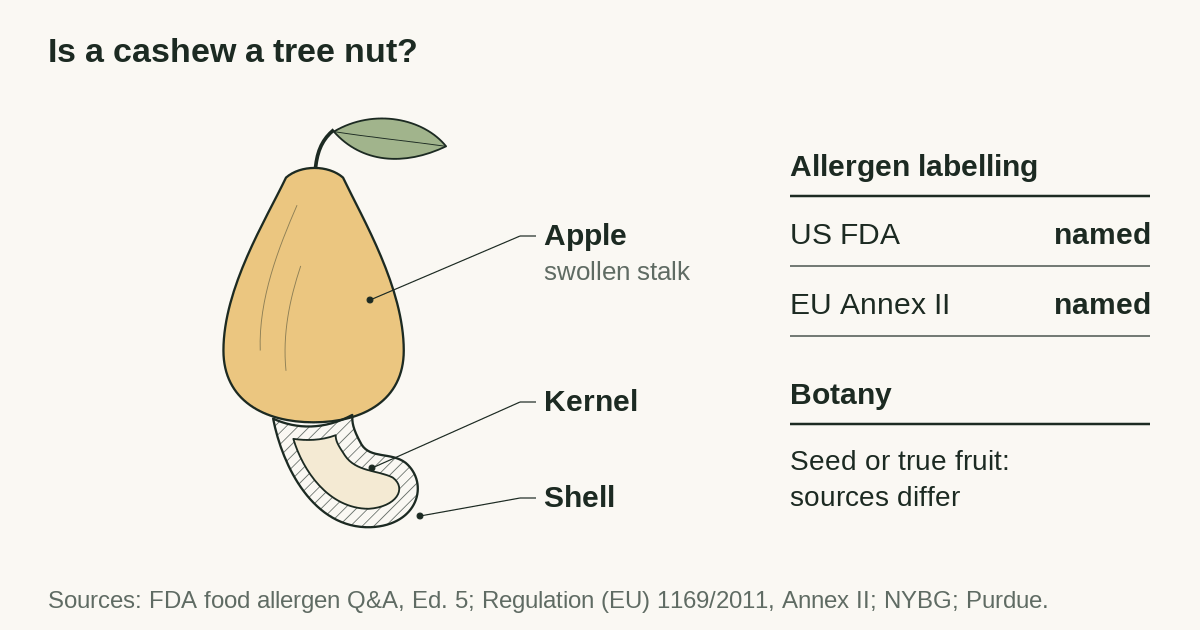
Is a cashew a tree nut? For labelling, yes. FDA lists cashew in its table of tree nuts that count as major food allergens, and EU Annex II names cashews among the nuts that must be declared. Botanists are less settled: some sources call the cashew nut a seed, others call it the true fruit. This post is part of our cashew food safety guide for importers, and it separates the botanical question from the legal one, because only the legal one decides what goes on your pack.
We are not a lawyer or a labelling authority. The summary below follows public texts we opened. Have your label reviewer or regulator confirm the wording for your market.
What botanists say about the cashew nut
The two plant sources we opened do not use the same words. The New York Botanical Garden describes the nut as the seed, enclosed in a brown to gray fruit, and calls the shell the fruit. It adds that the shell holds a dermatitis-causing resin, so nuts are eaten only after careful separation from it. Purdue’s NewCROP page by Morton takes the other view: it names the cashew nut as the true fruit of the tree, with a double shell around a kidney-shaped kernel.
On one point both agree. The juicy, pear-shaped cashew apple is not the fruit. NYBG calls it the swollen flower or fruit stalk, and Purdue calls it a pseudofruit. The nut is a separate part from the apple.
FDA states the difficulty plainly. Its guidance says there is no universally accepted botanical definition of tree nut, and that authoritative references use many terms (berry, capsule, drupe, fruit, nut, seed) for the same kind of tree product. So if a customer asks “is it botanically a nut”, the honest answer is that it depends on the reference.
What the US rules say
The US rule does not rest on botany. FDA’s allergen guidance (Edition 5, January 2025) says tree nuts are a major food allergen group, and that its list includes the tree nuts for which a robust body of scientific evidence supports inclusion. Table 1 of that guidance has 12 entries, and the cashew is one of them, as Anacardium occidentale L. of the family Anacardiaceae. Pistachio sits in the same family and also in the table.
Two practical rules follow from the same guidance. The specific type of tree nut must be declared, so the ingredient list or the Contains statement cannot just say “tree nuts”. And only the tree nuts in Table 1 belong in a Contains statement. A nut missing from the table is still listed by its common name in the ingredient list.
What the EU rules say
Regulation (EU) No 1169/2011 uses a different structure. Annex II has 14 numbered entries of substances or products causing allergies or intolerances. Entry 8 reads “Nuts” and then names them: almonds, hazelnuts, walnuts, cashews (Anacardium occidentale), pecan nuts, Brazil nuts, pistachio nuts and macadamia or Queensland nuts. Peanuts have their own entry, number 5.
Article 21 says the name of the substance as listed in Annex II must be emphasised in the ingredients list through a typeset that distinguishes it, for example font, style or background colour. Where there is no ingredients list, the particulars start with the word “contains”. The text also drops the requirement where the name of the food clearly refers to the substance. Whether a pack named after the nut falls under that exception is a question for your reviewer.
Need a price for this grade? Request a quote
The two texts side by side
| Point | United States | European Union |
|---|---|---|
| Governing text | FD&C Act section 403(w), as explained in FDA’s Q&A, Edition 5 | Regulation (EU) No 1169/2011, Article 21 and Annex II |
| Group name | Tree nuts | Nuts (entry 8) |
| Entries in the list | 12 tree nuts in Table 1 | 8 nuts named in entry 8 |
| Cashew named | Yes, Anacardium occidentale L. | Yes, cashews (Anacardium occidentale) |
| Peanut | Separate major allergen | Separate entry (5) |
| Group term alone on a label | Not enough, declare the specific nut | Name as listed in Annex II, emphasised |
Source: FDA Q&A on food allergens, Edition 5 (January 2025); Regulation (EU) No 1169/2011 as published in the Official Journal on 22 November 2011. The EU regulation has been amended since publication, so read the consolidated text for your date.
What it means for a buyer
Your cashew pack carries a declared allergen whichever route you choose, so the label question is about wording and typeface, not whether to declare. The harder question sits upstream. Cashew is the named allergen on your own line, so you should ask the processor what else shares its equipment. Our guide to private label cashew packaging covers what a pack panel carries, and the supplier-side allergen and cross-contact checks sit in the importer guide linked below.
If you sell into another market, do not assume these two lists carry over. The texts above are the only ones we opened for this post. We did not read the allergen rules of Canada, Japan, Australia or any other country.
Questions to put to your label reviewer
- Which text governs the market where the pack will be sold, and on what date did you read it?
- Does the ingredient list name the cashew, with the emphasis the market asks for?
- Is a Contains statement used, and does it name the specific nut?
- Which other allergens could reach the kernels on the processor’s line, and how are they stated in the spec?
The allergen and cross-contact checks to run on the supplier are in our cashew food safety guide for importers. If you already know the grade and volume, send a requirement and we price it with a processor that runs it. Label wording stays between you and your reviewer.
Sources
- FDA, Questions and Answers Regarding Food Allergens, Edition 5 (January 2025), questions C.5, C.7 and C.8, Table 1.
- Regulation (EU) No 1169/2011, Official Journal L 304 of 22 November 2011, Article 21 and Annex II.
- New York Botanical Garden, Plant Talk, on the cashew tree.
- Purdue University NewCROP, Morton, Cashew Apple.
Sources
- FDA, Questions and Answers Regarding Food Allergens, Edition 5 (January 2025), questions C.5, C.7 and C.8, Table 1
- Regulation (EU) No 1169/2011 on the provision of food information to consumers, Official Journal L 304, 22 November 2011, Article 21 and Annex II
- New York Botanical Garden, Plant Talk: The Cashew Tree, a Resource of Nuts, Apples and Even Brake Linings
- Purdue University, NewCROP, Morton, Fruits of Warm Climates: Cashew Apple
Frequently asked questions
Is a cashew a tree nut for labelling purposes?
Yes in the United States. FDA's allergen guidance (Edition 5, January 2025) lists cashew, Anacardium occidentale L., in its table of tree nuts treated as major food allergens. In the EU, Annex II of Regulation 1169/2011 names cashews under the entry for nuts. Both markets expect the label to name the cashew.
Is a cashew botanically a nut?
Sources disagree. The New York Botanical Garden calls the nut the seed, enclosed in a fruit, the shell. Purdue's NewCROP page calls the cashew nut the true fruit of the tree. FDA notes that no universally accepted botanical definition of tree nut exists, which is why its list is built on allergen evidence.
Can a pack of cashews say only tree nuts?
Not in the United States. FDA's guidance says the specific type of tree nut must be declared, so the ingredient list or Contains statement cannot just say tree nuts. The EU text asks for the name of the substance as listed in Annex II, emphasised in the ingredients list. Confirm wording with your label reviewer.
VietCashew supplies Vietnamese cashew kernels on one quote. We publish no prices, because a cashew quote is only valid for days. How an order runs and what we publish.
Need a price for this grade?
Send the requirement. We reply within 24 business hours with one detailed quote for the packed kernels.
Request a quote