Guides / Cost
Kernel Outturn Ratio (KOR): How Raw Cashew Nuts Are Graded and What the Number Means
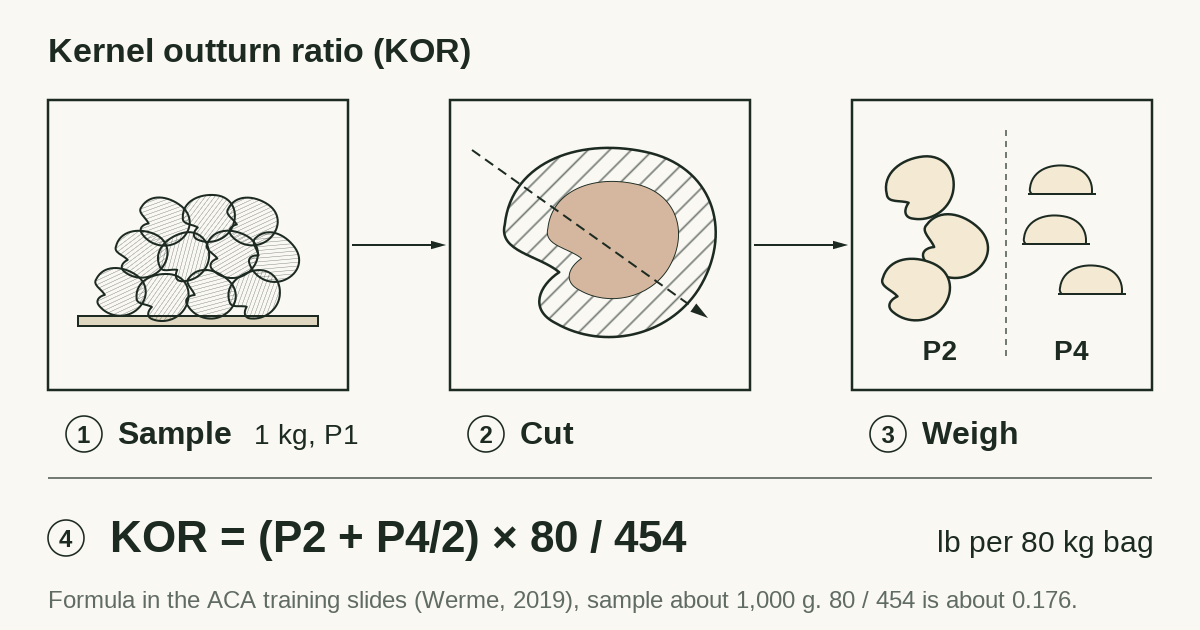
Kernel outturn ratio, or KOR, is the amount of good kernel a lot of raw cashew nuts gives after shelling, and the trade states it as pounds of kernel per 80 kg bag. A lot at 48 lb per bag holds about 27 percent kernel by weight. This post is part of our look at raw cashew nuts and outturn, and it explains where the number comes from, the units it travels in and why a processor’s kernel cost moves with it.
The method below follows three public documents we opened, and the figures are theirs.
What KOR is
The FAO page on raw nut quality defines outturn as the weight, in pounds, of useful kernels from one 80 kg jute bag of raw cashew nuts. Its worked example is 49 lb per 80 kg bag, which means 22.2 kg of kernel usable by the manufacturer if 80 kg of nuts are shelled. The East African draft standard DEAS 1000:2019 gives the same idea a formal name, kernel output ratio or shell out-turn, and defines it as the minimum quantity of good kernels that can be obtained after shelling per 80 kg of raw nuts.
Two things in that definition cause most confusion. The unit is a pound figure for a metric bag, which is how the sources we read state it. And the DEAS text allows either unit: it says the ratio is expressed as lb per 80 kg bag or kg per 80 kg bag. So “KOR 48” is only clear once the unit is named.
How the cut test sets the number
The African Cashew Alliance training slides by Mahamadou Werme describe the test in steps. The tester collects nuts from all bags into a pile, mixes this mother sample, splits it into quarters and builds the samples to analyse. One kilogram is taken, called P1, and the slide says it can range from 998 g to 1,002 g. Every nut in the sample is cut lengthwise into two halves, and the kernels are sorted into three bowls.
- Healthy kernels, accepted at 100 percent, are weighed with their skins as P2.
- Kernels accepted at 50 percent, the immature and pricked ones, are weighed as P4.
- Mouldy, moth-eaten, stunted and empty nuts, rejected at 100 percent, are weighed as P5 together with their shells.
The slide then gives the sum. Useful kernel, AU, equals P2 plus half of P4. Kernel yield, Ra, equals AU divided by P1, times 100. KOR equals AU times 80 divided by 454. DEAS 1000:2019 Annex A also sorts the kernels into six classes and ends its out turn formula with a factor of 0.176 per gram, which is 80 divided by 454, rounded. The draft’s layout of the earlier terms is unclear in the copy we read, so we use the ACA formula here.
Worked example. Take a sample of 1,000 g, with 250 g of healthy kernels and 40 g of half-credit kernels. AU is 250 plus 20, so 270 g. The kernel yield is 270 divided by 1,000, which is 27.0 percent. KOR is 270 times 80 divided by 454, which is 47.6 lb per 80 kg bag. With the rounded factor of 0.176 the result is 47.5, so the last decimal depends on the constant used.
Pounds, kilograms and percent side by side
The same lot can be written three ways. The table converts pounds per 80 kg bag into kilograms per bag and into kernel as a share of nut weight, at 454 g per pound as the ACA slide does.
| KOR (lb per 80 kg bag) | Kernel per bag (kg) | Kernel as share of nut weight (percent) |
|---|---|---|
| 36 | 16.34 | 20.43 |
| 40 | 18.16 | 22.70 |
| 44 | 19.98 | 24.97 |
| 48 | 21.79 | 27.24 |
| 50 | 22.70 | 28.38 |
Source: percent column from the ACA training slides (Werme, 2019), kilogram column calculated from the pound figure at 454 g per pound. These are kernel weights at de-shelling. The same slide shows the figure falling further along the line, for example 48 lb giving 27.24 percent at de-shelling and 23.07 percent at packing, at the loss rates the slide assumes. Typical figures only: confirm with the supplier.
Need a price for this grade? Request a quote
KOR next to nut count
KOR is not the only number in a raw nut deal. The FAO page also defines nut count as nuts per kilogram, with a typical range of 150 to 240, and says smaller numbers mean bigger nuts, which tend to give a higher outturn and bigger kernels. The ACA slides rate a count under 180 as excellent and a count above 230 as poor, with bands between. DEAS 1000:2019 ties both numbers together in its grades: Grade 1 asks for at least 48 lb per 80 kg and no more than 200 nuts per kg, Grade 2 for 44 and 220, and Grade 3 for 36 and 240.
Moisture belongs in the same discussion. FAO says to keep it below 10 percent after drying, because above that nuts can go mouldy, and below 6 percent kernels dry out and lose weight. The ACA slide gives a 7 to 10 percent range. For a worked intake routine, see our guide to testing a raw nut lot at intake.
Why KOR changes the cost of a kernel
A processor pays for nuts by weight and sells kernels by weight, so the yield sets how much nut it must buy for each kilogram of kernel. At 27.24 percent, one kilogram of kernel takes about 3.67 kg of nuts. At 22.70 percent it takes about 4.41 kg. That is a rise of 20 percent in the nut needed, before shelling, drying and peeling losses and before any change in nut price. We publish no price. The point is that a lower KOR raises the processor’s cost, and it shows up in the quote you receive.
For a buyer, KOR is rarely written into the kernel contract. It matters because it explains why two processors with the same nut price quote different kernel prices, and why quotes move when the origin or the crop quality changes. Our note on raw nut origins covers why one origin does not behave like another.
Questions to put to a processor
- Which method sets your KOR, and in which unit: lb per 80 kg, kg per 80 kg or percent?
- What sample size and how many bags do you cut per lot?
- Do you give half credit to immature kernels, and what is the minimum KOR you buy at?
- How do you handle a lot that tests below the minimum?
Close the loop in your own spec. If you want a quote for your grade and volume, send us a requirement and we price it with processors that run it. The raw nut terms stay between them and their suppliers, and our guide to raw cashew nuts and outturn shows how that number reaches your quote.
Sources
- FAO Sustainable Technologies and Innovations portal, How to estimate the quality of raw cashew nuts (RCN).
- African Cashew Alliance, Quality measurement of cashew nuts (KOR), Werme, 2019.
- EAC, DEAS 1000:2019 Raw cashew nut, Specification (final draft).
Sources
- FAO Sustainable Technologies and Innovations portal, How to estimate the quality of raw cashew nuts (RCN)
- African Cashew Alliance, Quality measurement of cashew nuts (KOR), M. Werme, FOCAS training slides, Bamako, August 2019
- EAC, DEAS 1000:2019 Raw cashew nut, Specification (final draft, as notified to the WTO), definitions 3.5 and 3.6, Table 2 and Annex A
Frequently asked questions
What does KOR mean for cashew nuts?
KOR is the kernel outturn ratio, also called outturn or kernel output ratio. It states how much good kernel a lot of raw cashew nuts gives after shelling, usually as pounds of kernel per 80 kg bag. The FAO page on raw nut quality gives 49 lb per bag, or 22.2 kg of usable kernel, as a worked example.
How is KOR calculated from a sample?
Cut about 1 kg of nuts open, weigh the healthy kernels (P2) and the kernels accepted at half value (P4), add P2 and half of P4, then multiply by 80 and divide by 454. The African Cashew Alliance training slides print this. DEAS 1000:2019 Annex A ends its formula with a factor of 0.176, which is 80 divided by 454, rounded.
What is a good KOR for raw cashew nuts?
We found no single public benchmark. The East African draft standard DEAS 1000:2019 sets minimums of 48, 44 and 36 lb per 80 kg for its Grades 1, 2 and 3, and the FAO page gives no threshold. A buyer should agree the unit, the method and the minimum in the contract instead of relying on a general figure.
VietCashew supplies Vietnamese cashew kernels on one quote. We publish no prices, because a cashew quote is only valid for days. How an order runs and what we publish.
Need a price for this grade?
Send the requirement. We reply within 24 business hours with one detailed quote for the packed kernels.
Request a quote