Guides / Sourcing
Where the Nuts Come From: Raw Cashew Origins Behind Vietnamese Kernels
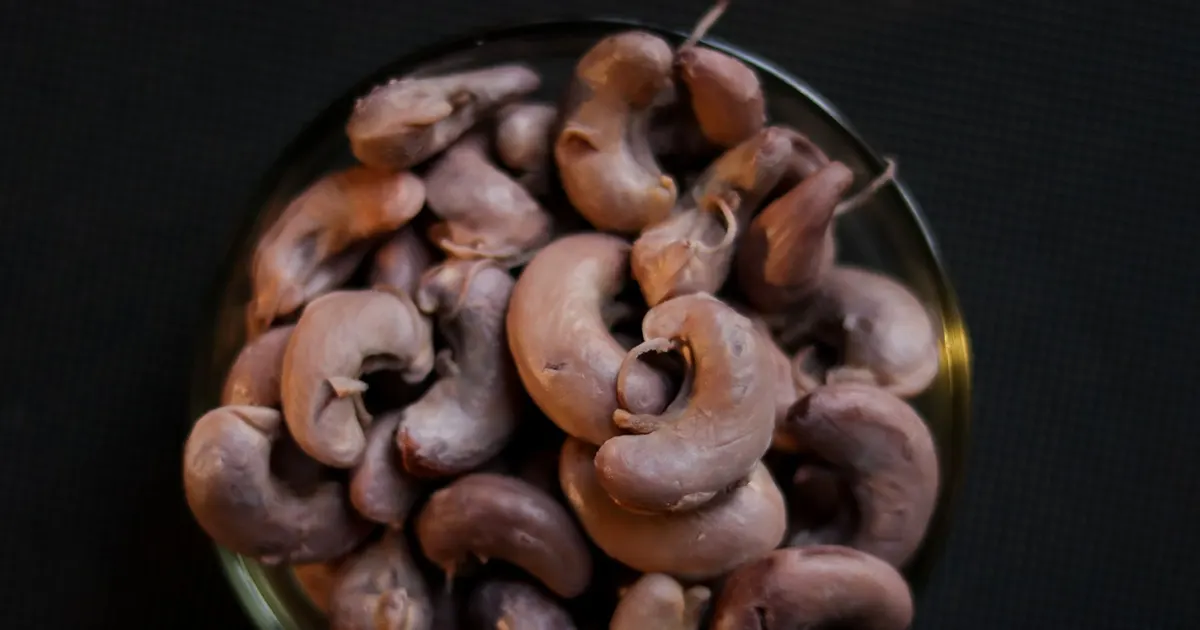
When a buyer says “Vietnamese cashews”, the picture in mind is often a Vietnamese orchard. The reality is more global. Vietnam’s plants shell more raw cashew nuts than its farms grow, so a large share of the nuts arrives by ship from other countries, and the origin of the nut is a separate question from the origin of the kernel.
This guide explains where the raw nuts come from, how origins differ in ways a buyer can measure, what shapes the cost and what to ask when origin matters to your product.
Why Vietnam imports raw nuts
Vietnam built a large shelling and grading industry, with trained labour, plants set up for volume and export links to the main kernel markets. Local cashew farms supply only part of what those plants can process. Raw nut producers in other countries often lack the capacity to shell at scale, so they sell the nuts to plants that do. Our market note for September 2026 describes how this dependence shapes the cost base today.
The result is a supply chain with two origins in one product. The nut may come from West Africa or Cambodia. The kernel is shelled, peeled, graded and packed in Vietnam.
The main raw nut sources
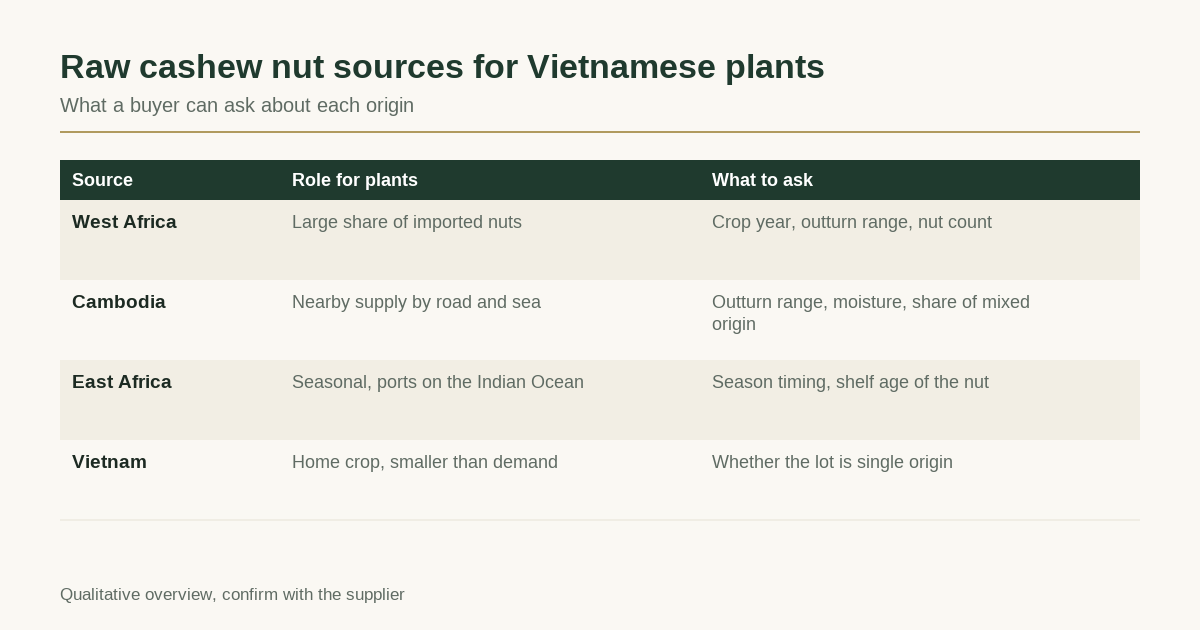
West Africa. Several West African countries grow large volumes of cashew and export most of the harvest as raw nuts. Cote d’Ivoire is among the largest producers, with Ghana, Nigeria, Benin and Guinea-Bissau also in the picture. The season runs on a different calendar from Southeast Asia, so these nuts arrive in Vietnamese ports in specific months. Because the nuts travel by sea over a long distance, their age and storage condition on arrival vary.
Cambodia. Cambodia grows cashews close to the Vietnamese border, and nuts move by road and by river and sea. The shorter route means fresher nuts and quicker turnaround, and it gives plants near the border a convenient supply.
East Africa. Tanzania and Mozambique supply nuts too, mostly through Indian Ocean ports, with a season that differs from West Africa.
Vietnam itself. Home-grown nuts, much of them from the south of the country, supply part of the demand. Our guide to Binh Phuoc cashews explains how a local origin claim should be read.
Trade volumes and shares shift every year with crop size, export policy and price, so this guide describes the roles and not the percentages.
What differs between origins
Buyers and processors compare nuts on a handful of measurable points.
Outturn. The kernel yield from a bag of raw nuts, usually expressed as pounds of kernel per 80 kg bag. It varies between origins and between crops. Our guide to raw cashew nut price and outturn explains how it drives cost.
Nut count. The number of nuts per kilogram, which sets the size of the kernels. A crop with a larger nut count per kilogram yields smaller kernels on average.
Moisture and age. Nuts that were dried well and shipped promptly give better kernels than nuts stored damp.
Defective nuts. The share of spoiled, immature or insect-damaged nuts in a bag, which lowers outturn and raises the work on the line.
Foreign matter. Stones, soil and sticks in the bag raise cleaning costs and wear on machinery.
How origin reaches the kernel price
| Factor | How it moves the kernel cost |
|---|---|
| Raw nut price at the port | Largest single driver of kernel price |
| Outturn of the crop | A lower outturn means more nut cost per kilo of kernel |
| Nut count and size mix | Shapes how much W180 to W320 the plant can make |
| Freight and storage | Adds to nut cost, varies by route |
| Export policy at origin | Taxes and bans change supply and price |
Several African producers have moved to keep more of their harvest at home for local shelling. That shifts what is available to Vietnamese plants and bids up nut prices in the seasons when supply tightens. Our guide to cashew kernel price factors shows how nut cost passes through.
Origin and food safety
Origin does not change the limits the kernel must meet, such as aflatoxin and microbial limits. What origin can change is the risk profile of the incoming nuts: how they were dried, stored and moved. A plant that checks incoming nuts for mould and moisture and rejects poor bags controls that risk before the kernel line. Our guide to aflatoxin and food safety describes the limits and tests.
Need a price for this grade? Request a quote
Mixed or single origin lots
Most plants blend nuts of several origins to smooth out size and outturn, and they rarely track which bag went into which tin. For most buyers that is fine. The kernel is graded and tested as a finished product, and the spec covers what matters.
If you need a single origin, for a brand story, a retailer requirement or an ethical sourcing programme, say so up front. The plant then has to segregate nuts at intake, run them as a separate batch and keep records from the port to the packed lot. That adds handling, may raise the minimum order and can lengthen lead time. Ask for the documents that would prove the claim, such as the bill of lading for the nuts, the intake record and the batch sheet.
Country of origin on the label
Customs rules treat shelling and processing as a change that gives the kernel the origin of the country where it was processed in many cases, which is why a kernel from imported nuts can ship as a Vietnamese product. Rules differ between importing countries and trade agreements, so check yours. If a retailer asks for the origin of the nut, answer with the nut origin and the processing country together, so there is no confusion on the label.
What to ask a processor
- Which raw nut origins are you running this season, and in what proportion?
- Are lots segregated by origin, and can you keep mine separate?
- What outturn range do you see by origin?
- How do you check incoming nuts for moisture, mould and defects?
- What documents can you provide to show the origin of the nuts in my lot?
Seasons and why timing matters
Each origin harvests in its own months, and a plant buys nuts when they are available and priced right. West African nuts reach the market in the first half of the year, and Cambodian and Vietnamese nuts follow a Southeast Asian calendar. The upshot is that a plant’s raw material mix changes through the year. A lot packed in one quarter may be mostly one origin, and a lot packed in another may be mostly another.
For a buyer with a steady programme, that means kernel character can shift between shipments. Size mix, outturn and defect levels follow the nuts. Plants smooth this out by blending, holding stock and sorting, but they cannot remove it entirely. If your product is sensitive to size or colour, ask for a counter sample before each shipment and compare it with your reference. Our guide to the sample approval process describes a routine that catches drift before a container sails.
A worked example of outturn
Take a bag of 80 kg raw nuts. A good outturn might return in the high 40s of pounds of kernel, and a poor one in the low 40s. On the same nut price, the difference means the plant pays for the same bag and sells several pounds less kernel. Spread across a container, that gap becomes a cost the plant has to recover through the kernel price or by lowering what it pays for nuts. This is why processors haggle over outturn when they buy and why a nut that looks cheap can be expensive in the end. Treat the figures as illustrations only, since each crop and each origin moves differently.
Finally, keep a simple record for each shipment: the grade, the colour class, the date of the counter sample, the origin the processor stated and the moisture on the certificate. After three or four lots you will see whether your supplier’s quality tracks the season, and you will know which months need an extra sample check.
Next step
If origin matters for your claim or your customer, say so in the requirement and state whether you need nut origin, processing origin or both. We price it with a Vietnamese processor that runs your grade, and you get one detailed quote. Send a requirement and we reply within 24 business hours.
Frequently asked questions
Does Vietnam grow all the cashews it exports?
No. Vietnam is the largest exporter of cashew kernels, but its plants shell far more nuts than local farms grow, so a large share of raw cashew nuts is imported. West Africa and Cambodia are two of the main sources, with East Africa also supplying in season.
Does the raw nut origin change the kernel I receive?
It can change the size mix, the outturn and the share of defective nuts, which affect the grade split and the price. It does not change the food safety limits the kernel must meet. Ask which origins a plant runs this season and whether lots are kept separate.
Can a processor guarantee a single origin for my lot?
Some can, if raw nuts of one origin are kept separate through the line, and this usually costs more or needs a longer lead time. If origin matters for your claim, state it in the requirement and ask for documents that follow the nuts from the port to the kernel lot.
VietCashew supplies Vietnamese cashew kernels on one quote. We publish no prices, because a cashew quote is only valid for days. How an order runs and what we publish.
Need a price for this grade?
Send the requirement. We reply within 24 business hours with one detailed quote for the packed kernels.
Request a quote