Guides / Market
Vietnam Cashew Exports in 2025: Full-Year Volume, Value and Markets
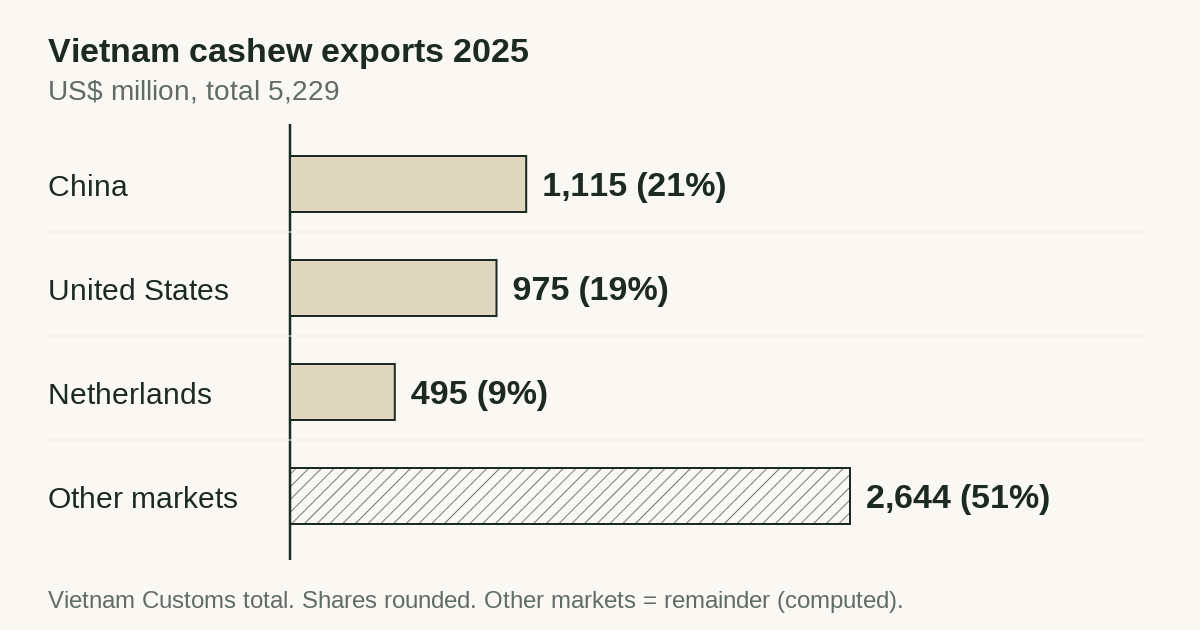
Vietnam exported 766,585 tonnes of cashews worth US$5.229 billion in 2025, according to Vietnam Customs figures published in January 2026. It was the first year above US$5 billion. China overtook the United States as the largest market for the first time, at US$1.115 billion against US$975 million. Value rose by about 20% on 2024, not the 5.7% some reports print: that figure is the volume growth.
This is a data page for buyers who plan a cashew purchase and want the year in numbers they can check. Figures are the full-year Customs releases as reported in January 2026 and are preliminary. Every reported number below was read in its source on 22 October 2026. Where two outlets disagree both are shown, and anything we calculated is marked as ours.
The 2025 figures in one place
- Export volume: 766,585 tonnes, a record, reported as up 5.7% on 2024 (VnEconomy, 12 January 2026).
- Export value: US$5.229 billion, a record and the first year above US$5 billion.
- December alone: US$466 million, up 29% on December 2024.
- Rank among farm exports: third, behind coffee (US$8.57 billion) and fruit and vegetables (US$8.56 billion), per VnEconomy.
- Raw cashew nut imports: about 2.94 million tonnes worth about US$4.5 billion, covered further down.
Two cautions on how to read these. First, Customs data is revised, so a later release can differ in the last digits. Second, this page reports volume and value as published and does not turn them into a price per tonne. An average across every grade, pack size and destination is not a price anyone can order at. The cashew prices page explains why this site publishes no price, and the kernel price factors post covers what moves a quote.
Value growth: 5.7% or about 20%
The sources disagree here, so here is the arithmetic.
Viet Nam News (26 January 2026) writes that value rose 5.7% as well as volume. VnEconomy, the VCCI republication and the Dân Trí report on antidumping.vn attach 5.7% to volume only and give no value percentage. They say 2024 was “over US$4.3 billion” and that 2025 added nearly US$1 billion.
The 2024 Customs figures were US$4.37 billion on 730,000 tonnes, up 13.3% in volume and 20.2% in value on 2023 (The Investor, 14 January 2025). From that base:
- Value: US$5.229 billion divided by US$4.37 billion is +19.7%. Even the rounder “over US$4.3 billion” that VnEconomy gives for 2024 yields at most +21.6%. Either way, about 20%.
- Volume: 766,585 divided by 730,000 is +5.0%. The reported +5.7% implies a 2024 base of about 725,000 tonnes, so the 2024 volume was probably revised down slightly after January 2025.
A cross-check from inside the year: VnEconomy reported for the first nine months of 2025 a value of US$3.77 billion, up 19.5%, on volume up only 1.6% (554,760 tonnes). Subtracting that from the full year leaves about US$1.46 billion and 211,800 tonnes in the last quarter, more than a quarter of the year in three months. A 5.7% value rise would not fit any of this.
So the year was about 5% more tonnes and about 20% more dollars. That gap is why the total crossed US$5 billion: 2025 was a year of rising value, not of a large jump in tonnes.
Top markets in 2025
China, the United States and the Netherlands are the only destinations with a full-year 2025 value in the sources we could open. The eleven-month columns are the closest like-for-like comparison with 2024 that is published: both periods are January to November.
| Market | 2025 full year, US$ | Share of total | Jan-Nov 2024, tonnes / US$ | Jan-Nov 2025, tonnes / US$ | Change Jan-Nov, volume / value |
|---|---|---|---|---|---|
| China | 1.115 billion | 21% | 117,420 / 687.84 million | 159,200 / 1.024 billion | +36% / +49% |
| United States | 975 million | 19% | 179,480 / 1.07 billion | 133,000 / 887 million | -26% / -17% |
| Netherlands | 495 million | 9% | not found | not found | not found |
| All other markets | 2.644 billion (computed) | 51% | not found | not found | not found |
| Total | 5.229 billion | 100% | n/a | n/a | n/a |
Sources: full-year values from VnEconomy (12 January 2026); eleven-month 2025 from the VCCI WTO Center (12 January 2026); eleven-month 2024 from The Investor (14 January 2025). Shares and the change columns are our arithmetic, rounded. The reported changes (China +35.5% volume and nearly +49% value; United States -26% and -17%) match the computed ones.
Three things stand out.
The swap at the top. The United States took US$1.07 billion in the first eleven months of 2024 and was the largest buyer. In 2025 China took US$1.115 billion over twelve months and the United States US$975 million. VnEconomy described the US market as stagnant in October 2025 because of tariff policy; the sources do not give a more detailed cause, and we do not add one.
The long tail is half the market. The three named markets add up to 49% of value. The rest is spread over many destinations, and no source we opened lists them with full-year values. VnEconomy names Germany and the United Arab Emirates as top-five markets for September 2025, nothing more.
The Netherlands is third by value. Part of the Dutch figure may be cargo that continues to other EU countries, and no source we found splits it. If you buy for the EU, the import requirements guide covers what applies at your border.
Need a price for this grade? Request a quote
Raw nut imports: what the exports sit on
Vietnam shells a crop it mostly does not grow. For 2025 the sources give:
- Volume and value: about 2.94 million tonnes and about US$4.5 billion. The 2.942 million tonnes figure is from Báo Đầu tư (1 August 2026, citing Customs); Viet Nam News and Thương hiệu quốc gia print “more than 2.9 million” and “nearly 3 million”.
- Growth: up 17.7% in volume and 39.3% in value on 2024, which passed the previous value peak of US$4.18 billion in 2021 (Thương hiệu quốc gia, 11 January 2026). Value grew more than twice as fast as volume, so the raw material cost more per tonne as well.
- Domestic share: Viet Nam News says home-grown nuts cover only about 10% of what the industry needs.
- Origins, share of imports: Cambodia 32.9% (Báo Đầu tư gives this as the share of both volume and value) and Côte d’Ivoire 25.3% in both outlets. Nigeria is 9.3% and Ghana 7.7% in the January report, and 9.7% and 8% in the August report, so the later release is slightly revised. The remaining quarter is spread over other origins that neither article lists.
- Value growth by origin (January report): Cambodia +38.7%, Côte d’Ivoire +47.6%, Nigeria +42%, Ghana +12%.
Two readings follow, both as arithmetic rather than as a measured industry ratio. Imported raw nuts cost the equivalent of about 86% of what kernel exports earned (US$4.5 billion against US$5.229 billion), and the gap between the two, about US$0.7 billion, is what Viet Nam News reports as the sector’s trade surplus. And every tonne of kernel exported corresponds to about 3.8 tonnes of imported nut in shell (2.94 million divided by 766,585). That ignores domestic nuts and stock changes, so use it as scale only, not as a yield.
For context, Viet Nam News reported Cambodia at 55.5% of import value in the first half of 2024. The 2025 share is lower, which points to a larger African share, but the two figures cover different periods and may not be built the same way, so take the direction and not the size. The raw cashew nut origins post describes how each origin differs and RCN price and outturn shows how raw nut cost reaches a quote.
What it changes for a buyer
These are readings of the data, not forecasts.
- Capacity has more places to go. China took about 159,000 tonnes in eleven months, up more than a third, while US volume fell by a quarter. A processor with full books can afford to be choosy about an unfamiliar small buyer. A clear spec and a repeat schedule help; the market note goes into this.
- Dollar value grew four times faster than tonnes. Whatever the unit price you are quoted this year, the national statistics say the average moved up, not down. Ask for the grade, the validity date and the pack on the same line every time you compare offers.
- Raw nut cost is the swing factor. With imports at roughly 86% of export value, a processor’s quote follows its raw nut position. The same logic sits behind short quote validity and deposits.
- Your origin claim needs a document. With about nine tenths of the raw material imported, “Vietnamese cashew” usually means shelled in Vietnam, not grown there. The Binh Phuoc origin claim post and the processor vetting guide list what to ask for.
Method note: HS 0801.31 and 0801.32
Cashew trade sits in two lines of Harmonized System heading 0801. Per the USITC tariff schedule, 0801.31 is cashew nuts in shell (raw cashew nuts, RCN) and 0801.32 is shelled cashew nuts (kernels). The trade press calls the export figure “cashew exports”, and our reading is that this is the shelled-kernel line, 0801.32. The import figure is called “raw cashew nuts”, which we read as 0801.31. None of the articles we opened prints the HS code, so the mapping is our interpretation, not a published breakdown.
Other things to keep in mind when you compare this page with another data set:
- The source is Vietnam Customs preliminary data as reported by news outlets. We did not open the Customs statistics tables themselves.
- Roasted or otherwise prepared cashews are classified under heading 2008 in the US tariff schedule (line 2008.19.10), so they sit outside 0801 and outside this page.
- Mirror data from importing countries (for example USITC or Eurostat) is built on a different basis and period and will not match Vietnamese export data exactly.
- Association totals, such as those from Vinacas, may use a different scope or cut-off from Customs. When a total does not match, check the period, the heading and the source before calling it a conflict.
Buying with this in mind
If you are planning a purchase, put your grade, volume and delivery window into the quote request and we will price the requirement with a Vietnamese processor that runs it. You get a reply within 24 business hours.
Sources
- VnEconomy, Vietnam's cashews enter the $5 bln club with record turnover, 12 January 2026
- Viet Nam News, Cashew exports surpass $5 billion for the first time, 26 January 2026
- VCCI WTO Center, Hạt điều Việt Nam gia nhập câu lạc bộ 5 tỷ USD (11-month China and US data), 12 January 2026
- The Investor, Vietnam's cashew nut exports hit record high in 2024, 14 January 2025
- VnEconomy, Vietnam's cashew exports on track for record $5 bln year (nine months), 25 October 2025
- Thương hiệu quốc gia, Năm 2025, Việt Nam chi gần 4,5 tỷ USD nhập khẩu hạt điều thô, 11 January 2026
- Báo Đầu tư, Xuất nhập khẩu điều vượt 5,6 tỷ USD (2025 import volume and origins), 1 August 2026
- Dân Trí via VCCI (antidumping.vn), Cashew exports hit a record $5.2 billion, China surpasses the US, 12 January 2026
- Viet Nam News, Cambodia is Viet Nam's largest source of cashew nuts (first half 2024), 19 July 2024
- USITC Harmonized Tariff Schedule, lines 0801.31 and 0801.32
Frequently asked questions
How many tonnes of cashews did Vietnam export in 2025?
Vietnam Customs data, as reported by VnEconomy and Viet Nam News in January 2026, put 2025 cashew exports at 766,585 tonnes worth US$5.229 billion. It was the first year above US$5 billion. These are preliminary full-year figures and a later Customs revision could move them slightly.
Did the value of Vietnam's cashew exports grow 5.7% in 2025?
No. The 5.7% figure is the volume growth in most reports. Against a 2024 base of about US$4.37 billion, the 2025 value of US$5.229 billion is roughly 20% higher. Viet Nam News attaches 5.7% to both volume and value, which cannot be right for value.
Which country buys the most Vietnamese cashews?
China, for the first time. Exports to China were US$1.115 billion in 2025 against US$975 million to the United States, with the Netherlands third at US$495 million. The United States had been the largest buyer in 2024.
Does Vietnam grow the cashews it exports?
Only a small part. Vietnam imported about 2.94 million tonnes of raw cashew nuts worth about US$4.5 billion in 2025, mainly from Cambodia and West Africa. Viet Nam News says domestic nuts cover only about 10% of what the industry needs.
VietCashew supplies Vietnamese cashew kernels on one quote. We publish no prices, because a cashew quote is only valid for days. How an order runs and what we publish.
Need a price for this grade?
Send the requirement. We reply within 24 business hours with one detailed quote for the packed kernels.
Request a quote