Guides / Sourcing
Buying Salted, Honey and Flavoured Cashews Wholesale: Base Kernel, Coating and Spec
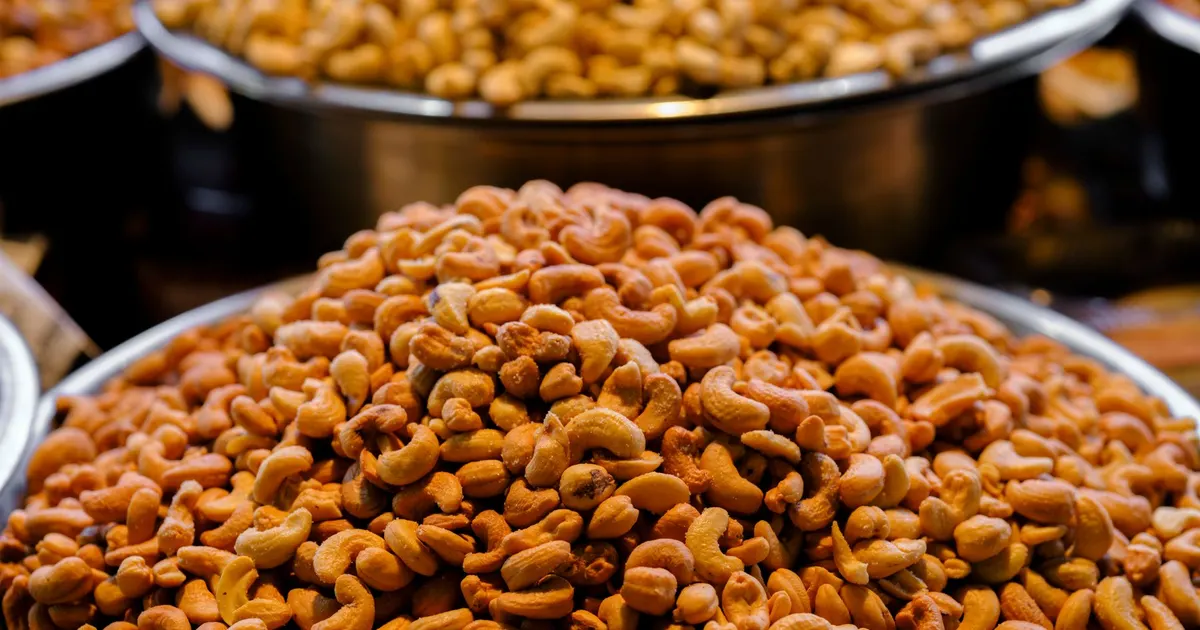
Flavoured cashews are one of the most visible parts of the trade. Salted roast, honey roast, chilli and lime, barbecue, wasabi and sugar glazed lines fill shelves in every market. Behind the flavour sits a plain question: which kernel goes into the roaster, and who does the seasoning? Get that right and a flavoured line is a good-margin product. Get it wrong and the best seasoning cannot hide a poor base.
This guide covers the main flavoured styles, which kernels suit each, and what to confirm when you buy seasoned kernels or plain ones to season yourself.
Two ways to source
Buy plain or roasted kernels and season in your own plant. You control the recipe, the allergen declaration and the coating. You need a roaster, a seasoning drum and packing equipment. This suits brands with their own production.
Buy finished seasoned kernels from the processor. The plant roasts and seasons to your recipe or a recipe of its own, and packs to your format. This suits brands without a plant or those who want to start small. Our guide to roasted cashews from Vietnam covers buying roasted kernels in more detail.
Some programmes combine the two: the processor roasts, and you season. Whatever the split, put the recipe and the responsibilities in writing.
Match the base kernel to the style
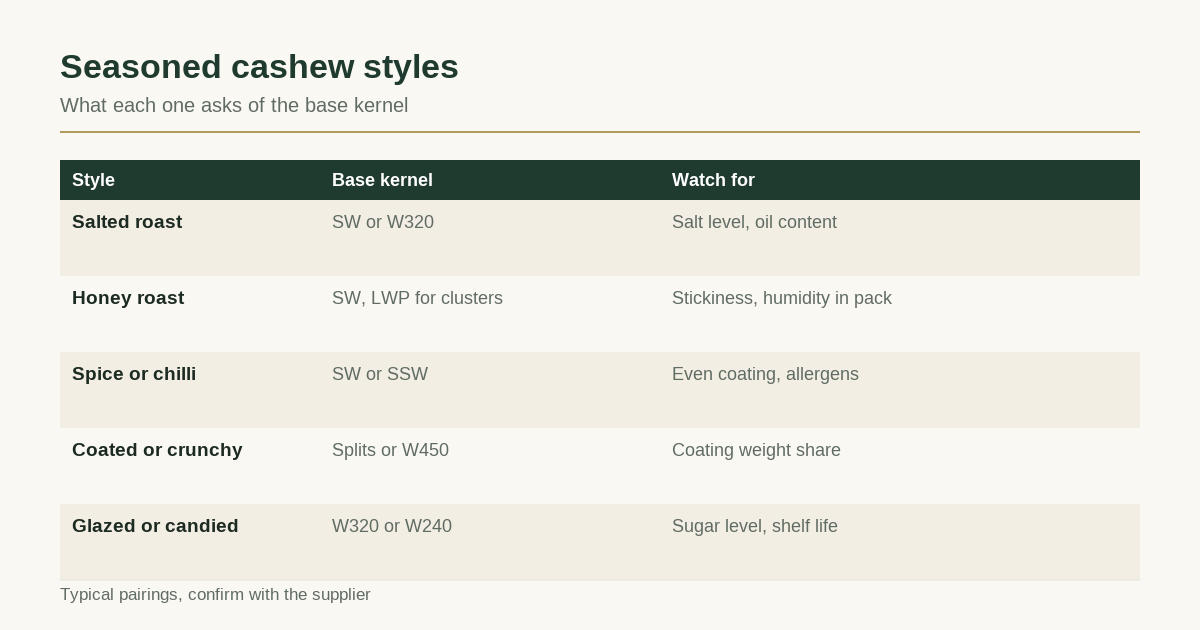
| Style | Base kernel | Why | Watch for |
|---|---|---|---|
| Salted roast | SW or W320 | Roast hides the tint | Salt level, oil content |
| Honey roast | SW, or LWP for clusters | Coating hides colour | Stickiness, humidity in the pack |
| Spice or chilli | SW or SSW | Heavy seasoning hides colour | Even coating, allergens |
| Coated or crunchy | Splits or W450 | Coating dominates the look | Coating share of weight |
| Glazed or candied | W320 or W240 | Visible, glossy nut | Sugar level, shelf life |
Why scorched kernels dominate
Scorched wholes carry a light amber tint from drying. White kernels, with their pale ivory colour, cost more. Once a kernel is roasted and coated, the tint disappears under the colour of the roast and the seasoning, so the premium for white buys nothing. Our guide to scorched cashew grades explains the classes and how the discount behaves.
Use SW for most seasoned lines. Use SSW for deep roast or heavy coating, where colour is fully masked. Avoid scorched kernels where the kernel stays visible and pale, such as a lightly salted raw-style line.
Salted roast
A salted roast is the baseline line. The kernel is roasted dry or in oil and salted, either with a dry salt that clings to the surface or with a brine that dries on. Salt levels vary by market, and the right amount is a matter of taste and local rules. Test against a competitor product and choose by tasting.
Check the oil content of the roasted kernel. Oil-roasted kernels carry extra surface oil, which carries salt well and shortens shelf life. Dry-roasted kernels are drier and keep longer, but take salt less evenly.
Honey roast
A honey roast uses a coating of honey or a honey-flavoured syrup, often with sugar and spices. The coating is sticky when warm and sets as it cools, but humidity can make it tacky again. Pack it in a barrier film and control the warehouse humidity. Splits and large pieces suit clustered honey-roast products. Check labelling rules where the word honey is used, since some markets define how much real honey a product must contain.
Spiced and coated lines
Chilli, barbecue, wasabi, garlic and similar styles use dry seasoning mixes or a thin batter coating. The coating adds flavour and can hide the kernel. Small kernels such as W450 and splits take coating more evenly than large wholes with deep curves.
Even coating depends on the process: the oil or binder, the seasoning ratio, the drum speed and the cooling. A trial batch will show clumping, bare patches or dust at the bottom of the pack. Allergens are the key risk here, since seasoning mixes often contain soy, wheat, milk or sesame. Your label must list them, and the processor must manage cross-contact.
Glazed and candied
Sugar-glazed cashews are a visible, glossy product that suits W320 or W240 kernels. The sugar level sets taste and shelf life. Check humidity control, since glazed kernels can stick together in warm, damp conditions.
Shelf life and packing
Seasoned kernels usually have a shorter shelf life than plain vacuum packed kernels. The seasoning adds moisture and surface oil, and many seasoned products are packed in gas-flushed pouches or tubs, not under vacuum. Our guide to vacuum packing and CO2 flushing describes the formats. Ask for a stated shelf life and the pack behind it, and run your own accelerated test.
Need a price for this grade? Request a quote
What to confirm before a trial order
- The base kernel grade, colour class and count range.
- The recipe: salt, sugar, spice, oil and any additives.
- The allergen declaration and the cross-contact controls in the plant.
- The pack format, film and shelf life.
- The minimum run for each flavour, which may be higher than for plain kernels.
- A counter sample of the finished product, approved by taste and by look.
Our sample approval guide describes the steps, and our guide to private label cashew packaging covers formats and artwork.
Common mistakes
Choosing the flavour first and the base later. The base sets cost and quality. Decide it first.
Skipping an accelerated shelf life test. Seasoned kernels can go stale or sticky sooner than expected.
Forgetting regional rules. Salt, sugar and additive rules differ between markets. Check yours.
Questions to put to a processor
- Do you roast and season to a customer recipe, and what is the minimum run?
- Which base kernels do you recommend for each style?
- Which allergens are handled in your plant, and how are lines cleaned?
- What shelf life do you state for each flavour and pack?
- Can you send a finished sample for approval?
Roast level and its effect on flavour
The roast sets the base flavour that seasoning sits on. A light roast keeps a creamy, mild kernel and suits delicate seasonings such as honey and sea salt. A medium roast adds a toasted note that stands up to barbecue and spice. A dark roast gives a strong flavour but dries the kernel and raises the risk of a bitter edge. Ask the processor to describe its roast profile for each style, including time, temperature and the final moisture, and judge by tasting rather than by colour alone.
Roast colour also interacts with the base grade. A scorched kernel starts darker, so it reaches the target colour sooner. If a recipe was developed on white wholes, the same profile can over-roast scorched kernels, and the first trial run should use the real base kernel, not a stand-in.
Minimum runs and flavour range
Seasoning lines change over between flavours, and each change costs time for cleaning, especially when allergens are involved. That is why processors often set a minimum run for each flavour and may ask for a smaller number of flavours at the start. If you want a range of five or six flavours, consider launching with two or three and adding others once volume is proven. Ask the processor what a realistic first order looks like, and whether it can combine flavours in a single container to reach a full load without breaking its minimum per flavour.
Labelling and claims
Words such as honey, natural and no added sugar carry legal meaning in many markets. Check that your recipe supports every claim on the pack, and that the processor’s ingredient list matches your label. Keep the recipe card, the supplier declarations and the allergen statement on file for audits.
Finally, plan for the first reorder at the same time as the first order. A seasoned line that sells well will need repeat runs, and the recipe, the base grade and the sample approval should be written down so that the second batch matches the first without a new round of trials.
Next step
If you plan a flavoured line, describe the flavours, the base grade you have in mind and the volume per flavour. We price it with a Vietnamese processor that runs it, and you get one detailed quote. Send a requirement and we reply within 24 business hours.
Frequently asked questions
Which cashew grade suits salted and flavoured cashews?
Scorched wholes such as SW320 are the usual base, because roasting and seasoning hide the light amber tint and the saving over white wholes is real. Splits and W450 suit coated and crunchy lines, and white wholes suit lines where the kernel stays pale.
Can a Vietnamese processor supply finished flavoured cashews?
Some plants roast and season kernels to your recipe, others supply plain or roasted kernels for you to season. Ask what each offers, what the minimum run is and whether they will work to your flavour spec. Always approve a counter sample of the finished product first.
How long do seasoned cashews keep?
Shelf life is usually shorter than for plain vacuum packed kernels, because seasoning adds moisture and surface oil and the pack is often not vacuum sealed. Ask for a stated shelf life and the pack format behind it, and test your own batch.
VietCashew supplies Vietnamese cashew kernels on one quote. We publish no prices, because a cashew quote is only valid for days. How an order runs and what we publish.
Need a price for this grade?
Send the requirement. We reply within 24 business hours with one detailed quote for the packed kernels.
Request a quote