Guides / Sourcing
Buying Cashews in Bulk for Food Service, Wholesale Clubs and Repackers
Bulk is where cashews are cheapest per kilo and easiest to buy wrong. A food service distributor, a wholesale club buyer or a repacker deals in volume, pack size and shelf life, and the details that matter are different from a retail brand’s: cost per portion, case counts, rotation and the ability to reorder the same product for years.
This guide covers the bulk formats, which grades suit each kind of buyer and what to confirm before a container leaves the plant.
Who buys in bulk
Food service distributors supply restaurants, caterers and institutions. Their customers cook with cashews or serve them in mixes, and what they judge is cost per portion and reliable supply.
Wholesale clubs and cash-and-carry chains sell large retail packs to households and small businesses. They want a pack that looks generous at a low price per kilo.
Repackers and importers buy by the container and pack into smaller formats for their own customers. They care about the lot spec and the shelf life on arrival.
Food makers buying ingredients in bulk for their own lines. Many of the same rules apply.
The standard export formats
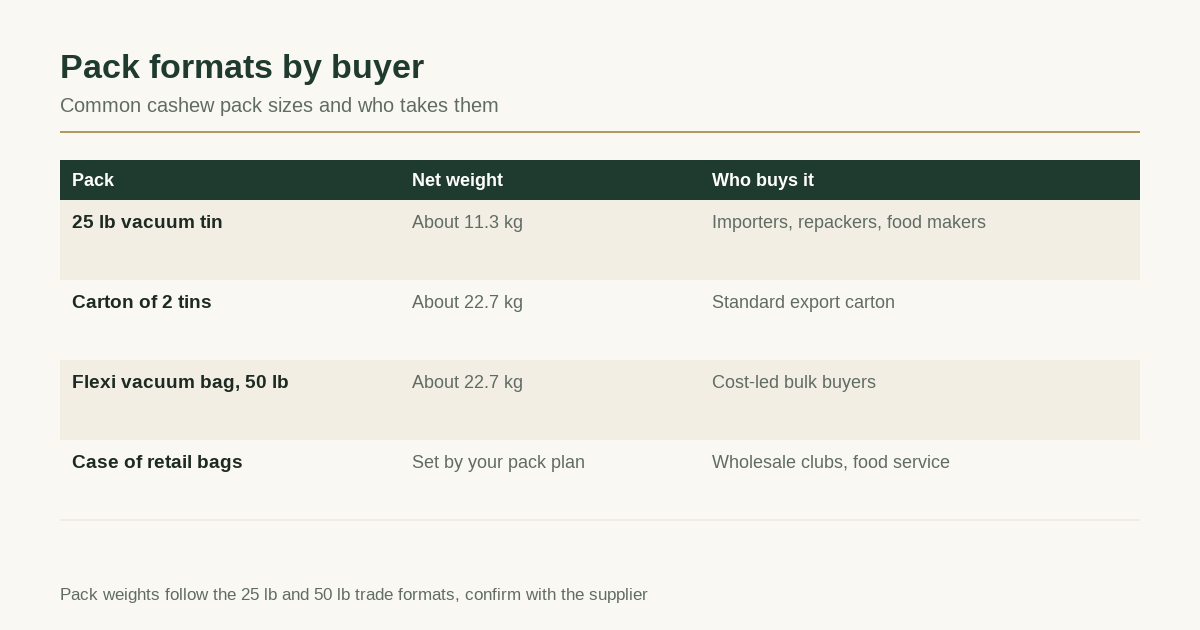
25 lb vacuum tin. About 11.3 kg net. Two tins make a carton of about 22.7 kg. This is the long-standing format for whole kernels, with the best protection against puncture and oxygen.
50 lb flexi vacuum bag. About 22.7 kg net, packed in a carton. It costs less than tins and packs more tightly in a container, but a puncture lets air in.
Retail and food service packs. Bags or tubs of a set weight, packed by the processor to your design, then cartoned. The pack cost per kilo is higher and a container holds less kernel by weight. Our guide to private label cashew packaging covers formats and artwork.
Our guide to vacuum packing and CO2 flushing explains how each format protects the kernel.
Pack formats by buyer
| Pack | Net weight | Who buys it |
|---|---|---|
| 25 lb vacuum tin | About 11.3 kg | Importers, repackers, food makers |
| Carton of 2 tins | About 22.7 kg | Standard export carton |
| Flexi vacuum bag, 50 lb | About 22.7 kg | Cost-led bulk buyers |
| Case of retail bags | Set by your pack plan | Wholesale clubs, food service |
Grades that fit bulk buyers
W320 and SW320. The most traded grade and its scorched version. Plants hold them in volume, quotes are fast and the price is easy to check. Our W320 reference page covers the grade.
W240. For premium food service and club packs where the cashew is the feature.
W450 and splits. For value packs, mixes and kitchens where cost per portion rules. See our guide to W450 and W500.
Pieces. For kitchens that grind, bake or sauce. Our guide to cashew pieces lists the grades.
Roasted and seasoned. Club packs often sell roasted and salted cashews, so kernels may be bought raw and roasted by a repacker or bought finished.
Container maths
A 20 foot container loaded with 25 lb vacuum tins holds roughly 16 metric tons of kernels. That is the unit most processors price around, and it is large: a repacker selling a tonne a month holds more than a year of stock. Our guide to MOQ and container maths explains how container size shapes the minimum order, and our guide to landed cost shows how freight and duties add up.
If a container is too much, options exist: share a container with another buyer, buy a part load by LCL at a higher cost per kilo, or buy from an importer in your market at a mark-up. Weigh the shelf life against the volume before you choose.
Shelf life and rotation
Bulk stock sits in a warehouse for months, so shelf life decides how much you can hold. An intact vacuum tin stored cool and dry commonly carries a stated shelf life of around twelve months, as processors usually quote it, though you should ask for the figure and its conditions. Date every carton on arrival, stack by lot and use first in, first out. Our guide to moisture, storage and shelf life covers the rules.
Once a tin or bag is open, the clock speeds up. Food service kitchens should use open stock within weeks and reseal or transfer it to an airtight container.
What to confirm before a container
- Grade, colour class and count range, with defect and moisture limits.
- Pack format, net weight per tin or bag and cartons per pallet.
- Lot dating, lot numbering and the shelf life the processor states.
- Certificates: your market’s required documents. See our guide to import documents.
- A counter sample from the run that will fill your order.
- Payment terms and the Incoterm. Our guide to payment terms and Incoterms explains common choices.
Need a price for this grade? Request a quote
Common mistakes
Buying more than you can rotate. A big container at a low price costs more if half of it goes stale.
Ignoring the repack risk. Repacking opens the vacuum pack. Do it in a clean, dry area and reseal quickly.
Skipping the arrival check. Open several tins from different cartons and compare them with the sealed reference. Our guide to quality claims on arrival shows the steps.
Questions to put to a processor
- Which pack formats do you offer for my grade, and what is the net weight per carton?
- How many cartons fit on a pallet and in a container?
- What shelf life do you state, and under what conditions?
- Can you pack retail or food service sizes to my design, and at what minimum?
- Can you split a container between two grades?
A worked example of cost per portion
A kitchen portion of cashews is often small, a few tens of grams in a dish or a salad. Take a 30 gram portion. A kilo of kernel gives about 33 portions, so a change of a small amount per kilo in the kernel price moves the portion cost by a very small amount, while a change in waste or yield moves it far more. That is why experienced food service buyers focus first on the pack and the shelf life, and second on the price per kilo. A carton that stays fresh for the whole use period costs less per portion than a cheaper carton that goes stale in the last third.
Work out your own figure: the monthly use in kilos, the number of locations, the storage space for cartons and the time the stock sits. A short table of these numbers makes the case for a pack size and a reorder rhythm clear before you ask for quotes.
Distribution and storage
Bulk cashews need a cool, dry room away from strong odours, since fats absorb smells. Keep cartons off the floor on pallets and away from walls and heat sources. If you serve several kitchens from one warehouse, ship out a month of stock at a time so that each site holds a small amount, and ask drivers to keep cartons out of hot vans for long periods. A simple log of lot numbers by site lets you trace a complaint back to one carton.
Private label in the club channel
Wholesale clubs often sell under their own label, with large tubs or multi-packs. A programme like this needs the processor to run to artwork, print and fill specifications, with a minimum order tied to the print run. Expect a longer lead time than for a plain tin, and plan for a first-article approval. Our guide to private label cashew packaging walks through the steps, and it is worth reading before you ask a processor to quote a club pack.
One last point on timing. Order lead times for bulk grades are usually quoted from the confirmation of the order, not from the enquiry, and they lengthen in the busy season before major holidays. Build a reorder point into your plan: when stock falls below a set number of weeks, raise the next order, so that a late vessel does not leave a kitchen without product.
Next step
If you buy cashews in bulk, state the grade, the pack format and the monthly volume in the requirement. We price it with a Vietnamese processor that runs it, and you get one detailed quote. Send a requirement and we reply within 24 business hours.
Frequently asked questions
What pack sizes do bulk cashews come in?
The standard export formats are a 25 lb vacuum tin, two to a carton, and a 50 lb flexi vacuum bag. Food service and club buyers often repack into smaller tubs or bags, or ask the processor to pack retail sizes for them, which costs more per kilo.
Which cashew grade suits food service?
Kitchens usually choose W320, SW320 or splits, because the nut is cooked into dishes or served in mixes and size matters less than cost per portion. Premium restaurants that plate whole cashews may step up to W240.
How many cashews fit in a container?
A 20 foot container packed with 25 lb vacuum tins holds roughly 16 metric tons of kernels, and flexi bags can fit a little more. Retail packs hold less by weight, so a container of retail cartons carries fewer tons of kernel.
VietCashew supplies Vietnamese cashew kernels on one quote. We publish no prices, because a cashew quote is only valid for days. How an order runs and what we publish.
Need a price for this grade?
Send the requirement. We reply within 24 business hours with one detailed quote for the packed kernels.
Request a quote