Guides / Sourcing
How a Cashew Processor Registers to Receive Work Requests
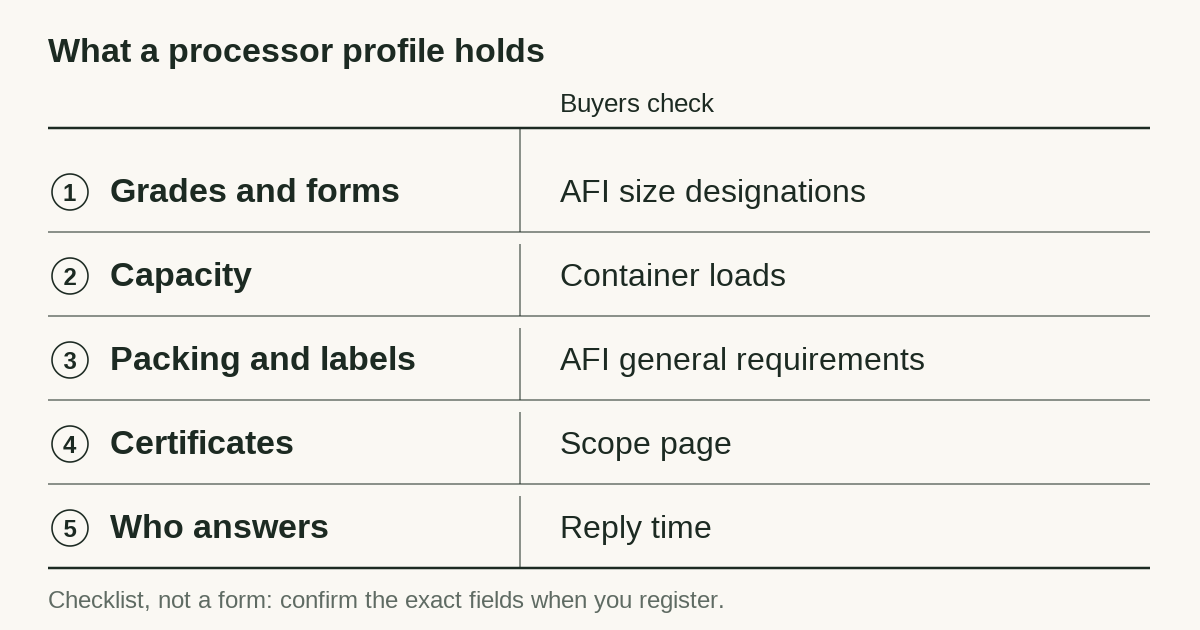
A cashew processor registers by telling us four things in plain terms: which kernel grades it runs, how much of each it can hold, how it packs and marks cartons, and which certificates it can show. After that, work requests from importers that fit those answers arrive from us. You decide which to quote. If your price and lead time work, we place the purchase order with you and you never deal with the buyer.
This guide is for the owner or export sales engineer of a cashew processing plant. We name no plant and we promise no orders. What follows explains what to prepare, so that the profile you register reads as a plant that can actually fill the grades it lists.
How a work request runs from your side
The steps on our processor page are short.
- You register your facility with grades, capacity, packaging and certificates.
- We send work requests that fit what you actually run.
- You quote us a price and a lead time for the requests you want to take.
- If price and lead time work, we place the purchase order with you and follow the order with you.
We send each work request to at most three processors, and only to those whose grades, capacity and certificates fit.
A work request shows enough to judge fit and effort and to quote, without naming the buyer. The sample on our processor page lists a grade, a volume, the packaging, a certification need, a destination, a first shipment window and a buyer type. The end buyer is never named and the spec sheet comes with the request.
Prepare five blocks before you register
Fill these in on paper first. The registration takes minutes when the answers already exist, and your first reply to a work request is faster still.
Grades and forms
List only grades you hold or can make from your own raw nut intake, not grades you would quote if asked. Use the trade names buyers use. The AFI specification for cashew kernels defines the size designations by kernels per pound:
| Designation | Kernels per pound |
|---|---|
| 180 (or SLW) | 140 to 180 |
| 210 (or LW) | 180 to 210 |
| 240 | 220 to 240 |
| 320 | 300 to 320 |
| 450 | 400 to 450 |
The same document defines a whole kernel as one with not more than one eighth broken off, butts as kernels broken crosswise that are less than seven eighths and not less than three eighths of a whole, and splits as one half split lengthwise with not more than one eighth of that half broken off. It also lists colour classes such as First Quality Fancy and Second Quality Scorched. If you run pieces, state the piece grades you run in the same terms. Our guide to Vietnam cashew grades shows how buyers read these names.
Capacity
State volume as something a buyer can plan around: how much of each grade you can hold in a month and how many container loads that is. Keep it as a range you can honour in a busy season and say which grades share the same line. Our note on container maths shows why buyers think in containers.
Do not state capacity you would only have if you bought raw nuts at a price you have not seen yet. If your volume depends on raw nut cover, say so in the profile in one line. See how a processor quotes forward when raw nut costs move.
Packing and labels
The AFI general requirements are a useful checklist because they are a published trade reference. They ask for new, clean, dry, leakproof, lead-free containers with an airtight seal and no internal paper liners, cartons of at least 200 pound test and 32 ECT, and, where CO2 is used, food-grade CO2 at a minimum 60 percent mix with the balance nitrogen. Cartons must show the product name, producer or packer name and address, grade, gross and net weight, country of origin, product, allergen marking and lot, production and date codes. The packing list must give lot, production and date codes with quantities.
List the pack types you ship, such as vacuum tins, flexible vacuum bags or cartons, and say who prints the carton marks and codes. See our notes on vacuum packing and CO2 flushing.
Certificates
Name each certificate as issued: the scheme, the scope that appears on it and the expiry date. Our processor page asks for HACCP at a minimum, with the certificate and its scope available on request. Do not list a certificate you are still working towards, and do not describe a plant as approved or certified by a body that did not issue the document you hold.
If you ship to the United States, a buyer will also ask whether your facility is registered with FDA. Registration places the plant in the FDA database. It is not an approval. FDA’s registration page says registration must be renewed every other year, and our reference on FDA registration for cashew processors covers the details and the current renewal window.
Who answers
Name one person and one backup who write English and who can read a specification. Buyers lose interest when the reply comes from someone who cannot answer a count or packing question. The qualification line on our processor page is a reply to our work requests within 48 hours, in English, and a refusal of any specification you cannot hold.
A technical sheet buyers will ask for next
Have one sheet ready that carries the lines importers check. The AFI document sets, among others, moisture of 3 to 5 percent by loss on drying, free fatty acids at a maximum of 1.5 percent as oleic acid, peroxide value at a maximum of 5 meq per kg, Salmonella negative per 375 g and Listeria monocytogenes negative per 125 g. Aflatoxin must meet the tolerance of the country where the goods are sold. These are the AFI’s reference values, so write the limits your own contracts use and the method you test with. Our checklist for what a good spec sheet shows lists the lines in the order buyers read them.
Need a price for this grade? Request a quote
Answer a work request well
A work request is not an order. It is an invitation to quote. A reply that works has four parts:
- A yes or no on the grade and the destination requirement, given in the first line.
- The pack and the lead time you can hold, with the volume you would reserve.
- Your specification sheet and the certificate that covers the plant, as issued.
- A sample route: how a counter sample is drawn, sealed and sent. See the sample approval process.
A clear no is a good reply. A processor that declines a specification it cannot hold is easier to trust the next time, and a missed shipment costs much more than a declined quote.
Four mistakes that make a profile weak
- Listing grades you only quote. A buyer who orders a grade you do not run will find out at the first sample.
- Certificate scope that does not match the plant. A certificate for one site does not cover another site or a packing house run by a third party.
- A capacity figure with no basis. Buyers ask how you know, and the answer needs a line, a shift pattern or an intake plan.
- Slow or generic replies. A copied reply to every request shows. A reply that uses the buyer’s own grade, volume and destination reads as a plant that read the requirement.
Importers often send a supplier questionnaire as well. Our guide to the importer questionnaire for cashew processors covers what is on it, and answering it once in a document you keep updated saves time on every preview.
Talk to us
If you process cashew kernels for export and want work requests whose grade, volume and certificate needs fit what you run, read how it works on our processor page and register there. We reply within 24 business hours. Standards and trade rules change, so check the dates on the sources below before you rely on a figure.
Sources
- AFI, Specifications for Cashew Kernels (updated September 2023)
- FDA, Registration of food facilities and other submissions
Frequently asked questions
What does a cashew processor need to register for importer requests?
The grades you run, the volume you can hold per grade, your pack types and carton marking, the certificates you can show with their scope and a named contact who writes English. The registration form on our processor page asks for grades, capacity, packaging and certificates.
Do I see the buyer's name before I decide to quote?
No. A work request shows the grade, volume, packaging, certification need, destination, first shipment window and buyer type, with the spec sheet. The buyer is never named. We are your customer: you quote us and, if price and lead time work, we place the purchase order.
How many processors receive the same work request?
At most three, and only those whose grades, capacity and certificates fit what the buyer asked for. We keep the list short so each processor on a request has a real chance of winning it.
Do I need a certificate to register?
Our processor page asks for HACCP at a minimum, with the certificate and its scope available on request. Some buyers ask for more, such as a BRCGS or SQF certificate or an FDA registration for US shipments. List only what you hold today, as issued.
VietCashew supplies Vietnamese cashew kernels on one quote. We publish no prices, because a cashew quote is only valid for days. How an order runs and what we publish.
Need a price for this grade?
Send the requirement. We reply within 24 business hours with one detailed quote for the packed kernels.
Request a quote